
Candour Productions: Leeds company behind Stacey Dooley documentaries, The Push and Libby, are you home yet?
Candour Productions has made some of the most compelling documentaries on British television. John Blow reports.

Anna Hall admits that lots of the films she has made over the years might fit, at first glance, the recent clamour for ‘true crime’ content. Yet the documentaries she works on are intentionally about so much more than that.
“My sense of justice has always been providing a voice for people,” says Anna, who runs Leeds-based Candour Productions.
Anna, who grew up in Dunblane, Scotland, started in radio in her 20s after leaving university with an interest in social issues.

Her first job in radio was at a station called Fox FM in Oxford, where she got an early taste of campaigning journalism. She moved up to Yorkshire, again working in radio until she got a job as a researcher at Chameleon Television in Leeds and was soon promoted to associate producer.
When the Dunblane Massacre happened in her home town in March 1996, she went to interview the families of victims. Her first film was Dunblane: Remembering Our Children, which came out on the first anniversary of the tragedy.
“I think my driving ambition has always been that I am a creative person, I wanted to make films that would make a difference - that’s the strapline for Candour - and I wanted to be able to try and educate, but I also wanted to chip away at things like prejudice and social inequality, and just really be able to try and tell those stories. And I guess as my career has progressed, I feel like that’s what I do, day in, day out, and really find the stories where, you know, they’re hidden.”
Another early example was Edge of the City, which presented four cases dealt with by Bradford Social Services and transmitted in August 2004.
It proved controversial, as it documented grooming gangs targeting girls in the care system a decade before the landmark Jay Report into child sexual exploitation in Rotherham was published 11 years ago, and similar criminal cases around the region repeatedly went to court.
“It was a huge film for me at that point in my career because I was still quite young, I was still in my early 30s, and then suddenly catapulted into the limelight of… ‘Is this woman for real? And what is she saying?’ In terms of that subject of uncovering all that grooming stuff.”
It is a subject she has returned to over the years, with her fourth film on the subject, Groomed: A National Scandal, appearing on Channel 4 last year.
Anna, now in her fifties, made films on a freelance basis but set up what is now Candour in 2014.
Moving to the capital was never on the cards. “As a young filmmaker, I made the decision not to go to London because I lived in Leeds and by the point I had made Dunblane and Edge of the City, I had a young family. I just decided that I didn’t want to root them all over the place,” she says. “That was in the early 2000s and I just thought, at some point someone’s going to need a director in the north. And so I just stuck to my guns, really.”
She remembers in the early 2000s that there was an “awful lot of inequality and an awful lot of prejudice against women, really, in the media. And I felt really strongly that I was just going to try and do my own thing. So that’s what I did.”
Candour remains female-led now, with its senior team all women.
She says: “The industry has been notoriously terrible for treating women well, for owning up to sexual harassment in the workplace, to owning up to bullying in the workplace, so I have lived through all of that. I started working in the media in the mid 90s. I can remember sexual harassment being very ever-present in my workplaces.
“I wanted to be a mum to my children and be a filmmaker, and I couldn’t see why there was any reason why I couldn’t do both things. But you know, when you have executive producers insisting that people are still in the office at eight o’clock at night, it’s completely unreasonable.”
Telling women’s stories has naturally become part of Candour’s social justice mission too.
In 2016 came Behind Closed Doors, a film about domestic abuse narrated by Olivia Colman, which Candour made for BBC One. Anna says: “That film, I know, has saved lives. It was the stories of three women who had finally realised that they wanted to press charges against their domestic abusers and 3.1 million people watched that live. It’s still on YouTube.
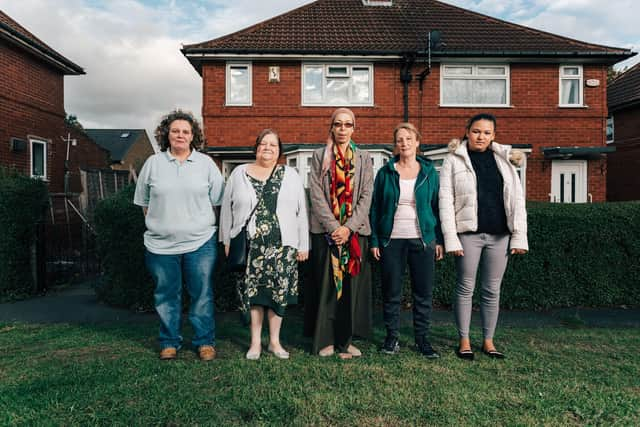
“It saved lives all over the world, that film.” The short Fighting Shame, in which a group of women from Leeds share stories of poverty, came out in partnership with The Guardian in 2019.
In 2023, Candour won a BAFTA for Best Factual Series with its Sky documentary Libby, Are You Home Yet? about the investigation into the disappearance and murder of Hull student Libby Squire.
Channel 4’s The Push, about a murder trial, won Best Doc Series at The Grierson Awards in 2024.
Documentaries fronted by public figures, meanwhile, include Panorama: Stacey Dooley and the Lockdown Babies for the BBC.
The Candour team is between 13 to 15 people but the head count inside its mill complex in west Leeds can go up depending on the project they are making - with about 70 people working there last year, she estimates.
Anna has seen her industry change a lot over the years, particularly more recently.
“I think the documentary climate has changed a lot in the last five years,” she says.
“We don’t all sit down to watch the telly at nine o’clock on a Thursday night anymore and so the overnight figures for channels are much less important now.
"They know that people will watch films on catch up, and they know that that’s how most of us consume our media.
“It’s very rare for somebody to sit down and watch something live.”
There are, she says, fewer commissions happening, even while to the casual viewer it can seem as though there is a huge boom in documentary-making. Commissioners are now more specific about what will work and are on the lookout for stories attached to a recognisable name or subject.
“Everybody wants to know, does this work on streaming?
"So little, single films like the Cutting Edge or the Modern Times (Channel 4 and BBC documentary series), those little quirky films just don’t get commissioned any more.
“The single films that we make that get commissioned are the big hitters, like The Disappearance of Jay Slater, like Groomed, like The Salt Path.”
And what of those big streamers? “Everybody wants a Netflix commission.
“We haven’t had a Netflix commission yet, but we are very hopeful that we will get one soon,” she says.