
Car review: Renault is back - so is the Renault 4 and the Renault 5
Renault is back, so is the Renault 4 and the Renault 5. The boxy, classless R4 utility hatchback/estate from 1961 to 1994 and the R5 hatchback of 1972 to 1996 have been revived as electric cars.

Forget Ford’s greedy plundering of its back catalogue with electric cars without credible roots to the original, notably the Mustang.
The clever thing about the Renaults is that they are completely new and fizzing with battery power and bright ideas but retain the styling charm of the originals. Both are constructed, or “made of France”, at separate factories near the Belgian border and carry subtle tri-colour decals of allegiance to the French flag.
The truest is the 5, an utterly charming five-door city-sized, small family chunk of French flair. It is already the reigning Car of the 2025 as judged by an eminent European jury. Colours include bright sunflower yellow and a vibrant jungle green. Design motifs in the cabin and on the body are cute but not kitsch. An illuminated figure 5 in the bonnet ventilation grille shows the state of battery charge. Its flared body work reminds us of the valiant, rear-engined 5 Turbo.
There is a choice of 118bhp and 138bhp motors with 40 kWh and 52 kWh batteries. Headline figures are a 0-62mph time in eight seconds for the 148hp motor and up to 250 miles battery range. Prices start at £22,995 for the 118bhp version, minus the £1,500 UK electric grant. Seen here is the 148bhp R5 in techno comfort trim, painted black over pop green at £27,393 minus the £1,500 EV grant. Accessories in abundance include a union jack roof decal.
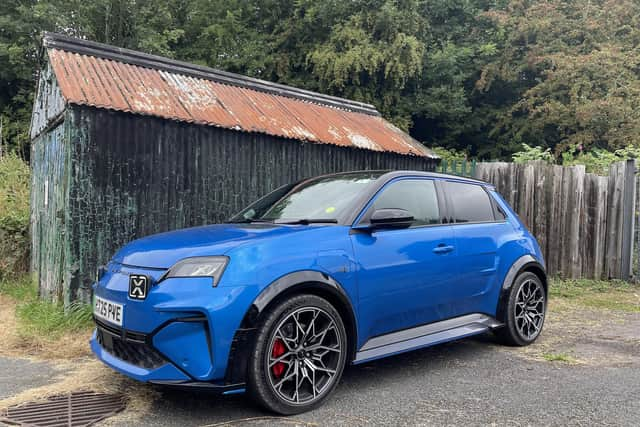
The 5 is the basis for the new electric Micra from Renault’s troubled alliance partner, NIssan, and made alongside the Renault. The same factory near Lille also produces the Alpine A290 version of the R5, from the Renault sports and racing division. This 217bhp licence risker can reach 62mph in 6.4 seconds and feels quicker. The pace of acceleration is frisky as you make sure it’s pointing in the right direction. The instrument screen lights up with a burst of radiating lines which are distracting but can be deleted. Top speed, 105mph. It looks and feels stunning, with its X signature daylight lamps at the front and an elegantly crafted luxury interior of two-tone nappa leather. Price for the GTS seen here, £38,600 minus a £1,500 EV grant.
The petrol-engined 5 was once everywhere. I garaged a Campus version for a year after its owner was banned. A much earlier memory was driving through France to the Corbières, pursued by a Gallic young blood in a 5. I took corners faster and faster until he almost lost control and abandoned. I was in my Lotus Super 7, a yellow and silver dream cum mechanical nightmare. By the time I got back to the Channel both car and driver were suffering from heat/mental exhaustion. I took the train north. The Lotus went on a breakdown truck and was sold.
Anyway, I would’t have any of the above Renaults because the electric 4 is better in too many ways. It is bigger, roomier, quieter and softer riding, more practical and has its own array of options including an electric rollback canvas top, roof and bonnet stripes, a black bonnet and lots more. Main grades are evolution, techno and iconic, with prices from £26,995 minus the £1,500 EV grant.
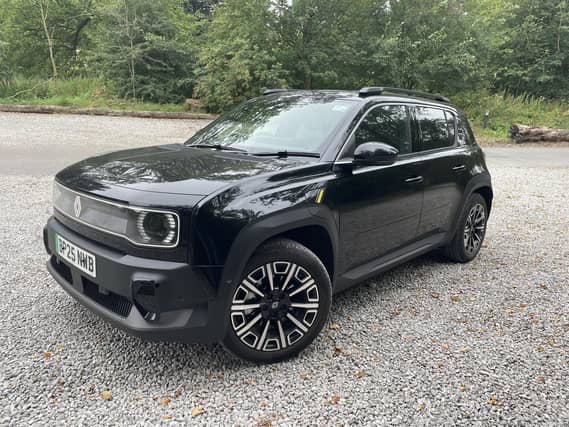
It shares the 5’s 148bhp electric architecture and is several inches longer overall and between the axles giving useful extra legroom in the back, is taller and has greater ground clearance and a flat loading sill into the boot. It has an integrated illuminated glazed over grille and headlamps with the first use of a lit-up Renault lozenge logo.
Renault took the 4, 5 and A290 to a rare provincial driving day, based at Coniston Hall Hotel, near Skipton. Time was limited to around 30 minutes per car which is better than nothing and I wouldn’t normally bother with such a brief encounter but I was curious. I had a never fulfilled desire for the original Renault 4. If I lived in France or Spain where they are still plentiful I’d have one. I have always been fond of French cars. Once I nearly bought a house near Narbonne with a Renault 6 included yet the only Renault car I owned was the 4’s predecessor, the rear-engined 4CV, which I bought at a grand night of eating and drinking in Touchan. Today I have an 18-year-old Renault-based campervan which, touch whatever, is very reliable.
The new electric 4 won me over on this first meeting. I know Chinese electric cars are good value but I want soul and tangible pedigree and a link to my French love affair.
The 4 gives me that. If I had one I’d respect the pace, charge appliances from its battery, make use of the baguette holder, find daily delight in its design and try not to lose the slippery key card which Renault persists in making black and without a lanyard hole. Oh, and any colour other than black, which does not suit it.
Renault 4 iconic comfort: £30,995; 52 kWh battery; 148 bhp; Torque 181 lb/ft; One speed Transmission; Top speed 93mph; 0-62mph 8.2 seconds; Economy four miles per kWh; Claimed range 247 miles; Weight 1362kg, 750kg towing; CO 2 zero; Length 163 inches/4.1m; Website renault.co.uk