
Ceramic cats among antique collection of Porsche-driving medic Dr Eileen Cobb at Tennants auctions
A few weeks ago I was writing about famous dogs. Now it's the turn of cats - and you may hard put to name any celebrated ones. A few felines from cartoons and literature may spring to mind, such as Felix, Garfield, Top Cat, Tom (as in Tom and Jerry) and perhaps The Cheshire Cat from Alice's Adventures in Wonderland.
But when it comes to real-life cats...not so many. Simon the cat won the Dickin Medal ("the animal VC") for surviving injuries, raising morale and controlling rat infestation on HMS Amethyst during the Yangtze Incident in 1949 but few could recall his name. Then there was Dick Whittington's Cat - or was there? Nobody has a name and there's no proof it even existed.
When it comes to statues, that's a different story. London, for instance, has plenty, including Dr Samuel Johnson's cat Hodge, immortalised in bronze; Kasper, carved in polished London Plane and afforded a place setting at dinner if there are 13 guests at The Savoy following an incident in 1898 when a South African diamond magnate laughed off the superstition and was shot dead on his return home; and Humphry, a popular ginger tom, sculpted in bronze after 18 years' residence at the Mary Ward adult education centre.
Further afield, take your pick from dozens immortalised in bronze or stone. There's Towser the Mowser, a tortoiseshell who killed the extraordinarily specific number of 28, 899 mice in and around a Pershshire distillery from 1963-1987; Trim, venerated in Sydney as the black cat who accompanied Royal Navy officer Captain Mathew Flinders (1774-1814), leader of the first inshore circumnavigation of mainland Australia, and was once taken prisoner along with his master by the French in 1803; Totti, companion of Finnish poet Edith Sodergran (1892-1923), afforded a monument in Roschino, Russia, where her owner spent her summers; and Panteleimon, a famous Persian who died in a restaurant blaze in Kiev after being adored by customers and staff for many years.
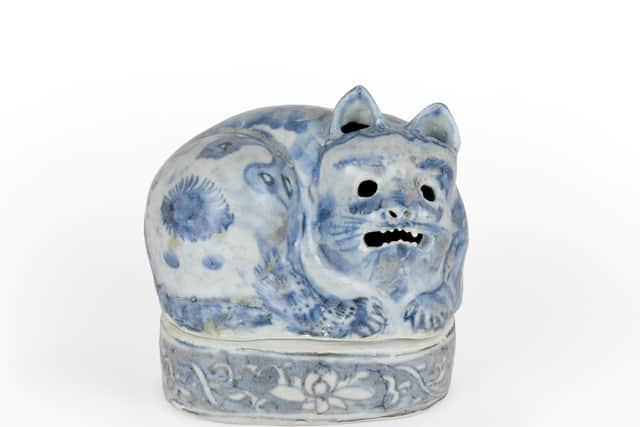

Now to ceramic cats and the emergence at Tennants next month of 25 fun specimens among the wide-ranging antiques and jewellery collection assembled by the late Dr Eileen Cobb, who rose through the medical ranks to become a consultant anaesthetist. In 1972, the Porsche-driving medic married orthopaedic surgeon Nigel Cobb, who pieced back together British motorcycle racing legend Barry Sheene (1950-2003) following his life-threatening crash during practice at Silverstone in 1982. Eileen was the "on call" anaesthetist that day.
Cats on offer include a stunning Chinese porcelain figural nightlight and stand, late Ming Dynasty, probably from the time of Emperor Chongzhen, who reigned from 1627-1644. Naturalistically modelled lying down, its openwork ears, eyes, nostrils and mouth give it a somewhat startled and aggressive appearance. Painted in underglaze blue with mottled effect known as fukizumi to simulate the cat's fur, it has an oval base decorated with a band of lotus. The 13cm wide nightlight cat, similar to one in the British Museum, is estimated to fetch £3,000-£5,000 at the Asian Art Sale on March 14.
Others, offered at the 20th century Design Sale on March 1, include a happy-looking polychrome faience (tin-glazed) green-eyed cat by Émile Gallé, circa 1900, seated wearing a decorative headscarf and a pendant bearing the portrait of a dog, listed to fetch £1,000-£1,500 and a 30cm high long-necked, green-eyed Continental pottery cat, again from about 1900, yellow with blue symbols. This one has a more model estimate of £100-£150.
No piece about cats in art would be complete without mention of that mad genius Louis Wain (1860-1939). His illustrations of cats were so popular that few Edwardian homes were without at least one of his famous cat annuals and many nurseries had Wain posters hanging on their walls. His brightly-coloured anthropomorphic cat images were everywhere and interest in his work has continued into the 21st century.
Dr Cobb's, naturally, contains at least one nod to the man of whom writer HG Wells said "made the cat his own [and] invented a cat style, a cat society, a whole cat world." It comes in the form of A Lucky Sphinx Cat, modelled as a squat Cubist Egyptian, one of a group of nine designed in 1914 by Wain for Max Emanuel & Co. It is estimated at £400-£600.
*The oldest evidence of domestic cats is believed to be a paw print from 9,500 years ago found in Cyprus and perhaps the oldest known depiction is a 120ft. long carving in the Nazca Desert of Peru that dates to 200-100 BC.