
Coastal erosion set to claim wartime pillbox on Yorkshire's coastline

The North Sea is about to claim yet another relic of the once extensive network of military defences built along Yorkshire’s coast nearly 90 years ago.
A pillbox manned by infantry in World War Two and later by the Royal Observer Corps during the Cold War to spot enemy aircraft, is slipping down the cliffs near Tunstall, and will soon be on the beach.
The type of pillbox at Tunstall was known as the “lozenge” type. It was made of reinforced concrete and had firing slits. It was built alongside a range of defences including machinegun posts, trenches, gun emplacements, beach searchlights, minefields, and barbed wire fences.
Construction of pillboxes commenced following the fall of France in June 1940. The coast and inland was significantly fortified to counter the threat of invasion.
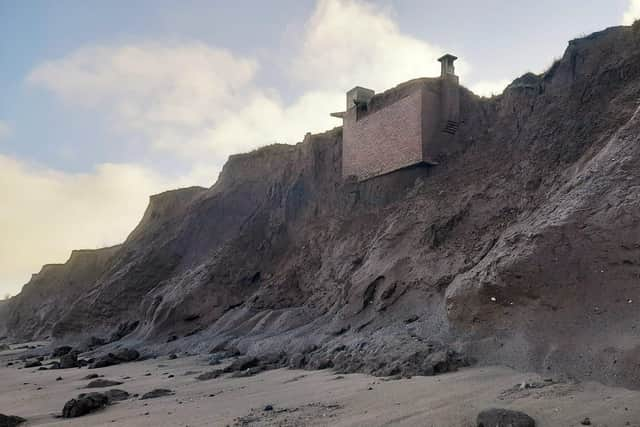

Although erosion rates vary, recent records suggest parts the coastline below Aldbrough are eroding at up to 4.5 metres per year.
On the beach half a mile south, near the Sand Le Mere holiday park, are the remains of a double row of anti-tank cubes, which were intended to prevent enemy forces advancing along the beach.
From 1950 to 1965, the pillbox was used as an “Orlit” post and was manned by volunteers, trained to identify a wide range of allied and enemy aircraft types. It was near an underground monitoring post, apparently already lost to the sea, whose role was to monitor and estimate the location of any nuclear explosion, and subsequent fallout.