
Could Donald Trump help solve 40-year quest to identify famous wreck off Yorkshire

Could a legendary US naval shipwreck lie just a couple of miles off Yorkshire’s coast? Retired commercial diver John Adams certainly believes so - and he hopes to rope in US president Donald Trump to end his 40-year quest to positively identify the wreck.
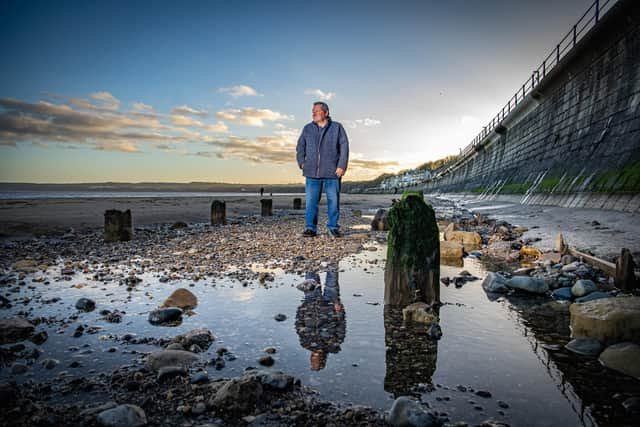
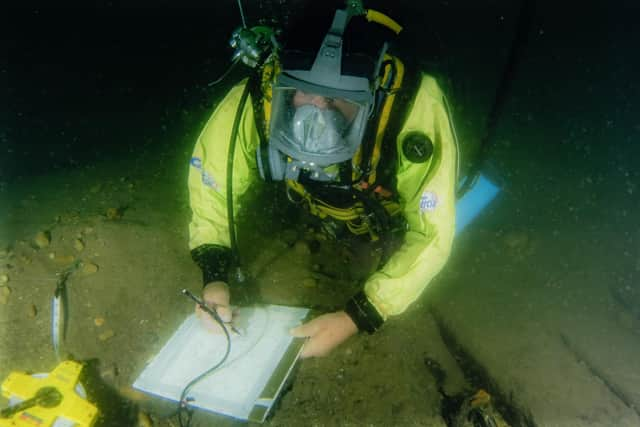
It was back in the mid 1970s while trying to free a net as a favour for a fisherman in Filey Bay that John, 80, first came across what he believes to be the wreck of the Bonhomme Richard.
Such was the murkiness of the water it was more by feel of what he encountered that made him think it was different from those he normally dived.
“Just by touch it was obvious it wasn’t metal. We were used to feeling rusty sharp metal - there’s dozens out there. This felt like wood.”

John may not have thought any more about it, but it happened that his wife’s teacher at school was Arthur Godfrey, a mine of information about local wrecks.
“The first thing I said to Dave, who I was diving with, was could it be the wreck of the Bonhomme Richard?”
If so, it was a stunning find, of a ship led by a much mythologised captain - Scottish too, which is where Donald Trump may come in.
Onlookers had a ringside seat from the 400ft high cliffs at Bempton when the Battle of Flamborough Head took place on September 23 1779, the first naval engagement off the UK coast during the American War of Independence.
While forgotten about in the UK, in the US children grow up learning about the Bonhomme Richard’s captain John Paul Jones, considered the founding father of the US Navy, and his “victory” over the Brits.
He attacked British ships escorting a convoy off the Yorkshire coast, famously resulting in Jones capturing two Royal Naval escorts, HMS Serapis and the Countess of Scarborough, with his damaged ship, despite heavy losses, thus securing a major morale boost for the American cause. His remains were exhumed from Paris in 1905 and he lies in great splendour in a replica of Napoleon’s tomb in the Naval Academy Chapel in Annapolis, Maryland.
Over the years there have been several major unsuccessful expeditions to try and locate the Bonhomme Richard.
“Clive Cussler (a famous wreckhunter came in 1980) and promised local fishermen £20,000 or £30,000 to put him on the wreck. Half the fishing fleet said: ‘I know where it is’.”
National Geographic came at the turn of the millennium. None it appears have produced a better contender than John’s wreck, but support has been lacking in the right places.
John’s wreck - he has now been the licence holder for many years - has three sections of hull, one 40m long.
Dendrochronology identified the chunky timber, some sheathed in lead, as continental oak, dating to the early 18th century, which ties in with the fact that Bonhomme Richard was a French merchant ship turned battleship.
They even found evidence that it had been altered, but apart from finding an incredibly well preserved leather shoe jammed under the wreckage, they’ve not found any of its 40 plus cannon. So why have some experts been so hard to convince?
John and his supporters say it’s because the Americans believe John Paul Jones’ report that he spent 36 hours trying to save the ship, which would mean its eventual resting place being many miles offshore.
“Jones was a bit of a bullxxxxxxx,” says James Hodgson, of The Yorkshire Coast 1779 Research Group, who thinks it inconceivable that Jones would have hung round in a sinking ship for long given the risk of getting hung by the Royal Navy.
“He was basically embarrassed he lost his ship which he’d been given by some very wealthy French aristocrats.
“He said he tried to save it for 36 hours. The fact of the matter is he didn’t capture or destroy a single ship in a convoy of 40 merchant ships insured for over £100 million - and lost his own ship.”
It’s now nearing the 250th anniversary of the battle and there are plans afoot for a massive maritime festival in Filey in 2029.
James said: “2026 is the 250th anniversary of the Declaration of Independence - we are going to let the Americans get on with that.
“President Trump’s term of office will be over in 2029 but the invitations will go out when he is still in office. We will be inviting whoever is US President and the head of the US Navy - maybe he would come in his own capacity.”
John hopes so too. He said: “There’s been very little interest in the wreck since 2008 when the Americans last came.
“John Paul Jones was Scottish, he was trained by the English Navy and he decided to fight for the Americans.
“Donald Trump is a fellow Scotsman, if you like - let’s hope he takes an interest.”