
Developer's 'significant dishonesty' cost local businesses thousands of pounds
A court has heard that a would-be property developer’s “significant dishonesty” led to local companies losing out on tens of thousands of pounds.
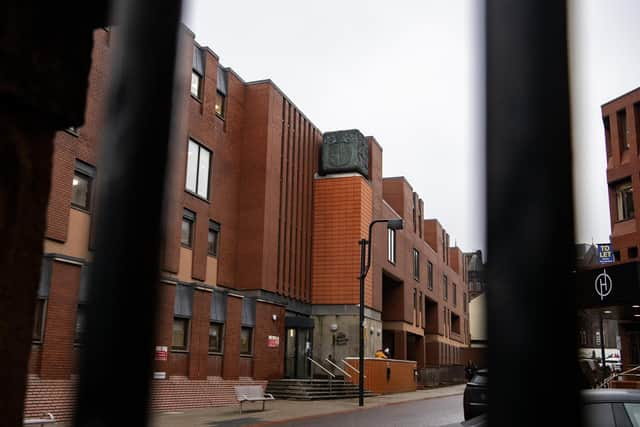
Ishfaq Hussain appeared at Leeds Crown Court on Monday (Jun 1), where he was banned from being a company director for four years and ordered to carry out 180 hours of unpaid work.
The case relates to the planned development of two adjacent plots of land in Allerton almost a decade ago.
After racking up debts to different companies – including Bradford demolition firm Thomas Crompton – father-of-eight Hussain transferred the land to a different company that had only just been set up.

Despite his wife being director of that second company, Hussain claimed to have no link to the new landowners – and said he would not be able to pay back any of his debts.
Hussain, 54, of Sunbridge Road, pleaded guilty on the first day of his trial earlier this year to an offence of fraudulently transferring company property under the Insolvency Act 1986.
His sentencing hearing was held on Monday morning.
The court was told Hussain had 22 previous convictions – but none of these were similar to this charge.
James Lake, prosecuting on behalf of the Insolvency Service, said Hussain’s company Reeson Homes Ltd was incorporated in late 2014 – with Hussain as the sole director.
Mr Lake said: “In 2015 the company purchased two pieces of linked land known as Sandy Lane. In 2016 they set out to develop the land, and engaged contractors to carry out the work.
“During this process the company built up numerous debts, the company didn’t have the money to pay these. One of the principle creditors was Thomas Crompton, who was owed £40,000.”
He said Hussain had given the demolition company cheques to pay off some of this money, but the cheques bounced.
In February 2017 the land was transferred to another company, Paddington Homes Ltd, as creditors closed in and the company faced insolvency.
Paddington Homes Ltd was incorporated on the same day Hussain instructed solicitors to transfer the land, with his partner appointed as its sole director.
No money changed hands despite transfer documents falsely recording a payment of £250,250.
The 54-year-old then claimed the land had been sold to an unconnected third party and that payment had been made.
The Insolvency Service said this was a “calculated attempt to ensure that people owed money would never be paid.”
A winding-up petition was issued against Reeson Homes Ltd by a company owed more than £40,000 for work carried out on the Sandy Lane site. Reeson Homes Ltd was wound-up by the court in June of that year.
In the months that followed, Hussain made repeated false statements about the transfer to insolvency practitioners, creditors and official investigators.
At a creditors’ meeting, he described the land as having been sold to an “unconnected party”.
He told the Official Receiver – a court-appointed official who investigates how and why companies fail – he had no personal connection to Paddington Homes Ltd.
Hussain also signed a personal guarantee for work carried out on the Sandy Lane site under the false name “Adam Khan”, using a contact number registered to him.
When CCTV footage from the day the guarantee was signed was later obtained, it showed Hussain as the person who had signed it. He nevertheless denied having signed any personal guarantee and claimed “Adam” was a childhood nickname.
The land was subsequently recovered through civil proceedings brought by the liquidator at Bradford County Court in 2019.
The court was told Thomas Crompton had since recovered its money through the sale of that land.
Mr Brogan, defending Hussain, said: “The defendant acknowledges this was a very large mistake. This happened in 2017, a lot has happened since then.
“The reason for doing what he did was to protect family money.”
He said Hussain’s marriage had broken down because of the case, and he was now living with his mother.
He was working as a manager at a car sales site, where his income was based on commission. Some months he would earn as little as £500.
Mr Brogan said: “He was made bankrupt and has no savings.”
Judge Neil Clark said: “You transferred the land to another company where your wife was director, but you were really the person in charge.
“You said you didn’t know the name of the company that had taken on the land – that the land was transferred to an unconnected third party.
“You used a false name in the winding up petition. You lied about the land being in a trust to benefit your wife and children.”
Referring to the impact of the crime on others, Judge Clark said: “Thomas Crompton is a hard working man and was just one of the creditors who suffered a significant cost because of this – not just in money, but in anxiety, stress and lack of sleep. It effected the quality of his life.
“But you have not attempted to blame anyone else. This is a case where there was a significant degree of dishonesty designed to frustrate the insolvency service.”
Hussain was given a six month custodial sentence, suspended for a year.
He was ordered to carry out 180 hours unpaid work, and ordered to pay costs of £1,000 to the Insolvency Service.
Hussain was also banned from being the director of a business for four years.