
Deep Green: Firm behind Bradford scheme aims to use heat from data centre to warm local sites
Often described as the backbone, or nerve centre, of the digital world, the need for data centres across the globe has skyrocketed following the advent of technologies such as generative AI and cloud computing.

But this rise also brings with it a major threat to the environment, with data centres using vast amounts of power, as well as vast amounts of water to dissipate the excess heat used for processing.
On the outskirts of Bradford, however, a plan has been proposed which developers claim could not only mitigate these issues, but provide major benefits to the surrounding community.
“In really simple terms, we develop and operate data centres which re-use the heat they create,” says Mark Lee, CEO of Deep Green, the company behind the Bradford plan.
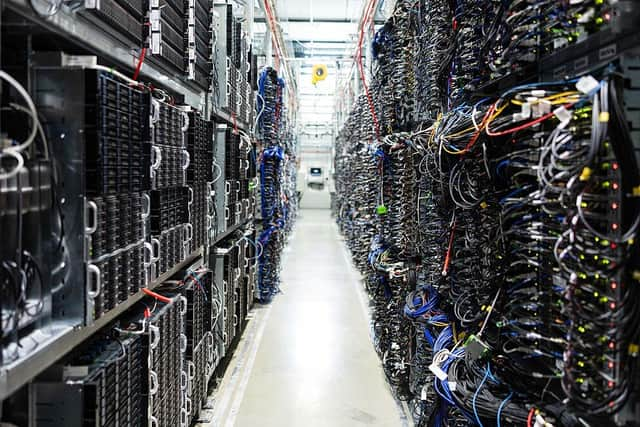

“In a world of AI, in a world of high-performance compute, we're aspiring to be something quite different in the way that we work. The aspiration is that we are a positive force for good for the community, local businesses, technology and actually the environment as well.
"The reality is that the UK needs more data centers to drive AI development, to drive business, to drive academic workload. We make no apology for that. It's a reality of where we are and where we are going, but we believe really strongly that we we can do that in a better way and do that in a different way to how others are doing this."
Last year, in late July, Octopus Energy-backed Deep Green put forward a planning application for a new, almost 37,000 sq ft facility in Bradford.
If approved, the facility will not seek to dissipate the heat produced by its operations, but instead re-use it, providing heat to a number of buildings in the city.
To do so, Deep Green’s data centre will sit alongside a new heat pump facility being built by 1energy, providing heating to locations including Bradfor’s law courts and City hall.
“We are currently in the process of going through planning on our site at Bradford, and that will be a 5.6 megawatt data center,” says Mr Lee.
“We will land that right next door to 1energy's district heat energy center. In very simple terms, the heat that we generate from our compute – which, by the way, generates a lot of heat – we will recapture that, and we will prime 1energy's heat pumps.”
Deep Green’s Bradford plan is part of a wider effort from the company to re-think how heat from data centres can be used. The company utilises a “closed loop” system in its data centres, meaning that it only uses what it describes as "negligible" amounts of water to cool.
In Manchester, Deep Green is in the final stages of building a site where heat from one of its data centres will be used to warm a local swimming pool.
“When we are finding sites, when we are identifying opportunities from sites, we're really looking at the other end of things from normal data centers,” says Mr Lee.
“Computers, when they’re processing, are actually incredibly efficient heaters. If you look at most data centers, and the energy consumption related to those data centers, what is typical is they'll use a vast amount of energy to dissipate that heat.
“That can be through water, it can be through air cooling, it can be through a variety of different cooling measures, but we just look at that in a different way.
“That heat is not waste, It's an opportunity. We can use that heat to replace other heat generation providers. So rather than thinking about having a standalone heat generation provider and a standalone data centre, you effectively bring those two together.”
Mr Lee also hopes that the Bradford data centre could have a positive impact for other local institutions, with local academic institutions able to use the facility in their research, and local businesses also able to use it for high value processing work or AI.
Though heat reuse technology has already been used in other countries for a number of years, Mr Lee believes that the Deep Green is at the “forefront” of such systems in the UK.
“If you look at other markets, Scandinavia and the Nordics have had heat re-use from data centers for a number of decades, So it's absolutely a proven technology,” he says.
“And the same can be said if you look at some other geographies across Europe. In Germany for example, they are mandating people to use heat reuse within their data centers.
“This is coming, but we believe we're at the forefront of this in the UK.”