
Dr Helen Sharman: Moon discoveries should benefit “all the world"
It has been 35 years since Dr Helen Sharman became the first British astronaut and first Western woman to venture into space when she took part in an eight-day mission orbiting the Earth. Amid the excitement of the Artemis II mission – where Nasa sent four astronauts to the Moon for the first time in more than 50 years – Sheffield-born Dr Sharman said Moon discoveries should benefit “all the world, not just some parts of it”.
“We need to use space wisely” says first British astronaut
Dr Helen Sharman, the first British person to go to space, said Moon discoveries should benefit “all the world, not just some parts of it.”
Future Moon missions could help humans generate clean energy to send back to the Earth via microwaves, which Dr Sharman said has already happened in an experiment on a small scale.

This has motivated her to campaign about who should own that energy, the products made with it, and ultimately who gets to benefit from discoveries in space.
She said: “We need to properly collaborate with the rest of the world. We need to allow countries with emerging economies to be able to be involved.
“If only the countries that have already financially invested can benefit, then we exacerbate global inequalities that we already have.”
Dr Sharman explained the recent Artemis II lunar flyby mission is “the precursor to ultimately landing on the Moon and establishing operations”.
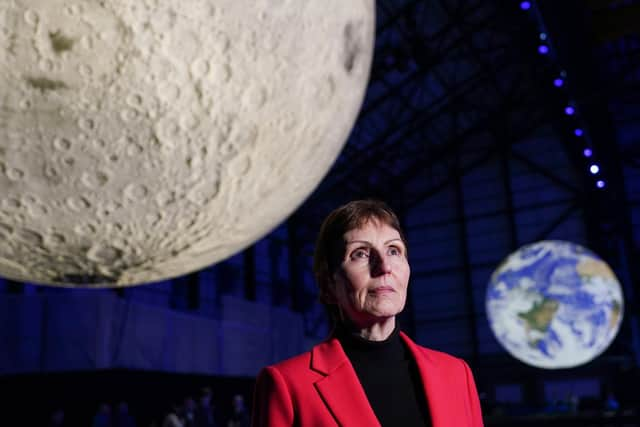
Future lunar missions will aim to explore the South Pole of the Moon, which Dr Sharman says is a “strategic location” with lots to discover.
These discoveries include ice, new materials to mine and manufacture for infrastructure and electronics, research into the effects of solar wind and radiation, and exploration of a large crater called the Aitken basin, which may reveal what lies underneath the Moon’s surface.
All this, Dr Sharman says, will help us learn about the Moon, the solar system, the Earth and how to protect it.
Though the UN 1967 Outer Space Treaty stipulates that no one can own the Moon, Dr Sharman said: “once you’ve established an operation on the surface of the Moon, no one is allowed to interfere with that operation. That’s tantamount to owning the land, because you’re owning use of the land.”
She said the ‘lunar economy’ is estimated to be worth $142 billion by the 2040s, so discussions about what is fair are urgently needed.
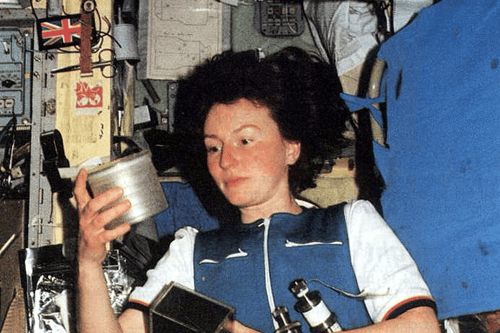
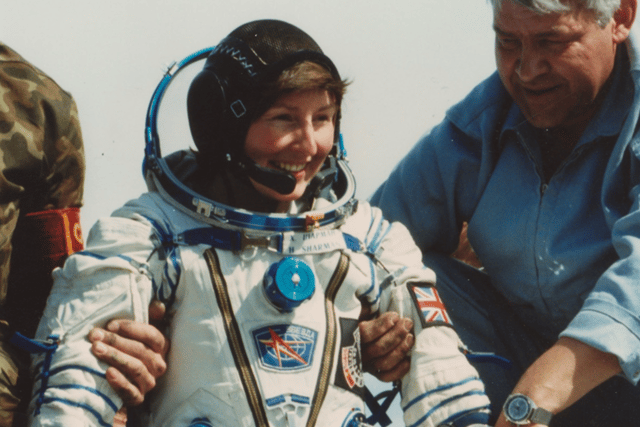
Dr Sharman, originally from Sheffield, spent eight days in space in May 1991, six of which doing science experiments on the Mir Space Station in low Earth orbit.
Her mission, Project Juno, was set up at the end of the Cold War where the Soviet Union asked Western countries if they would like to send somebody to space, as an act of soft diplomacy.
Dr Sharman was selected for the opportunity out of 13,000 applicants, and spent 18 months training at Star City, the cosmonauts military base in Moscow, with sea training in the Black Sea.
35 years later, Dr Sharman remains enthralled by space exploration, including the recent Artemis II mission, which saw humans fly the furthest from Earth in history.
She said: “I’d love to have gone [on Artemis II], I’d like to go to the Moon, walk on the Moon, I’d like to go to Mars. Which astronaut wouldn’t? What a phenomenal mission.”
“Being able to see the Moon closer. They were still a few thousand miles away from it but those images we saw are just spectacular.
“The colours are very good these days from digital but they’re never quite as vibrant. It’s partly an emotion behind it as well. They saw meteors landing on the Moon, the flash of light that those meteors created.”
Human beings have always wanted to explore and push boundaries, Dr Sharman says, and she predicts that in around 20 years, we might land on Mars.
She said: “We think that the first people who will go to Mars are probably now coming towards the end of their school career.”
To students who enjoy science, and might be interested in a career in space, Dr Sharman said: “Study well, make best use of your opportunities and be kind to one another and the planet.
“Remember, every astronaut has a good back up plan.”