
Adders: How Yorkshire is playing a key role in protecting Britain's only native venomous snake
Nidderdale National Landscape is playing a leading role in a pioneering Natural England species recovery project that uses DNA analysis to reveal how healthy and connected adder populations are across England.

Adder populations in the UK are in decline nationally.
Scientists and conservationists have selected Nidderdale's adders for the national study involving whole genome sequencing - due to the area's well-monitored populations and extensive semi-natural habitats.
The work is funded by the Natural England Species Recovery Programme, supported by Bangor University and Newcastle University, with Natural England staff delivering fieldwork locally alongside the Nidderdale National Landscape team, volunteers and staff from Yorkshire Water.
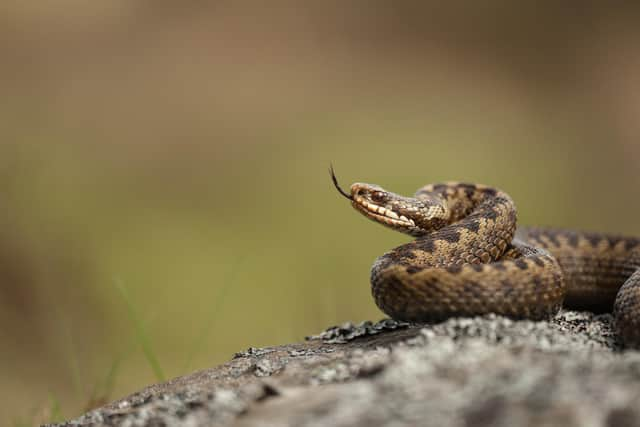

Together they are collecting DNA samples from adders to help scientists understand population health and connectivity.
The whole genome sequencing technique reads the complete genetic code of each snake, revealing whether populations are mixing well or becoming isolated.
Findings will be compared with other study areas to build a clearer national picture.
However, the team has issued a warning about threats to the adders they are working to protect.
Dr Kelly Harmar, Biodiversity Officer at Nidderdale National Landscape, said: “Adders are sensitive to disturbance by people, and this is thought to be a major factor in their current population decline.
“Adders emerge in spring in cool air temperatures and need to bask in the sun to bring up their body temperature – disturbance causes adders to seek shelter and stops them from basking.
"This can use up the animal's energy reserves at a critical point in the year, affecting their survival chances.
"Nidderdale's adders are found at remote sites and are less vulnerable to disturbance, but we had multiple recent reports of photographers actively seeking out adders within our protected landscape and sharing the location of their sites.
"This both disturbs and threatens them, and we strongly discourage anyone actively seeking out adders unless it is to document their population for conservation purposes."
Nidderdale National Landscape has monitored adders for many years and believes the area could be nationally important for reptiles due to larger, less-disturbed areas of habitat than in many southern landscapes.
The team worked with Natural England to collect painless scale samples for DNA analysis by Bangor University.
The study compares Nidderdale with other reference populations from areas of high and low gene flow, to show whether populations are well connected or at risk of inbreeding. Further samples have been collected this autumn.
Dr Harmar added: "We have surveyed adders here for several years, and we think Nidderdale could be nationally important for reptiles.”