
Amazing insects hiding in plain sight
Each summer I seem to discover another amazing creature that I didn’t know existed in Britain. It started decades ago when I was living in a crummy flat in Swansea and a stag beetle flew into my room on a warm summer’s night.
These are seriously big insects that look like they could be a real threat, as the males wield enormous fighting claws which are used to grapple with rivals. I had never seen anything like it and was amazed that something so fiercely exotic was out there in our environment.
I assumed I had encountered a rare and precious creature and so went to the local library to find out. Yes, younger readers, it really was necessary to physically go and pick up a book in the days before the internet allowed you to point a camera and ask an app.
What I discovered was that, instead of being rare, it was listed as a creature that is common as muck. My dangerously intimidating invader turned out to be a plodding consumer of locally available leftovers that only used its weaponry on other males of the species.

These days, those once common creatures are increasingly hard to find, and a sighting has now become a more special event.
Large and spectacular insects struggle to get enough oxygen into their systems.
They don’t have lungs and rely on the air getting into the body via a system of ever smaller tubes that are spread all across their body.
Once they get to a certain size, it becomes increasingly difficult for enough air to get to the organs that need it, and that limits the possibility of growing into a monster.
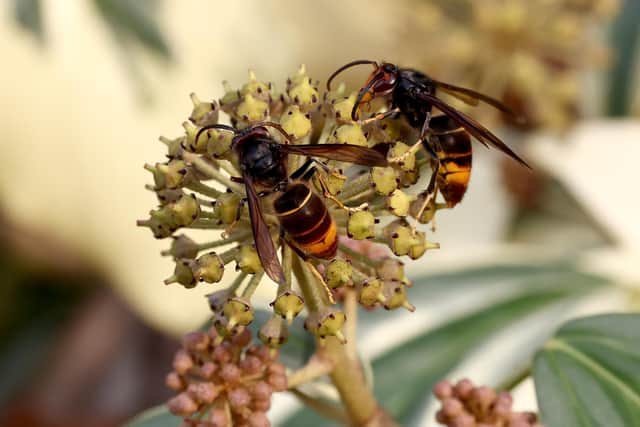
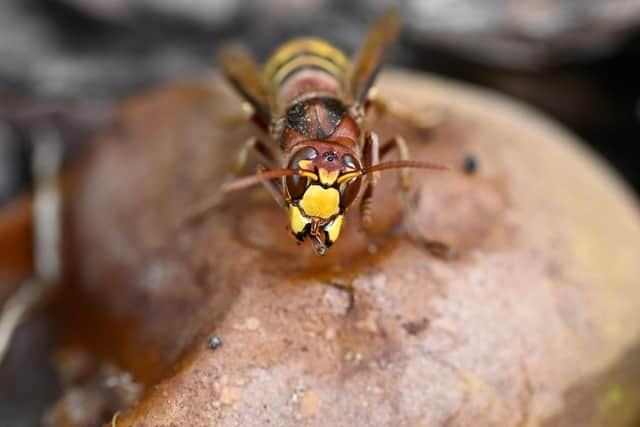
Right at the edge of the size possibilities are queen hornets.
I saw one two summers ago and was instantly shocked by the sight of a huge beast flying at speed across a garden searching for other insects to eat or a male to mate with.
Invading Asian hornets are actually smaller than our European version but have techniques for attacking honeybee hives which can wipe them out in a couple of days.
Our native European hornet has existed harmoniously in our countryside for thousands of years.
It is bigger and tougher than other members of the wasp family and munches its way through enough insects over the course of a year to build up its own nest and raise a fresh generation of queens.
They then mate and overwinter in the ground before starting a fresh nest.
The one I saw seemed to be more than twice the size of a bog standard wasp and was flying at a rapid pace but exploring occasionally, so I was able to follow the magnificent creature from a safe distance.
Undisturbed, they are not particularly aggressive, but the phrase “stirring up a hornet’s nest” is there for a reason. You don’t want to be stung by one of them, and you certainly don’t want to have an entire nest after you.
Left alone, they normally pay you the same courtesy, and there is usually absolutely no need to call in a pest control specialist to poison something so rare and special in our environment.
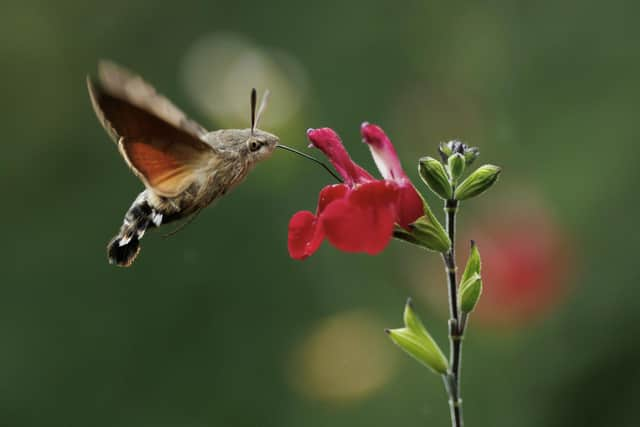
The amazing creature that I’ve seen for the first time this year is the hummingbird hawk moth.
These are hot weather specialists and have only just started to overwinter in the north of Britain and be here in any numbers.
The clue to their appearance is in the name. They are big for an insect and look very like a tiny hummingbird. They also behave exactly like one, as they use much the same food sources.
I saw my first one sucking nectar in the wonderful gardens of Newby Hall, near Ripon.
It hovered in front of the flower exactly like a tiny hummingbird and extended an enormous tongue deep into a flower that had hidden its nectar safely away from less skilful pollinators.
Its wings were moving so fast it was hard to see them. That means it is living a very high-energy lifestyle that requires a warm environment and a ready supply of nectar.
So look out for the likes of Buddleia, and you might get to see one. I spotted my second of the summer in a suburban garden in the village of Bradley, near Skipton.
As our environment changes, so do the insects that are around for us to see.
With luck, we will continue to be able to see stag beetles, hummingbird hawk moths and queen hornets for many years to come.
If you want to help with that, the single best thing you can do is not to spray your garden, as many suburban gardens have become really valuable refuges for rare and beautiful creatures.