
Breaking down the barriers for fish in Yorkshire's rivers
While rivers and lakes are home for more than ten per cent of all known animal species, despite covering less than one per cent of the Earth's surface, almost a quarter of all freshwater species are threatened with extinction.

Healthy rivers depend on connectivity, since fish, particularly migratory species such as salmon, rely on being able to migrate upstream and downstream to spawn and access a variety of habitats throughout their life cycle.
A Belfast University study published in June found while both native and non-native population sizes generally increased after barrier removal, the positive effect was strongest for native species.
In response to the issue in Yorkshire, the Great Yorkshire Rivers partnership of Yorkshire Water, The Rivers Trust and Environment Agency (EA) is funding a £21m drive to address all artificial barriers negatively impacting fish populations in the region by 2043. Organisers said the scheme is gathering momentum following the removal of weir obstacles on the Black Brook at Greetland, near Halifax and Stocksbridge on the River Don in Deepcar, Sheffield and ford removals at Staindale and Staithes in North Yorkshire. This week has seen a major scheme completed by the Yorkshire Dales Rivers Trust (YDRT) on Skeeby Beck, between Richmond and Scotch Corner, a popular destination for fly fishing enthusiasts before a slurry-related pollution incident in 2023 killed all life in the watercourse.
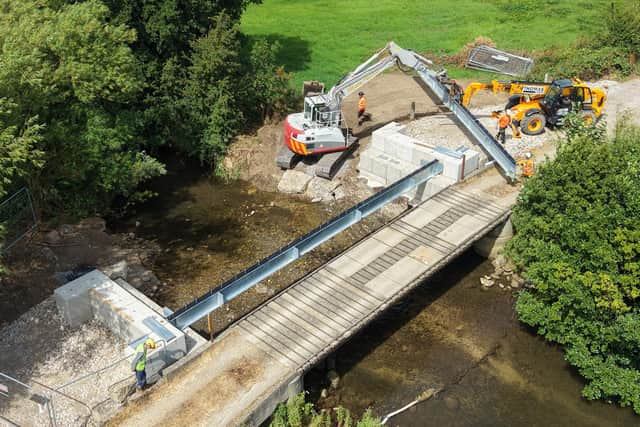

Project manager Sarah Lonsdale said: “Skeeby Beck had a significant fish kill that led to a category one incident being declared by the EA. It essentially wiped out the entire catchment, from the point of the pollution downwards. The EA did surveys and there wasn’t a single live fish. They were all washing up on the banks, it was quite horrific."
Surveys by the EA and the Wild Trout Trust after the incident showed fish populations struggling to recover. In response, YDRT is working to identify all barriers to fish migration, which can be as small as a culvert pipe, but often include bridge aprons and weirs.
Sarah said: “There are thousands of data points now where these barriers exist which paints a picture of how fragmented our watercourses are."
She said the ford at Skeeby Beck – essentially a large concrete slab in the middle of the channel - had represented a significant barrier to fish migration. Structures in rivers create an impoundment effect, where the water backs up behind it as well as making for slow and sluggish flows upstream, which causes sediment deposition. Sarah said: “This isn’t great as you get a lot of fine silts that then smother all the river gravels. Essentially, the impoundment reduces the quality of habitat for fish, but also aquatic invertebrates.”
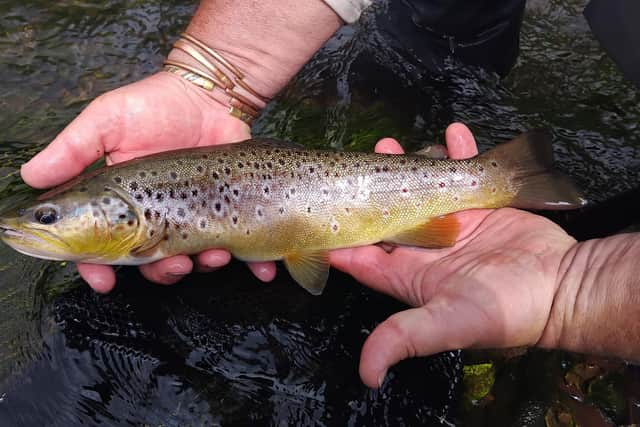
Ahead of the work, surveys of the beck conducted by YDRT and the Wild Trout Trust identified grayling, trout, bullhead, minnow and stone loach, in low numbers, while also in the catchment on the Swale there are Atlantic salmon and European eel. Sarah said: “Fish could move neither up nor down Skeeby Beck and the impoundment has all sorts of impacts on the habitat condition as well.”
"Skeeby had a ford before the 1970s, when they added to it. These things have existed for a long time as have the weirs built for mills or navigation.
"Some of them are protected for historic reasons, but the awareness of the impacts of these things is now definitely increasing.
"When people think of fish barriers they jump to their importance for migratory species, but barrier removals really benefit local species too like stone loach and bullhead by creating a more connected landscape.
"It increases their resilience to climate change or if there is a pollution incident as they can move out the way, reach more foraging grounds and rest areas. It’s about creating that diversity of habitat for them that they can reach.”
YDRT has prioritised the devastated beck and has worked with the tenant farmer and landowner for more than two years on a project to remove the ford.
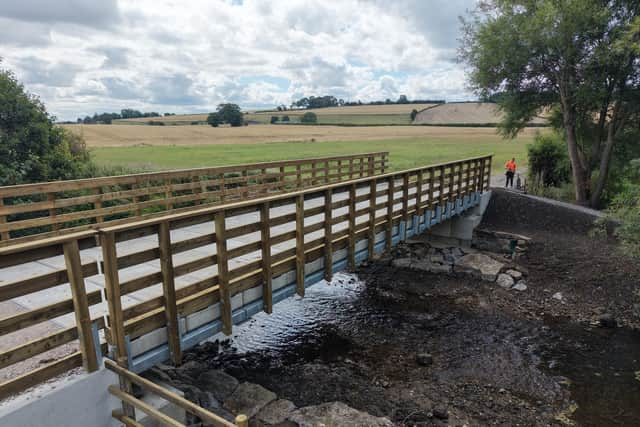
Sarah said: “As we needed to retain access for the farmer, it wasn’t as simple as removing the ford, we needed to build a bridge.”
Project organisers say the beneficial impact of the bridge replacement for the ford has started to show almost immediately. The habitat is beginning to restore upstream, with some riffles – shallow part of a stream or river where the water flows brokenly - forming.
Sarah said: “A river has a great ability to restore itself if it is given the chance to. Over time gravels will move through the catchment and we should start to see quite nice riverbed quality as well.”