
Call to action as Yorkshire threatened by Russian invasion
A study has revealed how the narrow-clawed crayfish, a species native to the Black Sea and Caspian Sea basins and threatening to spread across Yorkshire, is as aggressive as the better known invasive signal crayfish.

University of Leeds researchers have concluded the narrow-clawed crayfish has the potential to cause similar ecological harm to North American signal crayfish, the burrowing of which has been estimated to have caused £11.6m of damage to irrigation structures and riverbanks over the last two decades in the UK.
While the early Victorian Boshaw Whams reservoir, near Hade Edge, contains the only known population of narrow-clawed crayfish in Yorkshire, academics last year found the 153,940 cubic metre body of water to be in the containment stage of the “Generalised Invasion Curve”.
The West Yorkshire-based academics stated action was urgently required to prevent further spread.
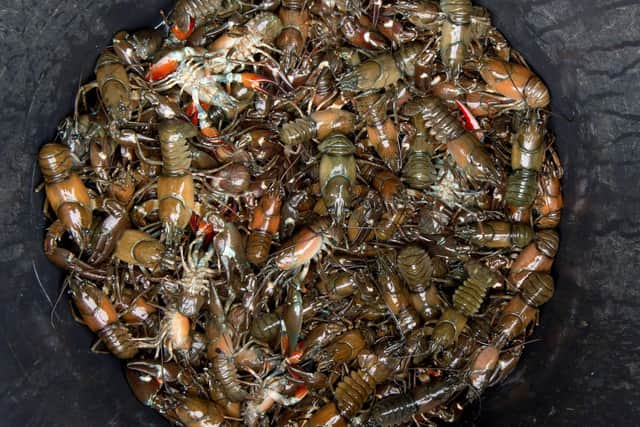

Following the publication of the latest research in Biological Invasions, lead author James Hodson underlined how invasive species are a major driver of biodiversity loss, particularly within freshwaters.
The PhD researcher said the narrow-clawed crayfish has potentially been overlooked by ecologists despite populations having been established across the UK.
He said: “Our study, which is the first looking specifically at the impact of narrow-clawed crayfish in the UK under different temperatures, showed they are similar predators to signal crayfish under all temperature conditions.”
Both species of crayfish are like freshwater lobsters and usually palm to hand-sized. They are found in still waters such as lakes, wetlands and reservoirs, on all continents apart from Africa and Antarctica. Both narrow-clawed crayfish and signal crayfish have big appetites for aquatic plants, algae, invertebrates, and even fish eggs. Crayfish have also been known to eat each other when food sources are low.
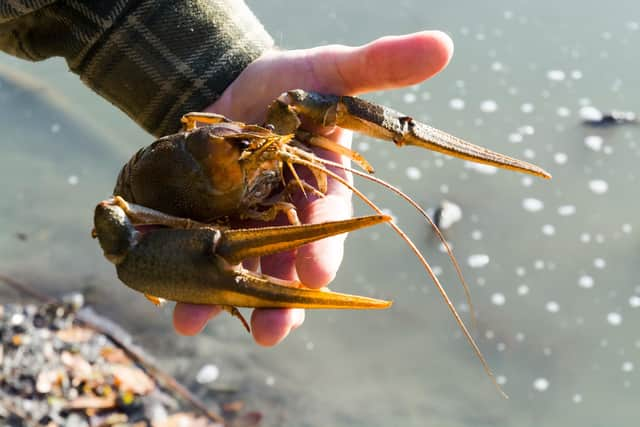
Although narrow-clawed crayfish normally have smaller populations than signal crayfish, and they do not carry crayfish plague, they are still large-bodied predators which have the capacity to alter ecosystems.
“This is a real concern as we’ll be seeing ecological shifts if they spread into further locations and disrupt native communities,” Mr Hodson said. “The impact on prey could also be exacerbated by global warming, as higher temperatures could increase abundance and feeding rates of invasive species.”
Crayfish invasions are notoriously difficult to manage, so the priority must be on slowing the rate of new invasions down by addressing policy shortcomings.
The experiment was conducted by exposing the signal crayfish and narrow-clawed crayfish to four temperatures ranging from 9C to 22C. The team then observed and compared the two species’ functional responses – how much one crayfish can consume across a range of prey densities. This approach can also address whether rare native prey species will still be eaten by the crayfish population despite low numbers.
Researchers also looked at the relative impact potential, which considers how many crayfish there are at a certain temperature as well as their predatory impact. For instance, at certain temperatures the crayfish population may be bigger, which can then exacerbate a species’ predatory impact.
Mr Hodson said: “We wanted to find out how the impact would vary if temperatures increased, for example, in different seasons, different locations, or due to climate change.
“We found that narrow-clawed crayfish had the highest relative impact at 17C as they were still consuming large quantities of prey and they were more abundant. With the average summer temperature in UK still waters being around 15 to 20C, this finding is crucial in helping shape management actions.”
Dr Matthew Harwood, co-author on the paper, previously looked at the changes in population of the understudied narrow-clawed crayfish over time and estimated the size of the population at .Boshaw Whams to have a minimum size of 10,045.
The research also identified the UK population of narrow-clawed crayfish may have fewer environmental pressures, such as diseases, than they would find in their native population.
Dr Harwood said: “While eradication of established populations of invasive crayfish remains challenging, it is crucial for preventing the species from spreading out into the surrounding area to minimise ecological harm. We’re also urging environmental regulatory bodies to pre-emptively identify potential new damaging invaders and implement proactive policy to prevent invasions which may be facilitated by climate change.”
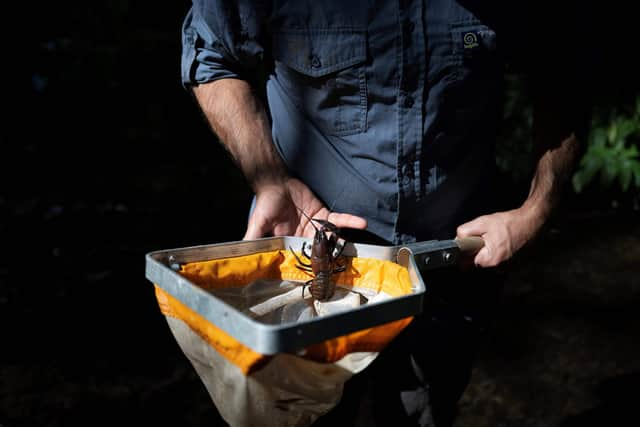
Dr Josie South on a crayfish sampling field trip. Credit: Ugly Sisters Production.
Senior author Dr Josie South, Associate Professor in Aquatic Ecology at the University of Leeds, explains: “Crayfish invasions are notoriously difficult to manage, so the priority must be on slowing the rate of new invasions down by addressing policy shortcomings. One of which is the lack of data on how organisms respond to increasing temperatures, which puts the UK at risk from species that we thought were harmless, such as the narrow-clawed crayfish. Our team’s work is designed to address this gap in knowledge and action.”