
Fleet Moss: How Yorkshire peatland has been restored after being compared to The Somme
The landscape at Fleet Moss was once so bleak that they called it “the Somme”, a black, broken up expanse, with gullies pouring water and peat down the hillside during heavy rain.

Just a few years back so much of the peat was exposed recalls restoration officer Jenny Sharman that “on one part the peat was moving, it was kind of like a very slow liquid volcano eruption of this moving top soil”.
The transformation of Fleet Moss, a steep climb away from Hawes, on Yorkshire’s highest road, has been incredible to see.
Where there was blackened land, cotton grass heads now blow in the wind, alongside green heather.
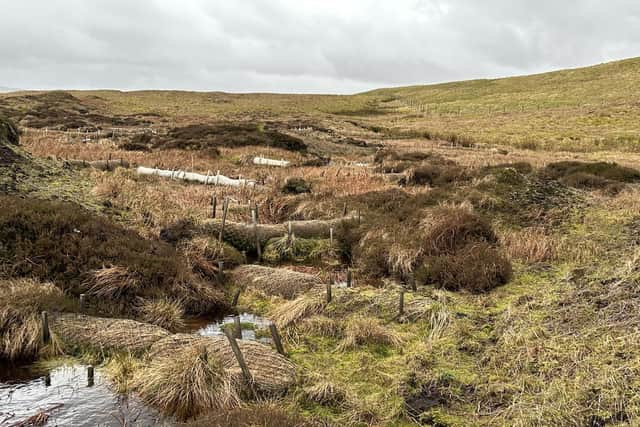

As the blanket bog has been restored, a wealth of life has returned, including dragonflies, carnivorous plants like sundew and Jenny’s favourite – short-eared owls which breed on the uplands.
Over the years drainage channels – known also as grips – had been dug into the blanket bog to drain the land for grazing by sheep.
“In the 1970s they put in lots and lots of grips, it’s like skin, if you have a wound, it does drain everything very rapidly,” she said.
The sheep did a lot of damage too, she says, plucking the grasses and herbs which formed a protective layer on top of the peat, exposing it to the elements, and wrecking the hydrology underneath.
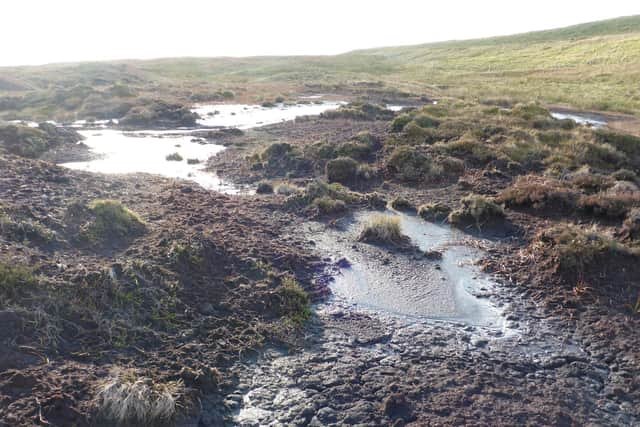
Their paths along the fenced boundary also became channels for water.
It was the parlous state of Fleet Moss that inadvertently started the Yorkshire Peat Partnership, a collaborative partnership working to restore and protect upland blanket bogs across North Yorkshire.
“My boss worked at the Yorkshire Dales National Park and they were looking at areas like Fleet Moss, thinking “how do we restore this?”
“That was how the Yorkshire Peat Partnership formed, but they started on other projects that were easier to tackle.
“I started surveying it in 2018, we walked the entire area. It was definitely the most challenging site we’d ever come across.”
It has cost a lot of money and a phenomenal effort to restore with helicopters having to be used to lift in materials.
“We had over 26km of gullies to reprofile and block. We did as much as we could with diggers to block the grips and gullies.
“We put in nearly 200 stone dams, over 1,000 timber dams and coir logs – they are a metre long and together stretch 14km.”
Contractors put in an incredible 154,000 cotton grass plugs and 73,000 sphagnum moss plugs.
This summer when much of the moors was tinder dry, Fleet Moss was gratifyingly squelchy.
A patchwork of different wetter eco-systems like Fleet Moss will be more resilient to fire, says Jenny.
“We’ve created artificial heather-dominated landscapes that are increasing fuel load.
“Rewetting takes time so that fuel load still needs to be managed until we can make a much wetter, boggy landscape.
“Once we’ve done that, the fuel load becomes less of an issue.”
She argues that hotter, dryer summers, which could become the norm with climate change, means people have to think about creating more resilient landscapes, and it must be done through collaboration.
“Having something that is out of balance, which has only two species living in it, isn’t going to be resilient.
“Water is key. If we don’t have that we are all in a mess when you think that 70 per cent of our water comes from peatlands.
“We need to maximise its potential as a reservoir.”