
Heavy metal rocks health of Yorkshire Dales rivers
As floods become more frequent and intense, nature in Swaledale and Nidderdale is facing an increasing threat from heavy metal pollution.

By the 15th century Swaledale and Nidderdale had become such significant lead mining centres that they were exporting to as far afield as Bordeaux and Danzig. It has been claimed there are more than 2,500 abandoned lead mines in the northern Dales.
Now, more than two decades after the threat of lead contamination in the Yorkshire Dales was first understood, a long-awaited project has been launched aiming to address the industrial legacy of pollution.
While the last lead mines closed more than a century ago, remains of spoil heaps and drainage tunnels are leaching heavy metals such as lead, cadmium and zinc into watercourses. Nearly 150km of rivers in Swaledale are impacted and farmers and gamekeepers in the area have reported the deaths of their animals and other wildlife from lead sediment washed out of abandoned mines.


Lead usually presents as an odourless and colourless poison in watercourses and floodplains, where in places such as Swaledale and Nidderdale animals set for human consumption graze. Highlighting the long-term impact of the pollution, Professor Mark Macklin, of the University of Lincoln, said: “I really do worry there could be a major human health incident in the future if we don’t get a grip on this.”
The water quality improvement project sits within the River Nidd and River Swale catchments, including Barney Beck, near Redmire, in Upper Swaledale, one of the most polluted, and Ashfoldside Beck near Pateley Bridge, where some 44km of the watercourse is impacted by heavy metal pollutants. Following the success of metal mine pollution remediation projects in Teesdale, river restoration charity, the Yorkshire Dales Rivers Trust is working with partners in the Water and Abandoned Metal Mines Programme on two further water quality improvement projects.
Tim Longstaff, who is managing the Barney Beck scheme, said: “Past mining activities in both river catchments have left behind loose, unvegetated, heavy metal rich mine wastes. “When it rains, heavy metals wash into the river from the mine waste, contaminating the water and harming the surrounding ecosystems and wildlife. Remediation work will include novel, experimental techniques to help introduce vegetation to barren areas to bind together mine spoils, helping to protect them from erosion and reduce water infiltration, along with stone revetment work along the most severely eroding riverbanks.”
The techniques being used build on those developed over the last two years on successful metal mine pollution remediation projects in Upper Teesdale, where an innovative hydroseeding technique (which involves spreading a mix of mulch materials and water with a hose), was developed with Terraffix Soil Solutions to establish new vegetation. On Barney Beck a biocrust (a complex assembly of organisms like bacteria, algae, mosses and lichens that naturally grow within all soils) has been applied along with the mulch to help plants establish on bare spoil, and installation of revetments are planned for this year. The Ashfoldside project is still in the early testing and analysis stage, to decide the most appropriate techniques to remediate the site.
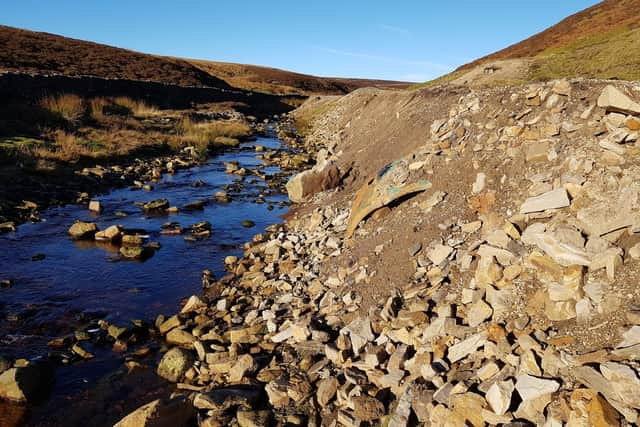
Tim added: “Both sites have a great archaeological, environmental and social value so it is rewarding to be working on projects looking to protect and enhance these aspects too.”
Yorkshire Dales National Park Authority member champion for the Natural Environment, Mark Corner said novel techniques were being used to re-vegetate the lead mine spoil beside Barney Beck. He said microbes were being introduced that would wrap up the heavy metals, so they cannot be washed into the beck.Mark said: “There are numerous former lead mining sites in Swaledale, so the long-term benefits for river water quality could be significant.”
The project will become part of the legacy of Tees-Swale: Naturally Connected, a unique collaboration between the North Pennines National Landscape and the Yorkshire Dales National Park Authority, and those who manage the land. It will also boost the work of the Yorkshire Dales National Park Management Plan Partnership, which is looking to bring 65 per cent of rivers into good ecological status by 2031.
Both the Nidd and Swale catchment projects support the government’s Environment Act target to halve the length of rivers polluted by harmful metals from abandoned metal mines by 2038.