
Kildwick: The village with lasting links to life at the crossroads
On the south side of Main Road, Kildwick, a 19th century milepost underlines its long-standing pivotal position between the historic wool-producing areas of Westmorland and Craven and the West Yorkshire textiles centres.
For 253 years Kildwick’s transport links have also included the country’s longest single navigable inland waterway, the Leeds and Liverpool Canal, which was dug out, mainly by hand, on a strip between the village and the River Aire.
Although boat traffic carrying coal and limestone over the Pennines has long since stopped, the recently improved towpath beside a lock-free stretch of the waterway attracts a steady stream of cyclists and walkers as well as herons and otters.
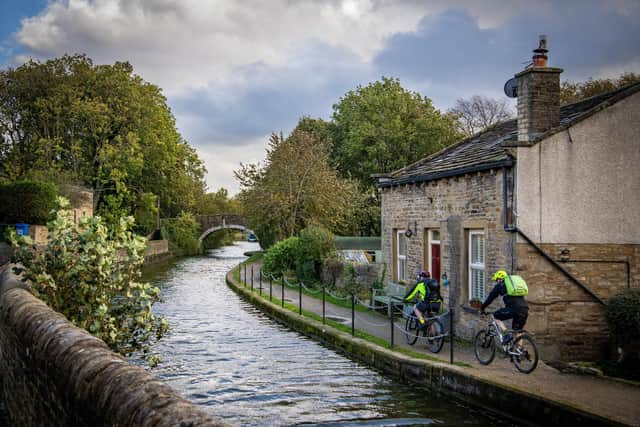

Beautifully decorated moored narrow boats line the canal as it passes fertile farmland, a popular canal-side cafe, playing fields and Kildwick Church of England Primary School, which has previously been ranked among the top primary schools in the country, before the Warehouse Swing Bridge.
Nearby, another bridge, the grade I listed Kildwick Bridge, was built as a packhorse bridge over the Aire in the early 14th century for Bolton Abbey’s Canons. It is believed to be Yorkshire’s oldest river crossing still in use, with a west side featuring medieval pointed northern arches and round arches to south.
Described by Bradford City Angling Association as “one of our most underfished venues”, Keighley Angling Club has previously taken the step of writing to schools in the area warning of the dangers of jumping from the bridge.
The canal passes through Kildwick like a golden thread. Former mills line the waterway which is carried over Kirk Gate and Newby Road by a single span aquaduct, creating the highly unusual village feature of a 50m tunnel, particularly so set against the rest of Kildwick’s historic core.
Further up the lane, overlooking the canal, is a former Methodist chapel, which held its final service in 2015 before the congregation relocated along Main Street to the Kildwick and Farnhill Institute, the venue for a spectrum of community activities such as coffee mornings and ceilidhs.
Fascinating windows into the village’s importance past remain, such as the gritstone 17th century stocks, which are thought to have been moved a short distance to the north side of Main Road, beside the church’s impressive southern gates, when a garden of remembrance was laid out after the Second World War.
The area overlooked by the church comprises a carved stone sundial shaft dated 1668 and a war memorial with floriated cross on a gothic column, naming 58 parishioners killed in the First World War and 18 during the second global conflict.
Physically overshadowed by adjoining Farnhill, which backs up to edge of Bronte Country moorland and has a population of about 500, Kildwick is about half the size, but punches well above its weight in heritage assets. The solid-looking single arched Parsons Bridge, off Kirk Gate, was built over the canal in 1774 and links the village’s grade I-listed Church of St Andrew with the graveyard and further up the hill Kildwick Hall.
The 14th century place of workship’s stone slate roofs, large iron clock face and ornate weather vane and two-stage tower makes for a striking and dominant landmark.
Features inside include fragments of an Anglo-Saxon stone cross and a stone tomb effigy of medieval knight Sir Robert de Styveton, potentially a survivor of the Reformation as Henry VIII granted Bolton Abbey’s Kildwick to Christ Church, Oxford. Perhaps its strangest element is stone head with peculiar eyes above the tower’s door, which it has been suggested could be a tenth century depiction of Odin or a 12th century Romaneque grotesque.
The church has had numerous facelifts and additions since, leaving it with what is believed to be England’s longest parish church nave - a rather grand place of worship for a small village. It also boasts a thank-you letter from Florence Nightingale, penned from an Istanbul hospital during the Crimean War, to the village’s vicar for sending convalescing soldiers his collection of books.
Near the church in The Parish Rooms, Coffee and Crumbs serves up seasonal specials such as Witches Brew Chowder and Corned Beef and Potato Pie. To the south-east of the church, at the foot of Priest Bank Road, there’s a pre-Victorian building, also with a stone slate roof, that was created to house hearses arriving for funerals.
At the top of the hill stands the imposing Kildwick Hall, a three-storey mansion that served as a hotel before being converted back into a home about 30 years ago. Four Buddhist shrines, which are thought to date from the late 18th century stand near the road. It is believed the garden ornaments were introduced by a relation of Clive of India, the first British Governor of the Bengal Presidency. Although the grade II* listed property has been linked with the Brontes, its main association with the literary family appears to twice serving as the Linton home Thrushcross Grange, in the first screen adaptation of Wuthering Heights in 1920 and in a 1967 BBC mini series of Emily Bronte’s novel starring Ian McShane as Heathcliff.
Kildwick Hall, on Grange Road, was built in 1642 by the Currer family, which is understood to be the inspiration for the pen name, Currer Bell, used by Charlotte Bronte after she worked as a governess few miles to the west at Lothersdale.
Further along the former high road, at the top of Priest Bank Road, is the 17th century Priest’s House, from where a five-minute walk along the lane with overhanging trees leads to the grange the Bolton Priory canons established as a goat farm and dairy in the early 14th century. An impressive collection of historic buildings with expansive views across the valley remains, including former stone barns, a farmhouse and a carriage house, which may once have served as a courtroom.