
Leeds researchers studying little-understood environmental impact of bottom trawling
Researchers from Leeds have played a key role in a new study looking into the environmental impact of bottom trawling.

Bottom trawling – the practice of dragging nets along the seabed for fishing – has long been known to disturb carbon stored in the seabed, but scientists do not fully understand how these changes affect the environment.
But now, University of Leeds researchers have been involved in a first-of-its-kind study aiming to address critical evidence gaps and assess the potential implications of bottom trawling on climate change.
Scientists from across the UK have travelled to the Irish Sea to study the impact of activity by three professional fishing trawlers, using novel techniques to track carbon.
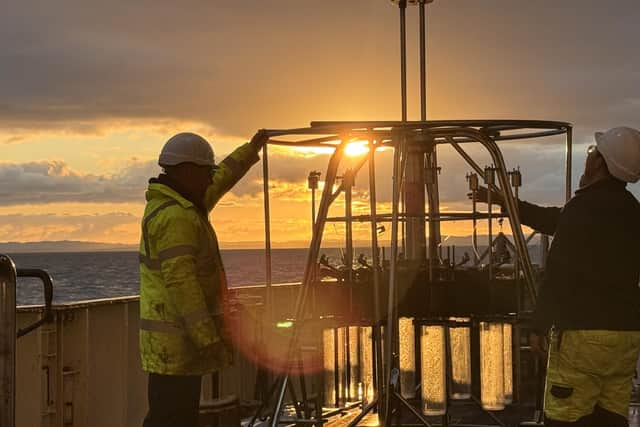

The SeaSTORE project, which has been funded by the Natural Environment Research Council, is led by Bangor University, in collaboration with Imperial College London, the University of Leeds, Heriot-Watt University, the Plymouth Marine Laboratory and the Centre for Environment, Fisheries and Aquaculture Science (Cefas).
Dr Will Homoky, associate professor of Marine Geochemistry in the School of Earth, Environment and Sustainability at the University of Leeds, who is the University’s project lead, and Dr Ruth Parker, blue carbon expert from Cefas, said: “Effective governance of the ocean requires a clear understanding of the seabed. Our team is using innovative sampling and analytical approaches to identify relationships between seabed composition and bottom trawling that will fill vital gaps in our knowledge.
“This highly collaborative research programme will rapidly improve the evidence base to provide stakeholders and decision makers with a clearer picture of the risk to carbon from bottom trawling. This will allow the design of management measures which support our net zero and food security goals while safeguarding marine biodiversity.
“We must consider science-based solutions that carefully weigh the trade-offs between climate action, human uses and nature protection.”
The SeaSTORE project is providing an opportunity for scientists working with the fishing industry to measure carbon in the water column and sediment during active, real-world fishing activity, helping researchers understand how disturbed carbon moves through water and how much carbon may be released into the atmosphere.
While previous research has suggested that bottom trawling may have a significant impact on the release of planet-heating carbon dioxide (CO2), it is unclear how much carbon from the seabed reaches the atmosphere in practice.
The research cruise in the Irish Sea, which began on 22 July and ended on 15 August, followed an earlier cruise in the winter. Together, the two research trips will help researchers to understand the impact of bottom trawling in different weather and seasonal conditions.
Professor Jan Geert Hiddink, Project Lead for SeaSTORE, from Bangor University, said: “Bottom trawling is the most extensive physical disturbance to seabed carbon stocks on the planet, yet we don’t know whether it turns sediments into a net source of CO2 , by how much, or where and when.
“This project aims to close that gap with direct measurement across contrasting environments.
“What’s missing is a holistic assessment. Previous work has looked at sediment carbon, water column processes, or air-sea exchange in isolation. We’re bringing all of that together for the first time, from the seabed to the atmosphere.
“Fisheries provide a quarter of the world’s seafood, and food production has to stay part of the conversation.
“Our aim isn’t to argue for or against trawling, but to make sure that trade-offs between food production and seabed carbon can be considered in policy decisions.”
Amongst the questions the project aims to answer is how the type of fishing gear, the frequency of trawling, and the type of sedimentary environment impact the potential for CO2 to be released into the atmosphere.
It is also looking into how surrounding seawater is changed and where carbon goes when it is disturbed by trawling, as well as how different approaches to trawling could reduce carbon loss and CO2 emission.