
Legendary hound that haunts landslip village
Centuries after the Washburn Valley’s textile mills went into decline, water continues to literally shape the community of Fewston.
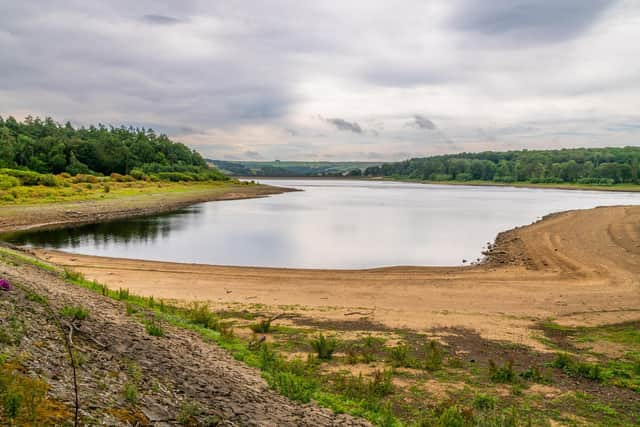
The village, lying on the edge of Swinsty Reservoir and a stone’s throw from Fewston Reservoir, has been shifted by the huge amount of pressure from the combined 8.2 billion litres of water they can store for Leeds residents and businesses.
The reservoirs were constructed by the Leeds Corporation some seven miles west of Harrogate, beside the shale-founded village in the 1870s to provide sanitary water for the city’s soaring population.
However, they were created by damming the valley and using naturally impermeable and flexible puddled clay, despite land around Fewston having previously been prone to landslides.

A Fewston clergyman is said to have remarked at the time: “Fewston must die so that Leeds may live”.
A year after the reservoir project’s completion his words were brought into sharp relief when it was reported an overnight landslip had left most of the properties in the village uninhabitable. The Yorkshire Post and Leeds Intelligencer told how Swinsty Reservoir’s high pressure had pushed water through the village’s shale foundation, leading the village to subside.
The article, headlined ‘Threatened destruction of the village’, stated residents were “fast quitting dwellings” due to cracks in the buildings developing at an "alarming rate”.
A few years after the disaster, the lane featured in ‘Yorkshire Legends And Traditions’, a book by the Rev Thomas Parkinson, with the Barghest of Busky Dike Lane, which he said was a supernatural hound-like creature able to transform its appearance.
He wrote: “Often was he seen, in days of old, promenading, with noiseless step, in the shade of the bushes and hedges, his long hair hanging from his sides, and his horrible eyes glaring upon the terrified wayfarer, and dragging with him his fabled chain.”
The drain into which the Barghest was said to disappear is beside the village’s one-time school. And the heart of the village is landmarked by a red K6 telephone box, beside a house which once served as the village post office.
Meanwhile, William Grainge’s History of Knaresborough states the area between the site of historic manor Cragg Hall and Fewston has been linked to a druid’s altar.
Although the hall fell derelict after the reservoirs were built and was in a parlous state in the 1950s when the impressive property was sold, taken down, rebuilt and later restored nine miles away at Holly Hill, Huby. Nevertheless, in woodlands north-west of the reservoirs, the bottom of the hall’s walls and remnants of associated staff cottages and outbuildings are still visible.
Ivy Cottage, which features a graduated stone slate roof and stands opposite the village church, dates to the mid-18th century.
The grade II* Church of St Lawrence stands on the southern side of Main Street, with a medieval three-stage tower and a five-bay nave featuring cross windows in eared architraves.
Near the place of worship’s north-east corner, there’s a huge slab chest tomb memorial to John Brerey, who died in 1613, nine years after he and three other Fewston farmers went before the York Diocese church court to accuse the village vicar, Nicholas Smithson, of failing to pay tithes taken from loads of cereal crops, fodder and livestock due from the previous decade.
Benefitting from a fossil-rich shellbed which serves as a natural lime based fertiliser as well as the minerals provided by shale, farming continues to be the area’s dominant industry.
While Fewston has a Diocese of Leeds church, Harrogate postcode and an Otley dialling code number it does have a definite sense of place.
As such, the number of historic properties are limited in and around what is a dispersed settlement, with a remote and tranquil feel, despite being near the A59 Harrogate to Skipton road.
This deeply rural character is reinforced by winding, narrow roads, such as Busky Dike Lane, which traverses high ground on the north side of the valley, and features overhanging trees and damp, moss covered dry stone walls.
The dwindling supply of safe housing in Fewston fuelled a further decline in the village’s population in the 1880s that had begun with the loss of textile mills, leading to a dramatic fall from about 850 residents in the 1840s. None of the village’s services during its Victorian peak, including shops, a school, post office and a blacksmiths remain.
The most recent census, in 2021, found just 186 people living in Fewston.
What the village lacks in residents it more than makes up for with visitors, particularly at weekends, when hikers converge to walk the 6.6-mile circular walk around Fewston and Swinsty reservoirs or numerous other trails. Yorkshire Water has provided good access to the beauty spots, with the largely flat, surfaced trails suitable for all abilities.
Also popular with visitors is the Washburn Heritage Centre, which saw 154 sets of 19th century Fewston residents’ remains removed from the churchyard when the facility was built in 2010.
Archeologists say the Fewston Assemblage has “global significance” being a rare post-medieval rural find.
Academics have concluded many of the remains belonged to pauper apprentices - workhouse children brought to Fewston to work in nearby textile mills in unsafe conditions for minimal pay.
There is a permanent exhibition in the centre’s lobby which can be viewed when the centre’s volunteer Tea Room is open on Saturdays and Sundays from April to the end of October and Sundays only during the winter month. The centre’s display includes a wall hanging with colour coded squares and motifs for each of the 154 unearthed skeletons.