
Mission to cut flooding threat to city

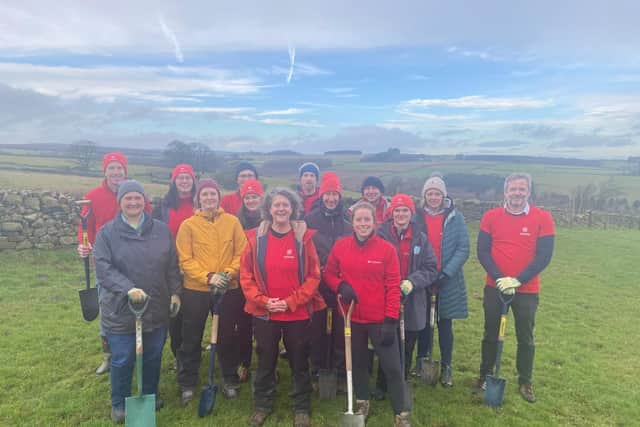
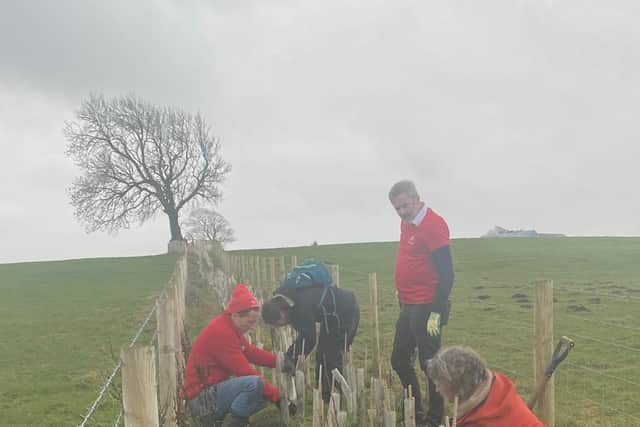
More than an hour’s drive from York, on a farm in Nidderdale, dozens of people have gathered to help lessen the impact of flooding on communities in North Yorkshire and the city.
Tree planting and hedge-laying are the tasks being undertaken today, as part of the government-funded Ousewem project run by City of York Council in partnership with numerous organisations, including North Yorkshire Council, Yorkshire Dales Rivers Trust (YDRT), Natural England, JBA Consulting and the University of York to avert the catastrophic consequences seen in the city and beyond in 2000 and after Boxing Day 2015.
City of York Council’s flood risk manager, Mark Henderson said there had been a huge amount of landscape changes over the last century and Ousewem provides a fantastic opportunity to improve York’s vulnerability to flooding, particularly as we witness the increasing impacts of climate change with more significant and extreme weather events.
The aim of Ousewem is to store as much water as possible on land upstream following heavy rainfall through natural flood management (NFM) schemes that are cost-effective and yield a plethora of benefits, including for nature, water quality and farming enterprises across the River Ouse’s 3,500sq km catchment, which comprises 8,000 properties at risk of flooding.

Mark said: "People in York see flooding on their doorstep and may not realise why it’s happening. This project connects everyone together, not just in awareness, but also physically. The project isn’t just making improvements on the ground, it’s also bringing people into it, hearts and minds, with understanding to influence further up and influence at all levels to transform the landscape.”
David Atkinson, the authority’s director of Environmental and Regulatory Services, said: “The ecosystem here in Nidderdale is of critical importance to what goes on in York. We know we can’t solely build our way out of flood risk in York. Given some of the flood incidents we have had in York over the last 25 years the least we can do as council officers is to do our best to safeguard everybody. Flooding is a critical issue in York and North Yorkshire. This type of activity doesn’t seem to contribute in terms of the balance of the criticality of that, but it does.
"All these little things together help us reduce that risk of incidents like on Boxing Day 2015. We are all working together to make life better for people in York and North Yorkshire.”
Vicky Murray, Ousewem programme and project manager, said: “What we can’t do is bring those properties completely out of flood risk, so we have to limit the impact. It’s about the ability of a city or community to recover more quickly.”
The pioneering programme includes modelling the catchment to identify where flood risk is and where natural flood management can be introduced to provide the greatest benefit to flood risk downstream. Led by JBA Consulting, this includes specialists examining factors such as geological hazards such as former mines and gypsum, and sediment movement.
Vicky said: “We know there are geohazards in the catchment, but they’ve never been modelled from a natural flood management perspective and never at catchment scale. We want an overview of the whole catchment up front when we’re creating the plan of what to do so we know where all the risks and benefits are.”
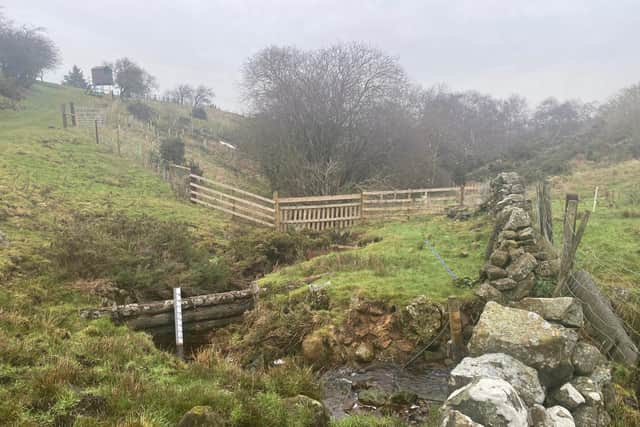
Another key element of the programme, which is being led by YDRT in collaboration with Natural England, includes work on the ground, such as creating scrapes and swales – depressions in the ground to catch water - and re-meandering rivers.
Vicky said: “All of our projects are developed in partnership with farmers and landowners. We work with them to find marginal habitat areas on their land which are less profitable for farming often because they are already wet or flood regularly, to explore what other opportunities there could be. Partnership working is essential because farmers are the long- term guardians of the land and bring deep, practical knowledge of how it behaves and how best to manage it.”
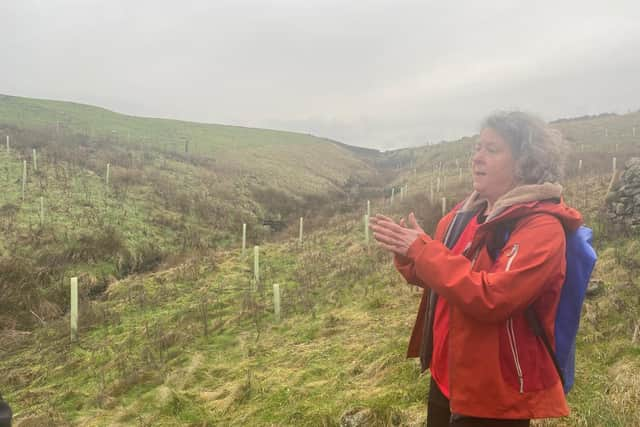
Amanda Crossfield, NFM programme manager for YDRT, said work to store water on land was being carried upstream of places that have flooded, such as Masham, Hawes, Reeth, Bishop Monkton and Hunton.
She said: “Working with farmers and landowners is at the heart of this programme. We have developed clear, practical processes that are designed to work for farmers and fit with how land is managed on the ground. The farmers we have worked with have been really engaged, and there is a strong level of trust because the offer is fully funded, flexible and shaped around their land and their priorities.”
Crucially, where other schemes see farmers and landowners having to pay for schemes up front and claim the money back, with Ousewem projects are funded 100 per cent at cost, meaning it does not impact on cashflow. Ousewem offers farmers modelling, design and contracts that are suitable to them, as ultimately, it’s got to work for their farm.
Vicky said: “We work with partners such as the National Trust and Nidderdale National Landscape and national parks to make those connections with landowners.”
So far, six Ousewem projects have been delivered and another 12 are awaiting planting seasons and getting a range of consents, with more that are in development.
The programme also includes work with the University of York to examine the co-benefits of NFM alongside its primary purpose, flood storage. These include benefits such as cutting carbon, soil health, habitats and water quality.
Vicky said: “The list of benefits is endless, but in the NFM world there has been very little work done to quantify the benefits. Everyone knows they exist, but not to what extent. One of the reasons why co-benefits is important is to understand how we can market natural flood management to future investors.”
In addition, to further understanding of the issue, Ousewem is developing an interactive rivers trail in York and is working with local schools and artists to create a place-based curriculum.
While many NFM schemes are funded by the Environment Agency from a flood risk or water quality perspective and there is some funding available from water firms and charities, generally the amount of funding is limited. Nevertheless, there is an emerging market with green investments, with a lot of interest from pension funds, into habitat and flood management and biodiversity net gain.
Vicky said: "In our project we are looking at how we can quantify the benefits of NFM to in a way that meets what investors are looking for. These funds typically operate at the scale of hundreds of thousands or millions of pounds, while many NFM projects are currently delivered at a much smaller scale. The opportunity is significant. If we can unlock those investment routes, we could deliver many more projects, reduce flood risk, enhance habitat and deliver climate benefits at scale. Developing that mechanism, to connect investment with delivery, is a challenge we are actively working to solve through Ousewem.”