
Oysters released into Humber Estuary in UK first to turn tide of decline

Huge oyster reefs once stretched out into the sea all the way down the East Coast.
The seabed was not the flat, muddy expanse we think of today, but an intricate 3D landscape made up of dead and living shells, crawling with marine life.
“We know there was a really big reef just outside Cleethorpes and it came into the mouth of the Humber," said Cate Holborn, marine communications manager for Yorkshire Wildlife Trust.
“It's difficult to know how accurate the maps are, but that reef went all the way down to the Thames."

The Romans were so keen on UK oysters that they sent them to Italy by boat – Emperors reportedly paid for them by their weight in gold.
During a dig a few years ago a Roman oyster processing site was found near Weeton, on the Humber, with large quantities of misshapen shells showing they may have grown naturally on a reef rather than on ropes.
But by the mid 19th century reefs that had thrived across Europe's coasts were dying off, due to overfishing, pollution and disease.
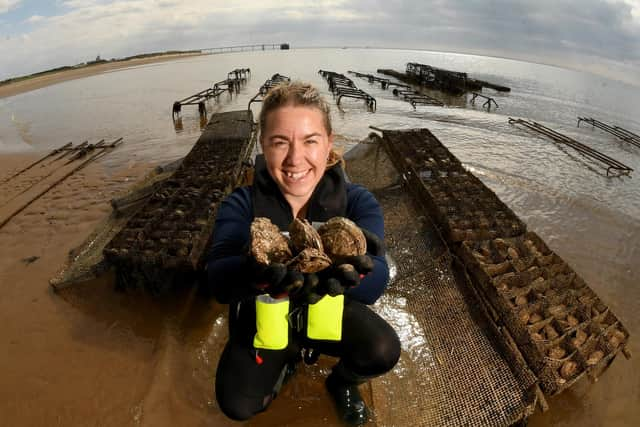
In recent years Yorkshire Wildlife Trust has been doing its bit to turn the tide, and estimate they've now got 3,000 adults as well as 25,000 larvae growing in an area on the estuary side of Spurn Point.
The trust is trying to work out which is the best and most cost effective way to reach their target of 500,000 oysters.
As well as growing oysters on trestles, and placing others directly on the seabed, they're also experimenting with growing larvae on scallop shells.
They began by buying native oysters from fishermen in Loch Ryan, Scotland, a sea loch which has the town of Stranraer on its shores.
These were then placed on the seabed and left "to do their thing".
The trouble was it was really expensive with each oyster costing £2.
They now bring in larvae from a hatchery at Aultbae, on the shores of Loch Ewe, in the north west of Scotland, which can travel in a small box.
The larvae, which are smaller than a grain of sand, are then seeded onto scallop shells, to provide a source of calcium carbonate which they need to build their protective shells.
Cate said: "We have these big tanks full of salt water, and an airflow, with the scallop shells at the bottom and the water constantly swirling.
The oyster larvae have a little foot that helps them swim around and detect the calcium carbonate in the shells.
“They attach themselves and live there for the rest of their life."
On Wednesday (Jul 30) the team was out placing the scallop shells in an area called Greedy Gut, a collapsed mussel bed, where there's water at any state of the tide.
Cate said large-scale marine restoration was still in its infancy: "We are still studying what the best ways are to look after our marine ecosystem. This project is a big step in the right direction for large-scale marine restoration in the future.
“The project runs until 2027 and we're looking for funding to keep going. We will do another release next summer.”