
Partnership between landowners could see 300,000 trees planted on moor by 2029
The wild and windy expanse of Marsden Moor is not renowned for its woodlands but that could all change thanks to a conservation programme.
Those looking out across the moor in West Yorkshire these days will see clough valleys studded with pale green tree tubes, each housing two-year-old saplings – a whopping 65,000 new trees that have been planted this year.
In 20 years, it is expected these trees will have grown into montane woodlands full of oak, birch, hazel, rowan and holly, creating wildlife-friendly corridors through the cloughs across the moor, boosting biodiversity and helping to mitigate the effects of climate change.
They represent the first stage in Landscapes for Water, a joint project for the National Trust and Yorkshire Water – the region’s two biggest landowners - that will plant an estimated 300,000 trees over 5,500 hectares of the South Pennines in the next four years.
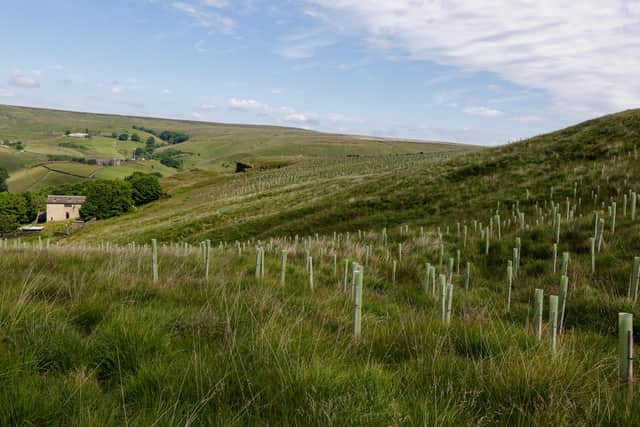

As well as providing new native habitats for wildlife, these trees are intended to provide natural flood defences.
Last year, a report by Forest Research showed that woodlands were worth more than £400m annually in protecting communities from flooding, by helping to slow the flow of rainwaters.
Hazel Earnshaw, lead countryside and woodland advisor at Yorkshire Water, said: “Trees are fantastic for helping us to deliver natural flood management. They intercept the water before it hits the ground. That really helps us to both alleviate flooding but also helps us with water quality.”

These aren’t the first woodlands to be found on these South Yorkshire moors. Archaeologists have found fossilised tree stumps on Marsden Moor, revealing a wooded landscape dating back the Mesolithic period (c8000-4000BC). However, in the centuries since many trees have been felled for building or charcoal burning, while the peat of the moor has been denuded by industrial pollution.
The new trees will form part of the White Rose Forest, the Community Forest for North and West Yorkshire, and have been funded by the Trees for Climate grant programme, part of the Government’s Nature for Climate fund.
Landscapes for Water will also include the installation of 3,500 natural flood management leaky dams (funded by the West Yorkshire Combined Authority) – natural barriers so that when storms occur, the water running down is held on the moorland for as long as possible, reaching downstream communities more slowly – and the implementation of large-scale peatland restoration.
Natural interventions are thought to be vital when dealing with the degradation of the landscape, which – as weather events become more extreme – have led to issues with fire and flooding around the South Pennines.
Simon Lyes, from Colne Valley Tree Society, added: “The work that’s been done so far is really impressive.
"Our little group has done 400 or so tree planting sites up and down the valley in the last 40 years, but to be involved in something on this scale has been really quite exciting.”
Landscapes for Water aims to improve upland habitats across our land in the Upper Calder and Colne catchments in the South Pennines.
It has been set up thanks to funding and support from West Yorkshire Combined Authority and the White Rose Forest (Trees for Climate Fund).
Tracy Brabin, Mayor of West Yorkshire, described the work on Marsden Moor as “important and meaningful” during work earlier this year.
The trees planted will form part of the White Rose Forest, the community forest for North and West Yorkshire, as well as the larger Northern Forest project from Merseyside to the Yorkshire coast.
Project lead for the National Trust, Jess Yorke, said: “The completion of phase one and the planting of 65,000 trees feels like a milestone in what we are trying to achieve with Landscapes for Water.
"By creating these clough woodlands we are turning back the clock in ecological terms, and hoping to protect the landscape for people and nature for centuries to come.”
In a National Trust video released to promote the work, she adds: “Many of us feel really, really frustrated that we are powerless and can’t do anything about climate change but what this project offers is an opportunity for the local community to get involved and be part of the fight.”