
Saltmarshes: Yorkshire researchers warn on looming loss of vital carbon sink and wildlife havens
Formed as mud and silt are washed onto the land by coastal tides, the UK’s saltmarshes are thought to store around five million tonnes of carbon.

As well as being an important habitat for wildlife, the sites are able to sequester CO2 from the atmosphere, much in the way that forests or peat bogs do.
But the UK’s salt marshes are at risk. As sea levels rise due to global warming, saltmarshes can become inundated by seawater, effectively drowning the sites. Saltmarshes have also been lost as land is claimed for agriculture.
Researchers in Yorkshire, therefore, are now warning of the major impact that future losses of salt marshes could have for both carbon emissions and biodiversity.
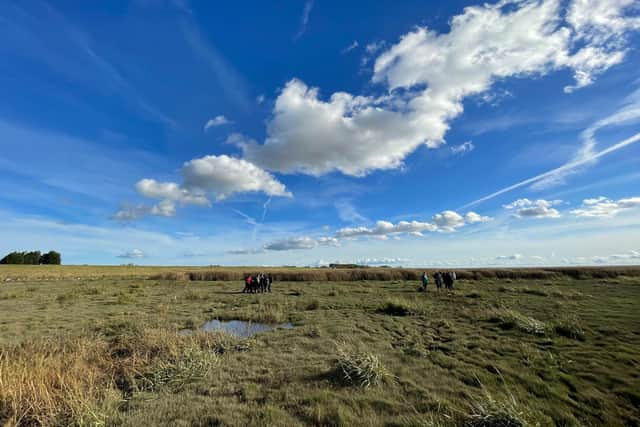

“Salt marshes provide a whole range of different benefits to the natural world and to human populations,” says Ed Garrett, assistant professor in Physical Geography in the Department of Environment and Geography at the University of York.
“This ranges from being an effective flood-defence mechanism – storing water during flooding – to reducing the energy of incoming waves, thereby reducing coastal erosion. They provide a biodiversity hotspot as well, and are much more biologically productive than some other coastal environments.
“But salt marshes are much more rare than they used to be. We now have about 450 sq km, but if we go back to the mid 1800s we had about 3,000 sq km of salt marsh.
“The Humber is really depleted in its salt marsh area. Only two per cent of the Humber estuarine area is currently salt marsh, and that's against a national average of six per cent of estuarine areas, so the Humber is much lower, there are only a few small fragments left.”
Garrett was one of several researchers to work on a paper published late last year on the role of saltmarshes in storing and sequestering carbon.
The research found that the UK’s salt marshes currently store around 5.2 million tonnes of carbon. Should these habitats be lost, however, that carbon is at risk of being released.
“When we’re talking about protection of saltmarshes, the biggest thing that could be done is to act on the climate crisis and address the causes of current sea level rise,” says Garrett.
“If we experience more rapid rates of sea level rise and continue to encroach on to saltmarsh area, we’re going to see a loss of the carbon that is stored.
“So rather than these places being an important store of carbon, they're going to become another emitter of carbon, compounding the UK’s greenhouse gas emissions, rather than being a valuable component in the effort to address greenhouse gases.”
Salt marshes are also home to a number of what Garrett describes as the UK’s "charismatic" wading birds, including oyster catchers, curlews and avocets, which use saltmarshes for foraging and roosting.
Though the UK has faced a huge drop in the number of saltmarshes it plays host to over the last 200 years, work is being done to protect and rebuild the sites.
A number of managed realignment schemes, which are designed to create new coastal habitats, are ongoing across the UK – including in the Humber – while Welwick Saltmarsh, in East Yorkshire, has been deemed a Site of Special Scientific Interest. Many salt marshes, however, still face wider risks.
“Building new salt marshes is one aspect, but the important thing is protecting the existing ones,” says University of Leeds-based professor of environmental change, Natasha Barlow.
“Salt marshes will build up sediment as the sea-level rises, but only to a certain degree. Eventually we can get to a position where sea level rise outpaces the rate of saltmarsh, and in that case we're going to have to actively encourage saltmarshes to migrate in land if we want to preserve them. If we had no sea walls or cities or farmland, the salt marshes would eventually move upwards, but the reality is that it's quite hard for them to do that in the modern day."
The CO2 release which would occur if salt marshes are overrun by water could also have wider global implications.
“If a salt marsh is flooded, eventually it will get eroded by ocean current, meaning that carbon then gets released into the ocean,” says Barlow.
"That can then be released through things like bubbles or seaspray into the atmosphere. When more carbon is in the ocean we can also end up with ocean acidification, and that's where we hear about things like coral reef deaths.
“This is why we need people, charities and the government to all come together and protect salt marshes, and say they are a priority.”