
The two Yorkshire villages joined by a historic Grade II-listed bridge
Despite sitting atop a ridge measuring just 41m tall, Ainderby Steeple’s church and tower, after which the village was named, can be seen across the vast and flat agricultural hinterland surrounding it and its almost conjoined neighbour Morton on Swale.

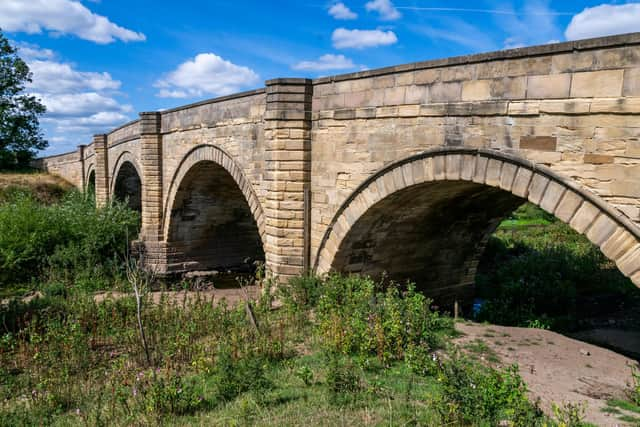
Withstanding this, at the villages’ gateway from the east stands its most memorable landmark, the four segmental arched Morton Bridge, created by Buxton Crescent and Harewood House architect John Carr at the turn of the 19th century.
Carrying the busy A684 between Northallerton and Wensleydale, an estimated 12,000 vehicles a day pass through Ainderby Steeple and Morton on Swale and over the bridge, which is subject to periodic closures, mostly due to flooding of the land and highway to the west of the bridge, which represents the only crossing of the River Swale between Great Langton and Skipton on Swale.
Locals have blamed authorities for leaving the arches thick with silt and debris, creating a dam-like effect.

Earlier this year electronic flooding warning sign installed at Warlaby crossroads, just to the east of the villages as part of a drive to cut traffic rat-running through surrounding villages.
Nevertheless, the parish council has heard while the average speed of cars in Morton on Swale was 29.9mph, the volume of traffic going through the village, dangerous overtaking and aggressive driving remains an issue for residents, as does the pumping station and storm overflow operated by Yorkshire Water beside the bridge, which has discharged into the twice this summer.
Overlooking what Northallerton Angling Club describes as “one of the best stretches of the River Swale”, the Grade II-listed structure has proved costly for taxpayers in recent years, having also been closed to repairs numerous times after being struck by vehicles.
Nevertheless, the villages have an equally impressive landmark at their eastern entrance.
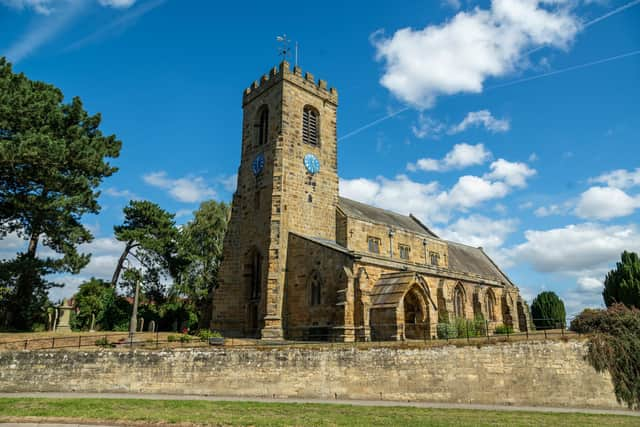
The 14th century St Helen’s Church and its steeple are Grade I-listed, placing it among the country’s most architecturally important ecclesiastical buildings.
Its local importance is underlined by its custodians illuminating the landmark at night to “make a welcoming sight to anyone passing through the village”, which has developed on the main route between county town Northallerton and Wensleydale.
Near the church there’s a cast iron late 19th century North Riding of Yorkshire milepost inscribed 'No Allerton 3' and 'Bedale 5, Hawes 33’.
Fashioned from coursed, squared stone and ashlar with graduated slate and lead roofs, the church’s three-stage west tower has clock faces to the west and south.
Inside, alongside three-bay arcades dating from when the church was first built, its treasures include a carved octagonal font of 1662 in the chancel, while benches near the nave’s west end have small panels of Jacobean decoration.
The church’s tradition of celebrating craftwork has continued with it being used for Morton Quilters’ charity exhibition.
The churchyard has gravestones to the last of the celebrated Victorian Booth Shorthorn breeders, Thomas Christopher Booth.
The Royal Agricultural Society’s show in 1868 saw his Lady Fragrant and Commander-in-Chief both named breed champions.
Nearby is the grave of Major William Henry Fife-Cookson, who called home nearby Georgian country house Langton Hall as well as Wykeham Abbey, near Scarborough.
Outside the Anglican church three Yorkshire Regiment privates, two identified as teenagers, killed during the First World War are honoured on a delicate memorial cross which Ainderby Steeple shares with Morton on Swale, which saw a rise in non-conformism during the 19th century.
On the southern side of the A684 a former United Methodist Free Church, built in 1879 and closed to worshippers in 2002, continues to serve as a focal point after being converted into a home.
On the north side of the main thoroughfare there’s a red brick former Wesleyan Chapel with a Welsh slate roof, dated 1815, which has been repurposed as the village hall, the main hall of which has a capacity for 70.
It’s a hugely popular venue for numerous regular groups, such as fitness classes and another dedicated to cultivating hardy plants.
Nearby, the Old Royal George Inn has served as a key community venue for more than 100 years. Alongside offering classic pub meals, the community-focused inn stages regular community events, quiz and live music nights.
Despite being more than 30 miles from the nearest coastline is named after the HMS Royal George, the largest warship in the world at its launch in 1756, which sank just 26 years later in a catastrophic accident with the loss of around 900 lives.
Ainderby Steeple’s pub, the Wellington Heifer, opposite St Helen's Church, is said to be haunted the ghost of an 18th century pedlar murdered by the landlord, which switches off lights and rattles chains.
With an autumn menu including spicy lamb and venison meatballs, the historic inn boasts panoramic views across fields to the River Swale, a 50Kw charging point for customers with electric cars.
While residents have Northallerton’s array of shops within a short drive, Morton on Swale has retained a village store which sells award-winning ice cream, with flavours such as Jammy Dodger and bubblegum proving popular with some of the younger villagers.
Remarkably, Morton on Swale has two schools.
Ainderby Steeple Church of England Primary School has recently achieved the an award in recognition of its whole-school approach to food, emotional health and wellbeing.
Meanwhile, The Dales School, a co-educational special school for children with severe and complex learning needs, has seen Ofsted inspectors conclude pupils are "well cared for and happy" and note that pupils "experience a highly personalised curriculum".