
The Yorkshire project on an ancient island which could take 3,000 years to complete
On an ancient island in Hatfield Moors, volunteers are helping to restart a process of peat formation that will take millennia. Alex Wood reports.

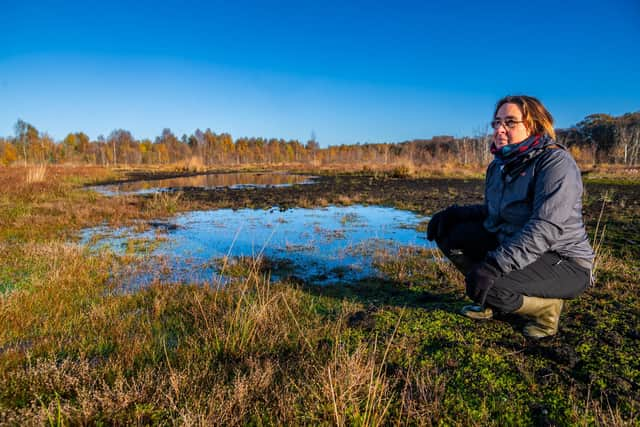
On an ancient island in the heart of Hatfield Moors, a fascinating project which aims to get peat growing again on the surrounding moors is ever so slowly taking shape.
Volunteers say the project could take more than 3,000 years as peat grows at a rate of just 1mm a year.
Ecologist Louise Hill is one of the volunteers at Gomde UK, a Buddhist meditation and retreat centre on Lindholme, founded in 2009 by Tibetan Buddhist master Chökyi Nyima Rinpoche.

Gomde began with a small group of students inspired to create a place to study Buddhism, practise meditation and spend time in retreat.
However, they found themselves caring for 120 acres of woodland, meadows and rare peatland within the Humberhead Peatlands National Nature Reserve, alongside historic buildings in considerable need of repair.
Seventeen years later, the estate has grown to 180 acres, with more than 70 volunteers helping to care for it.
Together, they have transformed buildings in poor repair into a meditation hall, dining hall, café, and accommodation. Some volunteers organise meditation and retreats while others cook, garden and maintain buildings.
On Saturday, their work was recognised by The King’s Award for Voluntary Service. Paulette Benjamin, founding trustee of Gomde UK, said: “This award belongs to everyone who has given their time, knowledge and care to Gomde over the years.”
Lindholme Hall stands on a pile of debris left behind by a retreating glacier. For thousands of years the island was surrounded by treacherous marshland. In modern times, almost all the original mire surface was stripped by commercial peat milling until the government bought out the rights 20 years ago.
Luckily, a fragment of moor, with one-metre-high cushions of sphagnum moss, was preserved by the Hall’s last resident.
Jack’s Piece was brought by the charity with contributions from local conservationists. It is this which is providing a source to grow more moss and restart the cycle of peat growth.
The moss doesn’t have roots and grows on a watery surface, creating its own acid environment – peat is essentially pickled moss.
Louise explains that they get a few handfuls of moss and grow it in polytunnels, on floating trays covered in bracken compost and with capillary matting which wicks up the water and keeps the moss wet.
The site is on a raised mire – a dome-shaped peatland that is four metres higher than the surrounding landscape.
“We’d been trying to hold water on a hill,” she says. “The Hall is like the centre of a polo mint, surrounded by 1km in every direction by raised mire.
"In the 1980s you’d come to the island on a causeway, and it would have been flat, dry, brownish-orange peat.
"Now you can see water, cottongrass – but it hasn’t got sphagnum moss, which is the peat-forming plant, the real carbon-sequestering plant.”
This year, they helped plant 2,000 sphagnum plants on damaged parts of Hatfield Moors. “For it to return to the bog we had before it was destroyed will take more than 3,000 years,” she said.