
Warning not to ‘overlook’ the north as study reveals stark air pollution disparities
A Yorkshire scientist has called on the Government not to “overlook” the North of England, after a new study revealed the stark contrast in the levels of air pollution faced by different groups across the region.

New research from the University of Sheffield found that low-income and ethnically diverse communities in post-industrial Northern English cities face up to 33 per cent more air pollution than their neighbours in wealthier areas.
The figure is more than double the national average disparity of 15 per cent between low-income, ethnically diverse communities and wealthier urban areas, suggesting environmental health inequalities may be more pronounced in some Northern cities shaped by industrial development.
The research shows that residents in these communities face significantly higher levels of nitrogen dioxide (NO2) air pollution – primarily caused by vehicle emissions.
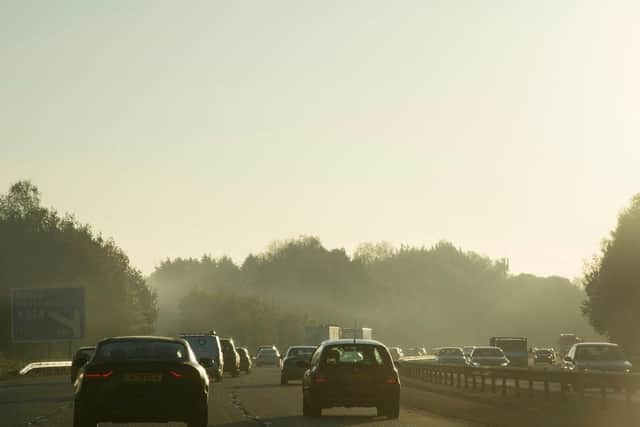

Long-term exposure to high levels of NO2 can be fatal, according to researchers, with proven links to cardiovascular and respiratory diseases, while short-term exposure can worsen existing conditions such as asthma and many other respiratory conditions.
Speaking to The Yorkshire Post, Dr Maria Val Martin, an UKRI Future Leaders Fellow and atmospheric scientist at the University of Sheffield, who worked as lead author on the study, said that she felt Northern cities had been “overlooked” in efforts to solve pollution issues.
She said: “My message for the Government would be, do not overlook the North. We want to have fair, healthier, greener cities across the country.
“Looking at funding to support city councils and local authorities, most of that funding has gone to the South. That's why some of these differences throughout history have been more pronounced.
“It's not just about the industrial legacy, or how these cities evolve, but the cities in the North didn't have the same support to evolve in a greener, healthier or fair way, compared to other cities in the south. I feel like the North has been overlooked.”
Dr Val Martin also called for the individuality of citites to be taken into account when looking at solutions, and a step away from “one-size-fits-all” sollutions”
The new study compared major Northern cities which have an industrial legacy with regional cities and towns which have a rural background.
Cities with an industrial background included Leeds, Sheffield and Manchester, while those assessed with a more rural background included Lincoln, Carlisle, Scarborough and Durham.
The study found that diverse communities in urban areas in major cities have the highest overall levels of air pollution and poorest access to good quality green spaces. In contrast, this disparity was far less pronounced in cities with rural histories, which showed no strong link between ethnicity, income and air pollution levels.
In Leeds and Sheffield, NO2 levels were over 40 per cent higher in low-income and ethnically diverse neighbourhoods compared to more affluent areas. In contrast, in regional cities and towns like Durham or Scarborough, these inequalities were weak or absent.
Researchers believe that this inequality has in part come about through housing becoming affordable in historically polluted neighbourhoods.
Dr Val Martin added: “During the industrial revolution, housing for workers was built very close to factories and major transport routes.
“The reason that we end up here today is because in these urban neighborhoods, in these industrial cities, this is where housing became affordable. That's the reason that low income and more ethnically diverse communities were able to afford housing there, but the industrial air pollution and the low density green space are still there.”
The study also found that while green spaces like parks and recreational grounds are present in low income and diverse areas, they are often located near busy roads or air pollution hotspots. Researchers said these environmental conditions, combined with an overall lower density of vegetation, significantly undermines their potential health benefits.
In response to the study and Dr Val Martin’s comments, a spokesperson for the Department for Environment, Food & Rural Affairs said: “Air pollution is a public health issue, and we are taking action to tackle it across the country.
“We have provided Local Authorities with £575m since 2018 to improve air quality, and we continue to work with them to cut harmful emissions and reduce everyone’s exposure to air pollution.”
The study was also worked on by the University of Sheffield’s Leah Holland, who began part of the analysis during her Masters in Biology dissertation in the School of Biosciences, and Paul Brindley from the School of Architecture and Landscape.