
'Whitby was considered for evacuation' - Firefighter reveals scale of impact 15 months on from Fylingdales Moor blaze
Fifteen months after the devastating fires on the North York Moors, the issue is under scrutiny at the UK Wildfire Conference at Headingley Stadium.

With tank shells exploding, billowing smoke limiting visibility, plans being made to evacuate nearby towns and brave souls being ordered to retreat from the frontline, it would be easy to mistake the scene for a Second World War movie.
But rather than a recreation of the 1944 Battle of the Bulge, this was the scene on the North York Moors in the summer of 2025 as described by one of the firefighters leading the response to what became one of the largest wildfires ever recorded in England.
Fifteen months on from an area the equivalent to 2,520 football pitches being devastated, North Yorkshire Fire and Rescue Station Manager Nick Allenby is standing before several hundred UK Wildfire Conference delegates at Headingley stadium, and it’s clear his memories of the traumatic incident are still raw.
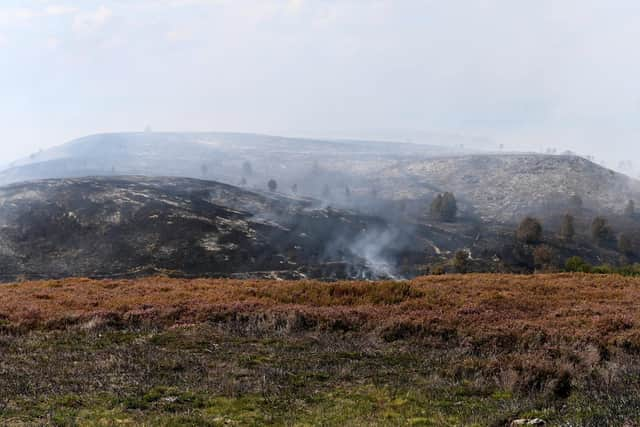

You can hear a pin drop in the huge room overlooking the hallowed cricket pitch as he explains how a known fire, contained in an woodland near Fylingdales that Forestry England said it was monitoring, rapidly got out of hand.
“Things changed”, he said. “Things started blowing up. A few days into the incident we had the first big explosion on the moorland.
"It turned out that it was an old War War Two tank firing range. Tanks would park up several kilometres away and fire shells at this moorland for practise.
“If we’re getting bombs going off on the moorland we go into defensive tactics.
"We couldn’t be offensively tackling that fire any more, so we were retreating to forestry tracks and other tracks just to try and put a perimeter around it.”
Mr Allenby said the shells had laid unexploded below the surface of the Fylingdales moorland for 80 years, despite regular controlled burning of the heather.
“We’d had heatwave after heatwave into drought. The peat was very dry,” he said.
“The shells that were exploding were the ones that sunk into the peat and historic fires have just burned across the surface.
"Fires now are burning into the peat, getting deeper, 200 degrees these shells were exploding.”
During the wildfire firefighters recorded 22 explosions, some of them “quite substantial”.
“I think there were many more that didn’t get recorded,” said the experienced firefighter and wildfires advisor.
He said with the wildfire taking hold at the height of a busy summer for the fire service, it very quickly became overwhelmed, and started “spilling into other services for support”.
Mr Allenby said: “Luckily, they could provide it. Already we’re looking at an incident with huge challenges for us.”
The wildfire was declared a major incident on August 13 as it closed in on designated Critical National Infrastructure at the RAF Fylingdales, which provides a continuous ballistic missile early warning service to the UK and US governments. Helicopters, drones and coastguard planes were called into action.
Asked what had saved the landmark radar station, Mr Allenby said bulldozer-created fire breaks outside the Snod Hill base, which along with a timely change of wind direction and large volumes of water proved successful in halting its advance there.
However, as the area around the base is also designated as a Site of Special Scientific Interest, it will have to be restored, so the Ministry of Defence will have to look at other options for managing wildfire risk in future, Mr Allenby told the delegates, adding: “They are fully on board with it now afer what was a huge scare.”
He said a key area for improvement would be getting sufficient volumes of water at the earliest possible stage to extinguish fires.
While using sea water again to wetten areas has been ruled out due to the damage it causes, Mr Allenby suggests the use of domestic wastewater that does not contain human waste might be worth exploring.
While the fire service had relied on historic data about how much water was needed for moorland fires, intense wildfires require up to four times the volume, he said.
“Go harder, go faster, more water would be the big takeaway," Mr Allenby said before revealing the fire service has since established contracts with water suppliers to get large tankers promptly to any incidents.
“So the future is looking a lot better for these remote incidents.”
Neverthless, on the August bank holiday, he said, the outlook appeared bleak as catastrophe struck.
Firefighters were defending a 3.2km northern boundary along a track, by cuting and wettting. The fire breached a small section of that line by mid-afternoon.
It “managed to sneak through, got onto the unburnt moorland and then it ran away”.
Mr Allenby said: “The next 10, 12 hours the rate that fire spread was incredible, and I’ve been fighting fires up on the moors for many years.”
He describes rapidly moving fire fronts with huge flames as an “amazing” and “quite frightening” spectacle, as well as being “unpredicable” due to changng direction with the wind.
“There were loads and loads of people chasing it across the moorland, voluneers, farmers”, he said, adding the amount of support that was provided by landowners and farmers had yet to be calculated.
“Could we have managed without that support? Absolutely not. We can’t keep blindly relying on that support without knowing what it is.
"I couldn’t put a figure on it but the support we received was incredible. From a fire and rescue point of vew, we cannot put fires on this scale without that sort of support.”
As the fire spread more challenges emerged and hidden costs mounted. Mr Allenby highlighted the impact on children who saw their parents going out to fight the fires.
“It must have been terrifying for them. Those are the impacts you can’t put a figure on.”
The fire was pushing towards Anglo-American’s Woodsmith mine, a multi-billion pound enterprise with several million pound a day running costs.
“Two o’clock in the morning we had to shut it down and evacuate it. Had they done all their pre-planning, had they considered that wildfire risk from the outside coming towards them?
"Probably not, so [I would] encourage industry to start lookig at that.”
Mr Allenby said the operation remained in a reactive phase. Holiday-makers were evacuated from caravan sites were as tactical coordinating groups set up evacuation cells for some of the coastal towns and villages.
“Even Whitby was considered for evacuation," he said. “It didn’t need evacuating, but work went on for planning it, huge pieces of work were done for that.”
The complexity of tackling the wildfire increased as it spread to woodlands.
“For me, witnessing in the north of England fires hitting forestry blocks, trees then torching and then crowning through forestry was quite incredible,” said Mr Allenby.
“Things are different now with these wildfires and with climate change. Very challenging to fight forestry fires - we don’t have the equipment to do it.
"These forests were grown on peatland, so as the fire dropped down to the surface the peat burns and exposes the roots. With a little bit of wind trees were falling down.
"Far too dangerous to be committing crews in. Again we are defensive firefighting.”
While smoke from the wildfire impacted significantly on some villages and led to road closures, leading to reports of acrid smells and pollution impacting on residents as far as the outskirts of Leeds, about 60 miles away.
Mr Allenby said during the 40-day wildfire, the fire service’s control room staff were “getting hammered with calls” from near and far.
“People phoning up saying ‘cant breathe, you need to put the fire out’.”
In the end more than 25,000 tonnes of peat carbon was lost.
The scale and length of the incident, the conference was told, underlined the significant increase risk of wildfires across the country.
The conference, which came just days after the closure of a government consultation over moorland management, then heard how a vegetation management study had exposed the impact of the government’s recent extension to the ban on controlled burning over peat.
“It’s very clear to see the correlation between areas that were managed and areas that had the lowest burn intensity.
"It’s been estimated over 7,000 tonnes of carbon was saved due to vegetation management on that site,” said Mr Allenby.
Asked about the impact of the ban, he adds: “There are always going to be barriers. We need to find cleverer ways to overcome them.
“We’re not ready for next year, but we are in a better place.”