
‘You can’t escape the impact’: Leeds research team working to understand impact of huge Borneo wildfires
A team of researchers led by the University of Leeds are braving extreme conditions in Indonesian Borneo as they work to assess the consequences from a huge swathe of peatland fires currently impacting the region.

According to satellite platform Nusantara Atlas, an area spanning around million hectares – roughly half the size of Wales – was impacted by fires last month in Indonesia, with the fires still ongoing both above and below ground.
Having travelled to the region earlier this month, a team of researchers are now working to understand the impact on air quality and how deep the peat fires have burned into the soil.
“This is quite a record-breaking year in terms of recent history. I don't think people expected to have another year as severe,” said Dr Ailish Graham, an air quality and wildfires research fellow at the University of Leeds, who is coordinating the team from the UK.
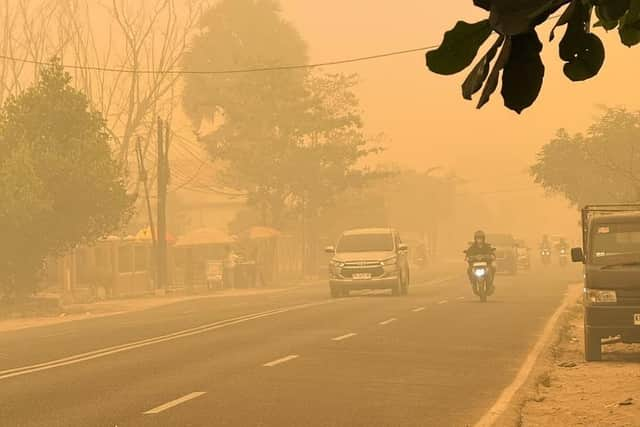

“People in that area, we know when they go inside their homes, they can't escape the smoke. The smoke goes inside their houses, so this is the kind of conditions that they're living in.”
While the situation has been worsened due to this year’s El Nino, Indonesia's Central Kalimantan is particularly susceptible to wildfires due to the impact of a major 1990s agricultural project.
The Mega Rice Project deforested and drained around one million hectares of peatland in a bid to create fertile ground for rice growing, using drainage canals which if combined would span the entire length of Europe.
Described by Dr Graham as “one of the biggest environmental disasters," the project failed due to the high acidity of peat soil, leaving in its wake swathes of dry and highly flammable land.
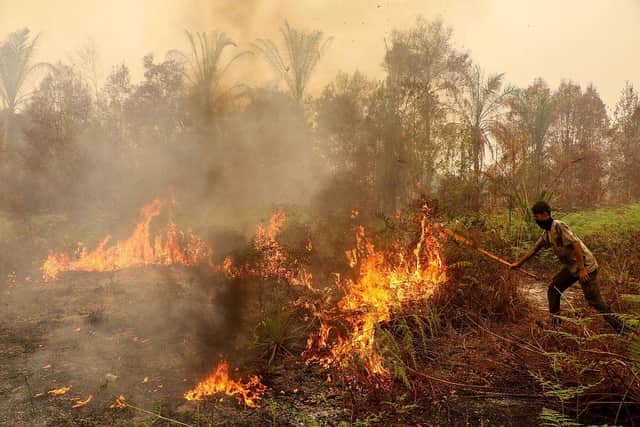
Peat is a major store of carbon, having built up over thousands of years, meaning when it burns, the stored carbon is released into the atmosphere, creating an even greater impact on the environment.
The dryness of the peat also means that when fires do happen, they burn for longer and are harder to put out.
“Peat fires can burn into the soil, and that means that they smolder for a really long time and emit a lot of pollution,” says Dr Graham.
“So you just start with a surface fire above where this ash is, and then the surface fire will go out after like probably a day or so, once all the vegetation above it has burned. But then the fire starts to then propagate downwards into the soil, and it can burn down to easily 50 centimeters if it's dry enough, and it'll burn for weeks on end. It's very hard to suppress when you spray water on the surface.”
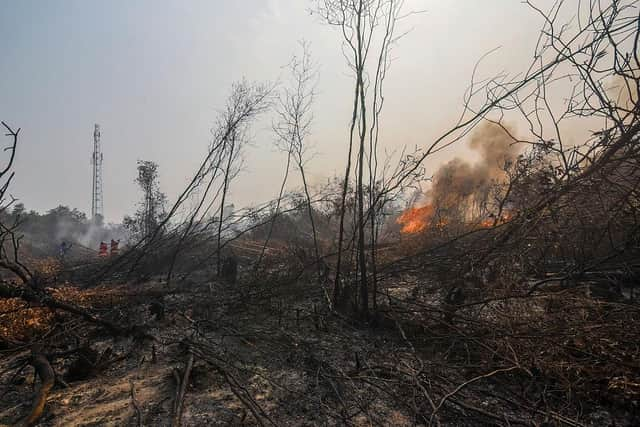
This is the situation currently impacting large parts of Indonesian Borneo, creating clouds of smoke which not only impact visibility but have the potential to severely impact the health of those living amongst them.
According to Indonesia’s health ministry, over 330,000 residents have had accute respiratory illnesses since the middle of August, up from 280,000 a week prior. But as well as immediate affects, it is also believed that smoke inhilation can cause longer-lasting issues.
Sensors put in place by the research team have shown that concentrations of PM2.5, microscopic particles linked with many health conditions, are currently over 13 times over what the World Health Organisation deems to be safe. The team roughly equates this to smoking around 18 cigarettes a day.
“Usually people associate air pollution with health conditions such as asthma,” says Jim McQuaid, a professor of atmospheric science who is part of the team working in Indonesia.
“However, smoke from fires also produces tiny particles that are less than a micron in diameter, much much smaller than the width of a human hair, meaning they have the ability to penetrate deep into the body.
“As you breathe them in, they enter into your lungs and cross into the bloodstream, and the smallest particles can cross what medics call the blood-brain barrier .It's estimated that in the UK alone, the cost of dementia care associated with air pollution is many billions of pounds a year.”
But as well as the invisible impacts, evidence of the fires is also clearly visible to the naked eye.
“You can't escape the impact of the fires and the smoke concentrations in the city,” says Mr McQuaid.
“It gets dark quickly because we're so close to the equator, but the smoke means it gets darker even quicker. We spend our lives outside living in an atmosphere that just smells of smoke, and everywhere you look is hazy.”