
Farm of the Week: The organic Yorkshire enterprise that is sticking with tradition
Eggs with special taste, from hens that live all their lives on farm, cows still milked in a six-abreast, sixty year old parlour receiving that special touch, a combine harvester that is 52 years old and a selection of elderly tractors, that’s how the Gibsons roll at Priest Garth Farm in Gillamoor in the North York Moors.

“We hang on to things as long as possible,” says John. “We seem to manage very well, the elderly tractors are repairable unlike modern ones. I enjoy going gently through life with them. I have three John Deere 3050s 2850 from the 1990s, two Internationals that are even older, and a New Holland 1530 combine harvester that’s just nicely run in now.
It is daughters Ruth and Rachel, who are largely responsible for the direction in which the farm is heading today with a herd of 50 dairy cows and currently 145 laying hens.
“We have a little shop,” says Eileen, John’s wife, who shares her husband’s humour. “Actually, shop is a bit of an overstatement. It’s a clapped out shed we fondly call a shop. We’ve a milk vending machine, we’ve two mini fridges, we sell people bottles if they want them and all we sell are eggs, milk and milkshakes.

“We’ve only been doing it a couple of years and to start with summer and weekends were a bit busier than other times but lately it’s just busy throughout, and we can’t squeeze the hens fast enough (that’s Eileen’s humour, not for real!).
John switched the farm to organic 20-plus ago and their social media page on Facebook is under their locally-known name Gillamoor Organics. John tells of how the farm has changed.
“My parents John and Ann Gibson first came to Manor Farm in 1950, where my brother Adam farms today. They were tenants and later bought the farm. In 1990 it was divided between Adam and I.
“Eileen and I had built our own farmhouse in 1977 and when the farm was divided we became Priest Garth Farm with 120 acres and then bought another 11 and rented some more.
“We were more of a traditional mixed farm growing cereals, seed potatoes and with only a small number of dairy cows, but today it is the cows that are the main thing and 85 per cent of our milk goes to Organic Herd, what used to be known as OMSCO that sells organic milk very well.
“All four of us are partners in the business and have been for quite a lot of years. Ruth and Rachel do all the dairying, looking after the cows, Ruth is expanding her hen flock and I do tractoring because I still enjoy driving elderly tractors that all still move, just.
“We keep growing enough cereals to feed the cows and in the last four years I’ve started growing organic rye which suits our organic system very well. It gives a good yield and I manage to sell some to the organic mill at Spaunton. We have a six year rotation of four years grass, two years cereals.
Rachel came back home twenty years ago, after having studied at Huddersfield University and having lived in Leeds.
“I drifted into the farm,” says Rachel. “Dad was getting quite tired of milking by then and found that I liked the cows. I hadn’t been particularly ‘farming engaged’ when I was younger.
“We now have around 50 cows in the herd, but I’m probably only milking around 40 at the moment. Overall we have around 75 including youngsters for the herd in future. Our base is Ayrshire. We went from Friesian to Ayrshire when we went organic, buying in from top Ayrshire men James Waterhouse at Fourth Milestone, from David Brydon from Hackness and Geoff Riby of Low Stonehills, all before I came back to the farm.
“I learned to AI. In the last five years I’ve started breeding the Dairy Shorthorn. We are still mainly Ayrshire with Dairy Shorthorn and five Friesians. We had one Friesian cow left from when the herd that had been at Manor Farm from grandpa’s original herd and so I bred her to a Friesian bull, and the five we have are all called Eileen.
“I love our small milking parlour because if I see a problem with a cow I can treat her in the parlour at milking time which is a lot less stressful for her. You couldn’t do that in a more modern set-up. It was handmade by Otterburn’s at Harome and was on a farm at Marton before we got it.
“Our herd average is only about 5000 litres but we are quite low input. Our cows are still going out during day in October, but more to air their udders and give that enrichment, they’d be very annoyed if they weren’t getting silage.
Rachel says their organic pasteurised whole milk contributes to Ruth’s magnificent eggs but that they taste really special because of Ruth’s special care of her chucks.
Ruth returned to the farm after having worked in Greece, Spain and York.
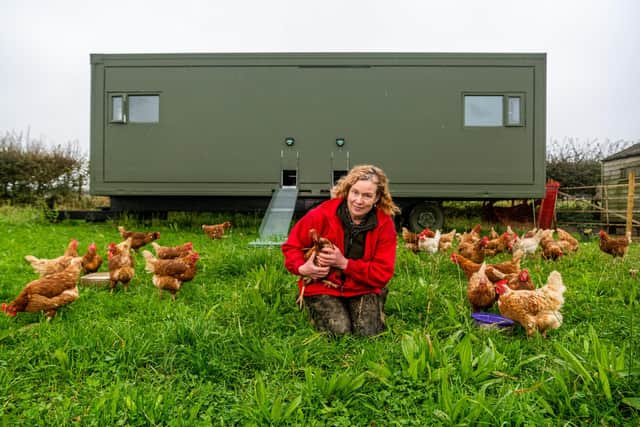
“I came back when my eldest son started school and after starting with just ten hens of different breeds fifteen years ago I soon found that keeping hens is quite addictive. I kept having to buy hen huts. We’ve just got our sixth.
“The first was only 6ft x 5ft and could house 16 organic hens. The latest one is 28ft x 8ft and is very ‘hen des res’ and will house 124 hens. I’ve about 145 hens at the moment but with this new one I’ll have capacity for 288.
“We also now have an egg packing room. I could only sell in our own farm shop or my own gate at Fadmoor until now, but now the egg packing centre just approved by Environmental Health and the Egg Marketing inspector means I’m now ready to sell eggs to other businesses as well.
“My hens are now largely Lohmanns, but with a few white leghorns and a very old cream legbar. I never cull my hens. They all carry on living here even if they are not laying. I’m currently getting more than 100 eggs a day.
“They eat layers’ pellets and have home milled meal, but their favourite is they have 20 litres of milk a day from the dumped milk and it really does make the eggs taste sublime.
John says he always saw his working life being on the farm, but he did try a different career for a while, in conjunction with farming.
“I wanted to expand my horizons and around 2000 I trained to be a psychotherapist for a few years. It worked well, apart from at harvest time. I found that brought a conflict of interest. I remember being at Kirkbymoorside Natural Health Centre when I felt I ought to be out in the fields – on my ancient tractors – but getting on whilst the sun shone.
Eileen and John met through Kirkbymoorside YFC, Eileen is also from a farming family, the Quartons of Hovingham. Rachel has a son Rufus and daughter Iris and partner Mark; Ruth has sons Dan and George and her partner is Phil.