
Gardening: Little ones that thrive at ground level
Hooray for the red, white and blue. For the low-lifes who can bring so much life and colour to the spring garden. How can anything so small be so overlooked, so under-rated, so often ignored? Perhaps because we are too busy looking up instead of down.
Saxifrage
Hooray for the red, white and blue. For the low-lifes who can bring so much life and colour to the spring garden.
How can anything so small be so overlooked, so under-rated, so often ignored? Perhaps because we are too busy looking up instead of down.
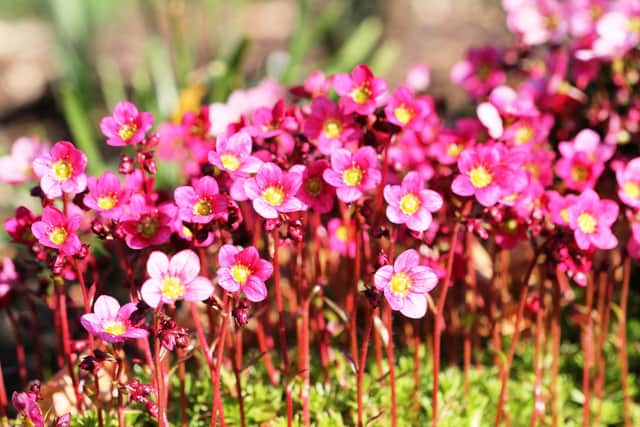

Saxifraga is the largest genus in the family Saxifragaceae, containing almost 450 species of perennial plants, known as saxifrages or rockfoils. The Latin word saxifraga means literally ‘stone-breaker’, and these midget gems can certainly live up to that description. They are tough and capable of living where the going gets rough.
Take, for example, Saxifraga cotyledon, the pyramidal saxifrage, from the mountains of Europe. It is a dainty plant, producing rosettes of tongue-shaped leaves about 20 centimetres across. In late spring and early summer, tall panicles of white flowers speckled with red dots, shoot out and upwards.
It’s a true classic in sunny sites in an alpine garden or in free-draining borders, rock gardens or containers.
Another eye-catching member of the family, Saxifraga urbium (London Pride), is an evergreen perennial forming a dense, spreading carpet of rosettes of spoon-shaped, long-stalked leaves with scalloped margins. In early summer, a profusion of pink-flushed white flowers are borne in airy panicles up to foot in length.
London Pride is easy to grow in any type of soil or situation, even in deep shade, which is why it was once so popular (it was a must-have for the discerning Victoria and Edwardian gardener). It can get a bit invasive but that no poblem – just pull up the bits you don’t want.
Something far more delicate yet equally hardy and attractive is Saxifraga crustata, another evergreen perennial which grows in dense mats of medium-sized plants which can reach from 12 to 24 centimetres in height.
Its leaves have a hint of silver, the result of tiny amounts of lime which is secreted by plant’s leaf margins.
On the whole, saxifrages can be annuals, biennials or herbaceous or evergreen perennials and are woodland or alpine plants. Some varieties do well in shade while others need more sun. Most are mat-forming which makes them ideal for using for ground-cover.
Iberis
People tend to take a lot for granted; we assume plants to keep on doing what they always do – growing and flowering, growing and fruiting, growing...
Which is why it comes as a shock when a plant fails to put in an appearance at the allotted time.
Thankfully, such shocks are few and far between and spring brings with it snowdrops, daffodils, apple blossom, a worrying number of weeds – and the delightful but vastly under-rated Iberis commutate, aka perennial candytuft, and also called I sempervirens.
For something so small, it can provide a lot of pleasure; in fact, this member of the cabbage family (Brassicaceae) has the ability to begin flowering in April and still be blooming well into June.
Iberis can be annuals, evergreen perennials or even shrubs, with narrow leaves and racemes of white, pink or purple flowers, but it is the rockery form which has proved to be such a godsend to gardeners.
I sempervirens is a spreading evergreen which may reach 30cm in height but it tends to spread outwards rather than upwards, so it’s best to keep a eye on it if you plant it in a small rockery where its narrow, dark green leaves will gradually overpower many a more genteel plant.
The flowers tend to be pure white and start out almost flat before gradually fattening out on top of short stems. If it gets out of control, pull it up; otherwise, prune it lightly after the flowers have faded.
This is a little plant which loves the sun, so give it an open site, a south-facing wall where it can root in cracks and crevices, or even encourage it to take hold in gravel paths. It likes moisture but not waterlogging, can tolerate most soils (in fact, poorer soils seem to suit it down to the ground) and is just as much at home in a container as it is in open ground.
Aubretia
Aubretia is normally a plant of early spring - which shows just how tough this little, mat-forming perennial is.
Normally, the lovely blue(ish) flowers are allowed to cascade over walls or trail across rockeries, but aubretia can be grown anywhere as long as it has well-drained, fertile soil.
It seems to be able to tolerate whatever nature throws at it and needs only a light going-over with secateurs to keep it in shape. Such pruning, after flowering, may also encourage a second blooming.
Aubretia thrives in full sun, but can tolerate partial shade.
Prefers well-drained soil, making it ideal for dry areas like chalky slopes and walls.
Once established, aubretia is relatively drought-tolerant, but water regularly, especially during hot, dry spells.
Aubretia prefers neutral to slightly alkaline soil and id ideal for rock gardens, gravel gardens, banks, slopes, and container gardens. It can also self-seed in the tiniest crack and then spread slowly to form carpets of colourful flowers.
It’s simple to propagate by seed, softwood, or semi-hardwood cuttings.
Allow for ample space to spread and simply prune it once it has finished flowering.