
Gardening: The season to be at the cutting edge
Autumn is the time to be taking hardwood cuttings. It isn’t a particularly difficult task, but it does require patience.
If you’re taking just a few cuttings, wait until the leaves have fallen from the shrub and then pick out pencil-thick stems of this year’s growth. Make an angled, clean cut just above a bud; six inches or so below, find another bud and cut straight across just below it. Now you have a hardwood cutting.
To encourage growth, dip the base into as hormone-rooting powder and push the cuttings into a deep pot containing compost and perlite. The tips of the cuttings should just peep out of the growing medium.
Water but don’t soak, and then put the pots into a cool greenhouse and let them overwinter undisturbed.

In spring, new top growth should appear on the cutting(s) – but leave well alone. This is where patience is important because the roots will still be virtually undeveloped; they need several more months before they are capable of sustaining life.
So, come next autumn, tease the cuttings out of their pots and then either pot them on or plant them outdoors somewhere sheltered where they can continue to gain strength.
Some shrubs, such as Ribes and weigelia, trees and climbers, are relatively easy to propagate by this method and you may get 100 per cent success; others are more difficult, in which case don’t be disappointed if some cuttings fail.
Fruit (pic of raspberry) xxxxxxx
People love fruit; and if they can grow their own, the pleasure is doubled.
So, we plant trees and bushes, feed them and water them – and then more or less forget about them until they start to lose their vigour and their fruits decline in quantity and quality.
Professional fruit-growers know that to maintain harvest levels requires regular maintenance – including winter-pruning. And it will soon be the ideal time to carry out such work even though the weather may be a bit intimidating.
Just remove some of the bigger branches of bushes and standards to allow air to circulate in the centre of the plants. Apples, pears, even gooseberries produce a lot of wood which quickly forms a mass, cutting out valuable light and even encouraging some diseases which can weaken or kill.
So, using sharp secateurs, cut out any damaged or obviously diseased wood and any shoots or branches that touch one another.
If you get your fruit from the supermarket, but fancy growing your own, then, again, November is a good time to start- with raspberries.
They thrive in moisture-retentive, fertile, slightly-acidic soils, which are well-drained and weed free. They hate soggy soils and shallow chalky soils, so give them what they want and they should repay you with bumper harvests.
For the best results, plant raspberry canes in a sheltered, sunny position, although they will tolerate part shade.
Planting can be done any time during the dormant season (November to March) as long as the soil is not frozen or waterlogged.
Most people grow summer-fruiting raspberries, which are ready for harvesting in early summer but there are autumn-fruiting raspberries, which are ready for harvest from late August to October.
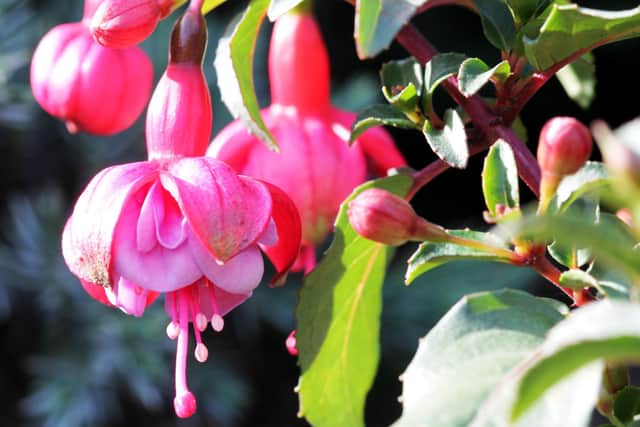
Fuchsia (pic of same) xxxxxx
Winter may well be in the ascendancy, but there are some plants that obviously have no inkling that summer and autumn are things of the past.
Fuchsias forget to change their clocks - many still even as winter approaches, and it’s up to the gardener to make sure that any mature, non-hardy fuchsias grown in pots and baskets with ripened woody growth, are protected.
Let them lose their leaves naturally and then prune plants back by about a third and leave them to have a well-earned sleep somewhere frost-free.
Summer bedders grown in containers need to be dug up and left to dry out. Then the roots should be trimmed back to the original rootball so the plant fits into its pot again. Again, find a frost-free spot and let the plants hibernate until spring. The temperatures should range from 45-55 F (4-7 C).
Then it’s just a case of watering plants once every three to four weeks. The soil should be moist but not soaked.
The last step to overwintering fuchsias is to wake them up again. About a month before the last frosts are forecast, take the plant(s) out of their winter home and cut all the branches back by half. This will encourage new growth.
Pop the plant(s) somewhere with bright filtered light, away from direct sun, and resume normal watering. Once the threat of frost is over, move fuchsias to a shady area outside and care for them as you normally would.
There are plenty of hardy fuchsias that are more than happy to be left outdoors throughout winter if they are growing in beds and borders where they have plenty of soil for their roots to avoid the effects of cold.
Leave them to do what they do naturally – lose their leaves and take on the appearance of bunches of twigs. Then, come late spring, they can be cut down to ground level; they will soon start to throw out fresh growth ready for another floriferous year.