
Gardening: Tips to reduce water use while keeping the garden looking lovely
Whatever the weather and wherever you are, there is no doubt that we tend to take water for granted, but it’s a precious commodity, particularly when there’s a shortage.
So here are a few tips to reduce the use of water in your garden and to help keep it looking lovely at the same time.
Every cloud has a silver lining - less time watering means more time to enjoy your garden this summer.
Tips to save on water:

1 Use your bath water and washing-up water on plants in the open ground. Providing you are sparing in the use of detergents, this makes useful irrigation water.
2 Don’t waste water on the lawn, save it for flowers and vegetables.
3 Set your mower higher to leave the grass a little longer. Longer grass retains its colour for longer.
4 Use a loam-based compost, such as John Innes, in pots and containers. It holds water and nutrients more efficiently.
5 Cover the surface of the compost in pots and containers with gravel or decorative stone chippings. It helps to keep the compost cool and retains moisture.
6 Mulch flowerbeds and borders with a good depth of chipped bark (or, if you can’t afford that, old compost). This retains moisture and suppresses weeds at the same time.
7 Try to water in the early morning or late in the evening when the ground and plants are cooler - less water evaporates and more water gets to the roots.
9 Choose plants that require less water: geraniums, petunias, helichrysum and gazanias are all good choices.
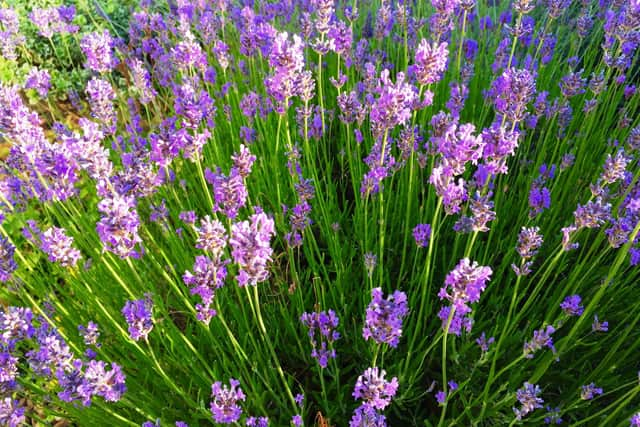
10 Think Mediterranean and aromatic: lavender, sage, thyme and rosemary all like hot, dry conditions and produce aromatic foliage.
Plants
Dry spells inspire some people to think about creating a bed where drought-tolerant plants can virtually look after themselves.
Is it feasible and, if so, what is the best way to go about it?
The answer is ‘yes’ – not just because warmer, drier spring and summers may become a reality, but also because it gives gardeners the chance to grow something different.
The best way to start is to see what does and what doesn’t like periods of hot, dry weather. If you can stand losing a few moisture-lovers, then throw them on the compost heap. If you can’t bear to part with them, treat them as special cases and be prepared to work overtime providing for their essential needs.
Whatever the case, the first and most important job is to get the soil ready to take the heat. Incorporate plenty of organic matter like old compost, well-rotted manure and leafmould, and water everything well. Then apply a thick mulch to keep down weeds – and to keep in the moisture.
Those special plants you just have to grow, whatever the cost and whatever the weather, can be watered by digging a small tunnel down to their roots and placing a bottomless plastic bottle in it. Leave the top of the bottle showing above the soil surface and simply pour water into it.
Finally, experiment with drought-loving plants, such as lavender and those with silver foliage or thick, fleshy or shiny leaves which have usually adapted to deal with dry situations.
Consider dianthus, a selection of geraniums (chose with care because some seed profusely and invade aggressively), oriental poppies, iris hybrids, potentillas, euphorbias and catmint.
Sedum
You have to be tough if you want to succeed. And if you’re just a few inches tall and live in some of the most inhospitable spots on Earth, you need to be very tough just to survive.
Which is why the sedums are such a success story. These small, compact, vigorous, free-flowering little plants have got what it takes to overcome drought and deluge, ice and heat.
They are often called ice plants, although the name stonecrop is far more suitable for a family which thrives in the sun and blooms profusely during the height of the short British summer.
Most are quite capable of surviving drought and deluge, can thrive in the poorest soil, and bounce back after being trampled underfoot by man and beast alike.
Unfortunately, as with all families, there are always one or two black sheep who tend to give the rest a bad name. S acre and S album produce masses of yellow and white flowers respectively, but they have a bad habit of spreading, colonising ground and taking over rockeries.
So if you don’t want a prolonged battle, choose instead ‘Coral Carpet’, ‘Cappa Blanca’ or S spurium, whose white, pink or red flowers can just about make it to the heady heights of three inches. They are garden trained and produce compact mounds of foliage which burst into colour in June and July.
And just to prove how tough these little fellers are, come autumn they can be lifted from the soil and prised apart to produce numerous clones to carry on the family name.
Not all sedums keep close to the ground – there are some which will happily make their mark in an herbaceous border and make their mark in later summer.
With fleshy leaves and wonderful, colourful flowers, they make summer a delight for both gardeners and the many insects which find the plants irresistible.