
Gardening: Why size matters for happy gardeners
How small is small? For someone who wants a ‘small’ tree for a ‘small’ garden, it’s unlikely to be the same as a ‘small’ tree for a ‘large’ garden. So, size really does matter; get it wrong and you could rue the decision for the rest of your life. Get it right, and you’ll be a happy man – or woman.
Plant Crataegus laevigata ‘Paul’s Scarlet’ and you’ll get beautiful red flowers in May and a tree that should eventually top out at just 26ft in height. That’s still a fair size, but as long as you don’t position it a few feet from the front window, things should be fine.
But if even that is just too high and mighty, then Malus baccata ‘Lady Northcliffe’ with pinkish-white flowers in May and yellow/brown crab apples in autumn, is yet more accommodating, normally growing to just 20ft tall.
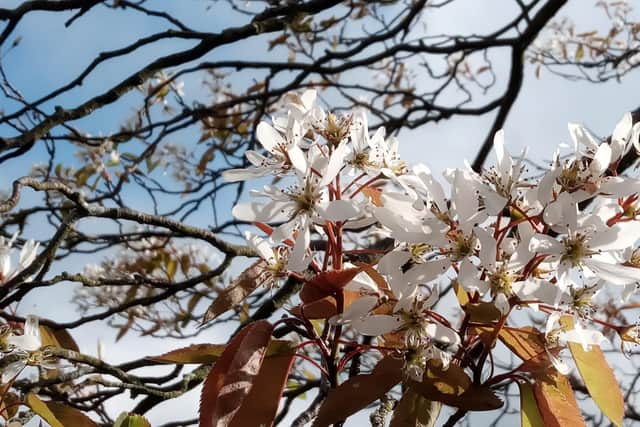
For autumn colour on a grand scale but from ‘small’ trees, consider Amelanchier × grandiflora ‘Ballerina’ which has white flowers and then stunning red fruits and leaves in autumn. It’s at its happiest in a neutral to acid soil and will do well to reach 20ft in height.

And the gorgeous weeping ornamental pear, Pyrus salicifolia ‘Pendula’, produces silver leaves on its way to a heady 16ft.
Autumn foliage is equally important, which is where Acer japonicum ‘Aconitifolium’ with deeply-lobed leaves, turning ruby-crimson in autumn, can make an impact. It grows to a moderate 16ft or so.
Crataegus persimilis ‘Prunifolia’, a hawthorn with crimson fruits and good foliage colour, is another ‘small’ tree (26ft) while Sorbus vilmorinii (pink-to-white fruits and autumn colour) is just as attractive but a good 10ft less in height.
Birch xxxxxxx
The ‘common’ silver birch, Betula pendula, is everywhere it’s possible for one to grow. It’s a tree capable of setting down roots in the most unlikely of places and the poorest of soils. It’s very common, but it’s a success story.
So successful, in fact, that it’s also become a tree of gardens throughout the land where it is appreciated for its delicate spring foliage, it’s equally attractive autumn leaves and, of course, its attractive bark.
And Betula pendula is exceptionally hardy and easy to grow in most soils and situations – shade or sun, places where the land is damp or dry. This is a tree that offers all things to all people, although it can become too big for some gardens, so if you’re thinking of planting a birch, choose with care.
And as there are more than 60 known species of the family, there are plenty of options of all shapes and sizes.
After Betula pendula is Betula utilis var jacquemontii with bark so white that it almost shines. In winter, a small group of these trees can light up the darkest day.
Perhaps the star performer is ‘Grayswood Ghost’, with the purest of white bark and which eventually grows to form a medium-sized tree; a star for any gardener with space for a specimen birch.
Betula papyrifera is also known as a paper birch or canoe birch, and is a hardy, fast-growing, white-barked tree with the added attraction of superb autumn colour.
Of course, not everyone likes white, but there are plenty more birches out there, including the Himalayan birch, Betula utilis ‘Park Wood’, whose bark has been described as looking as if it’s sculpted from smooth, dark chocolate. It grows to 40ft or so.
Magnolia xxxxxx
There are times when Nature can be a kind and considerate thing. In early and mid-April we were blessed with sun and warmth reminiscent of May.
Plants took advantage, seizing the opportunity to make the most of a window of opportunity. So, this year has been a pretty good one for one of the stars of the garden – the magnolia.
Everyone loves a magnolia but the vast majority of gardeners would probably think twice about growing one because of the trees’ reputation for being a tad on the difficult side.
Those superb flowers, many bursting out before the leaves, are guaranteed to bring a little warmth to the UK, which is far removed from their homeland of the south-eastern United States where they enjoy a climate only dreamed of this side of the Atlantic.
Balmy evenings are few and far between in England; besides, some magnolias – particularly M soulangiana – are at their best in late March and April.
The colours of the great waxy blooms range from pure white (Alba superba) to rosy-red (rubra).
But M soulangiana may start off small, but, given the right conditions, it will spread upwards and outwards until it’s no longer guaranteed to be flavour of the month in an average-sized garden.
Yet most people would forgive its stature and marvel at its fantastic flowers, this year given the chance to star without the damage normally wrought by an average early spring in Britain.
And talking of stars – the much smaller and much less in-your-face form of M stellata, which bears fragrant star-shaped flowers in March and April and which has the decency to grow to perhaps only six foot in height and not much more in width, has also taken advantage of the benign weather to bloom undisturbed.