
Gardening: Winter jasmine and flowering quince are climbers that won't get left in the shade
You see lots of climbing plants recommended for sunny walls, but few, if any, for shady walls. So what do you do if you have the latter but want to adorn them with something a little more interesting than an ivy?
Thankfully, there are a surprisingly large number of climbers which are quite prepared to do their bit to brighten up an almost-sunless wall – it depends on the space the gardener has available and whether he (or she) wants evergreen or deciduous and how much work they are prepared to do to keep the plants looking their best.
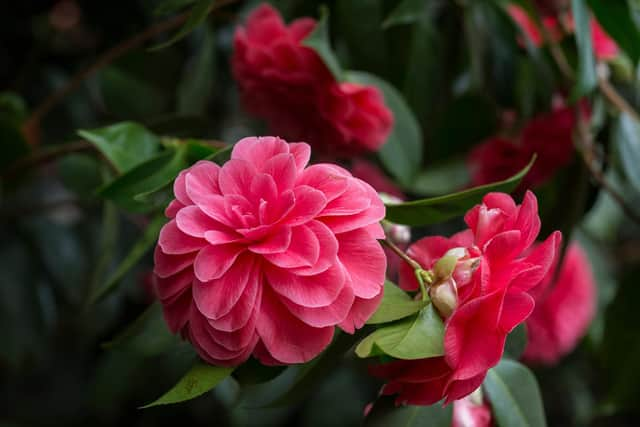
At this time of year, camellias (although not exactly climbers) are perfect for sites out of the direct sun and biting winds; they can be surprisingly tough and are relatively easy to maintain. Plus, they are evergreen and have stunning flowers in various shades – vibrant red, classy pink and even brilliant white.
They are reasonably good at keeping themselves upright, but a little help from unobtrusive ties will help to prevent them from getting too lax and lazy.

Flowering quince (Chaenomeles) are also at home on shade walls, but they need training to keep them from becoming straggly. Their stunning flowers appear early in the year before their foliage so the garden and the gardener are provided with the best uninterrupted show.
They do best when planted in sun or dappled shade, sites which encourage both masses of and fruit. They are happy in any neutral-to-acid soil, but they dislike heavily alkaline or waterlogged soils. Add another star for their ability to cope with temperatures down to -20°C.
Winter jasmine is yet another climber which will still flower in shade, although there will be fewer blooms than when the plant is grown in sun and they are smaller than those produced by camellias.
And if you are a lover of roses, some, such as ‘Zephirine Drouhin’, will flower in shade although for several months of the year there will be nothing but bare stems. Perhaps better to grow it through that evergreen ivy...
Pyracantha
When it comes to autumnal berries, there are few to challenge Pyracantha, the firethorn, for its intensity of colour – striking orange being the prevalent hue.
And not only is the plant bright and beautiful at an often-miserable time of year, but it’s also useful as an excellent source of food and shelter for wildlife, and as a hedge-cum-climber. The magnificent fiery orange and ruby red berries are set against a backdrop of dark, evergreen, glossy foliage which can brighten up the gloomiest winter days.
Because of its thorny nature, it is recommended as a living barrier for those unwanted animal (or human) visitors to your garden. Plant a few firethorns close together and within a couple of years they will be almost impenetrable.
But pyracantha isn’t just a plant for autumn and winter; those evergreen leaves provide year-round interest and there is an added bonus of small white flowers in summer. It can be grown as a hedge, groundcover or against walls and fences and it looks equally good as a freestanding shrub.
Firethorns are easy to grow in sun or partial shade and in any reasonable soil. Pyracantha ‘Navajo’ and Pyracantha ‘Orange Charmer’ are excellent choices. The latter is an evergreen, bushy, arching shrub with white flowers in spring and large spherical orange fruits in autumn. ‘Navajo’ sports vibrant orange-red berries nestled against shiny green leaves and can be resistant to fireblight, a particularly unpleasant disease.
And if orange isn’t quite right for your garden colour scheme, there’s an equally striking red variety; Pyracantha ‘Red Column’ will form a dense, prickly shrub, particularly in its upright form.
During the summer, plants produce sprays of bright white flowers, followed by eye-catching displays of sparkling red berries, providing food to the birds through the colder months.
Sweet peas
Growing sweet peas can take a fair amount of hard work. And it starts very early.
In mid-winter, dedicated sweet pea growers sow the hard, rounded seeds into small pots filled with compost. And to help things get started, they’ll have soaked the seeds overnight to encourage them to germinate quicker.
As the seedlings emerge, they tend to become tall and leggy so to persuade them to grow stronger and bushier, nip out the top of the stem just above a set of leaves.
Then, when the young plants are growing well and the risk of frost has passed, stick them outside to acclimatise. Give them a week or so to get used to the great outdoors and then plant them in their permanent home.
The less-dedicated among us plant the seeds later or buy ready-germinated plants in individual pots.
Sweet peas, being climbers, need some form of support so they can grow upwards. Many gardeners maintain that individual bamboo canes, a foot or so apart, are the best, but as long as the plants can cling on with their tendrils, anything will do. Even letting them clamber up and over conifer hedges can be very effective.
Always ensure that the soil is fertile and moist – watering can become a daily chore but it is well worth the effort to produce masses of sweet-smelling blooms.