
Givendale Farm, East Riding: Stable breed that provides quality meat
While lambing time always captures everyone’s hearts in spring, it’s also when calving of the larger proportion of the UK’s beef herds takes place and Givendale Farm livestock manager James Simpson is nearing the end of his hectic period that includes 180 Stabiliser breeding cows and 160 breeding ewes.
Givendale Farm is part of the JSR Farms enterprise that involves several farms across the East Riding. James looks after around half of the 1500 acres at the farm with arable manager Charlie Parker responsible for the rest.
James sees the Stabiliser breed, a composite breed originally put together through the crossing of the Hereford, Angus, Simmental and Gelbvieh breeds in the United States, as the way forward for anyone looking for growth rate, docility, mothering ability and above all quality meat, and the breed has just held its first ever online sale of bulls that saw two of Givendale’s achieve £7000 and £7200.
“Ours were the top two,” says James. “I came here from a Limousin and British Blue background of cattle breeding where you had to watch everything, to be there all the time, making sure everything was alright during calving.
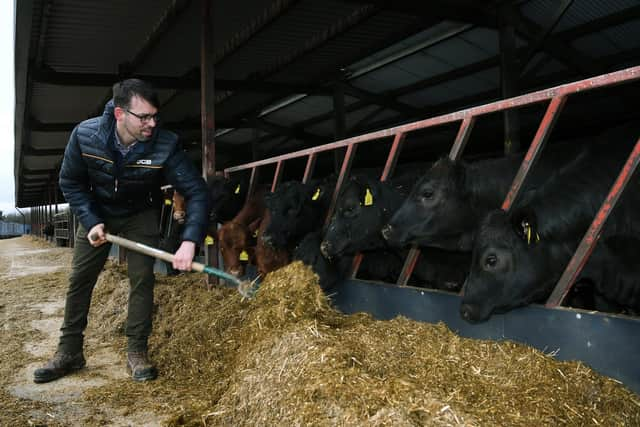

“You’re not having to jack calves out because they’re too big. I’m not saying you don’t occasionally have problems with the odd one, but on the majority we don’t, they’re up, sucking and the growth rates on them are great.
“These are a ‘do what they say on the tin’ breed. They get on. Their calving ease is unbelievable and their beef quality is right up with the best.
James says that when he first came to Givendale around ten years ago he found the weights on his Stabiliser fattening bulls quite deceptive to judge because of their strength in weight gain and because of how they look.
“From being able to judge such as Limousin and Blues I was 30-40 kilos out on what I thought initially, because these Stabilisers weigh like lead, but they don’t look as heavy as they are. They really do put the weight on and grow really fast.
“Stabilisers are certainly on the up. We’re gaining more interest on them all the time and we’re seeing an increase in livestock farmers breeding them every year. We now get quite a few who come to see us to buy heifers or a bull and most of that is because they’re wanting an easier life. They don’t want to be up in the middle of the night worrying about calves coming out on the floor and getting stuck.
“We start calving each year at the back-end February and we’ve the brunt of the herd done before the end of March.
Getting the stock out and into the fields is another springtime task for James who runs the livestock side of the farm with one other part-time team member.
“We start dribbling them out to grass, which is obviously weather dependent, around the start of April, and they are usually in towards the end of October and into maybe November. Our grasses are largely on steep Wolds and dales land where you can’t drive a tractor and so we are careful of over grazing as we don’t want the land poaching up. All of the dales grasses are in Higher Level Stewardship.
“We have a little bit of paddock grazing too. We have various grasses, in rotation with arable side, that are left in for 3-4 years.
James says the whole herd is the Stabiliser breed, which has changed in more recent times with the South Devon taking over from the Hereford in the breeds that make up its composite. Givendale is mainly about producing great breeding stock for other farmers.
“We try and push for breeding stock. Near enough all our heifers go for breeding, apart from ones that don’t make the grade. We keep all of our own replacements to the herd and sell the rest of the quality heifers and bulls. In a normal year we might have around 15 that we reckon are not good enough to breed from.
“We sell between 20-25 breeding bulls a year, which will leave here from yearlings to two-year olds. Bulls that go into the meat sector leave here between 12-14 months and are processed at ABP York. Any heifers we have for the meat trade will go at 18-20 months.
Natural bulling is James’ preference although he undertook some AI work last year.
“Normally I’ll put everything to the bull but I AI’d 30 of the herd last year. It was something different. We’re a closed herd. I don’t buy anything in. The only thing I will buy in are new bloodlines through embryos from America to move the genetics forward and to stay ahead of everybody else in the UK.
James says it is the calmness of the breed that really makes an impression on anyone who visits Givendale and that he rates the beef produced very highly.
“They’re known for their docility. They’re really very quiet and so easy to handle. The various people we’ve had work for us since I’ve been here have all commented on how quiet the cattle are.
“And the Stabiliser beef eating quality is absolutely terrific. It’s all purely down to the breeding. In America they get paid for eating quality and that’s great. That’s what’s driving it over there. The marbling in the meat it so succulent no matter what cut you eat. We always have Stabiliser beef at home and the Stabiliser team in our head office are working really hard on getting that message out about it.
The recent debut of the Stabiliser Online Sale has been hailed a great success with 19 bulls available, which came from the 80 multiplier herds that were involved.
James says that he sees the online bull sales becoming a regular feature for the breed as it continues its growth that currently sees it sitting at around tenth most popular breeding cow in the UK, but that he doesn’t see the Stabiliser necessarily being part of the annual summer agricultural show scene.
“It’s a breed with a specific purpose, to produce excellent beef and is all about increasing the number of commercial beef herds.
“Stabilisers are generally black or red, you want a solid colour. You can have the odd white bit on the head or feet, which comes from the older cows that have more Simmental in them.
“Those in the beef trade will say that at the end of the day it doesn’t matter what colour the hide is, they all look the same hung up.
James’ sheep flock is made up of Scotch Mules and some Cheviot Mules.
“We purchase ewes from Hexham and they’re this month’s priority. Now that calving is nearly over, we start lambing in April.
James is a local, originally from Fangfoss. He undertook an apprenticeship at Bishop Burton College and worked on a couple of farms before Givendale.
My granddad was a tenant on Garrowby Estate farms, so I grew up with farming and have loved it all my life, just like our three young children do too. My wife Beth works as a chef at The Gait in Millington.