
Henry Moore exhibition: 'Largest ever' exhibition opens in Yorkshire on Saturday
He was born into the heart of the industrial boom in West Yorkshire at the close of the 19th century and a world surrounded by mining, factories and glassworks.
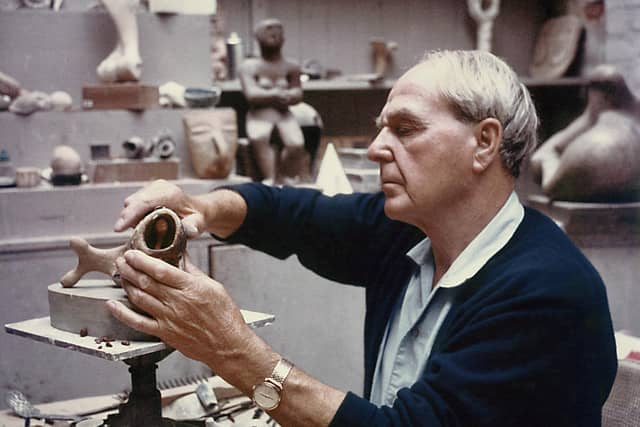

As a child, Henry Moore knew he wanted to be a sculptor and even now – some 40 years after his death in 1986 at the age of 88 – his work, inspired by the natural environment, continues to influence and dominate the modern art agenda.
This boy from Castleford, the seventh of eight children from a family beset by poverty went on to become one of the most internationally influential artists, pioneering a post modern and bold approach to sculpture in a period of time contrasted by depression and decadence, and bookended by two world wars.
With a vision then that was before his time, Moore’s work once again, here in the 21st century, is cultivating firsts.
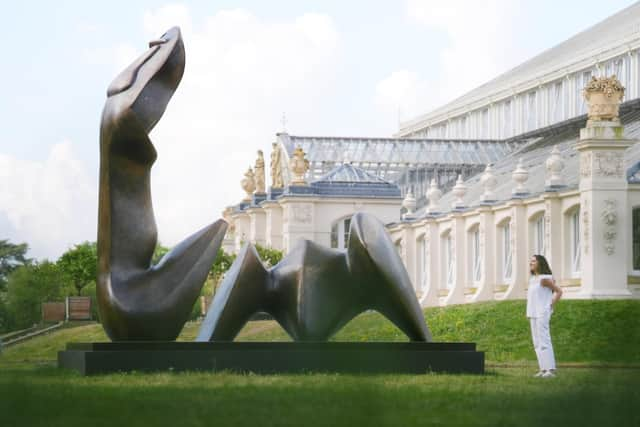
The largest ever and most comprehensive outdoor showcase of Moore’s work to date anywhere in the world is being displayed at Kew Gardens in London.
Throughout Moore’s long career, the connection to nature was a constant theme. Critics say he was able to transform the complexity and beauty of nature into abstract forms which felt human.
Moore always felt landscapes provided the perfect setting for his sculptures to be sited and viewed. It meant the natural architecture of the environment could amplify their visual and emotional impact.
It seems fitting then, that this latest exhibition, entitled Monumental Nature, sees 30 sculptures displayed across a 320-acre UNESCO World Heritage Site which boasts in the region on 2.5m visitors each year.
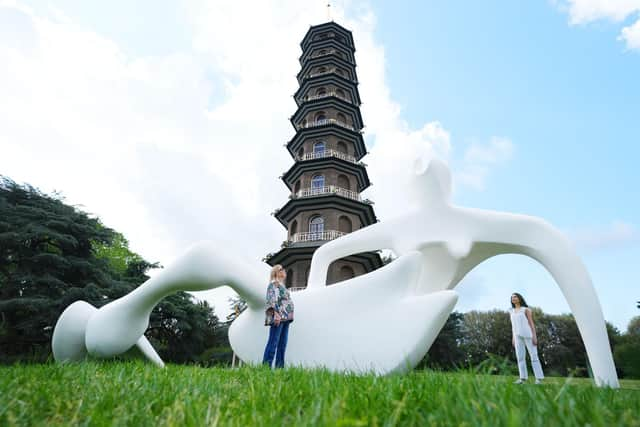
Throughout the run, which begins today, visitors and fans of the artist will be encouraged to reflect on how they perceive and interact with the natural world.
Works on display will include Large Two Forms, Sheep Piece, Large Reclining Figure, Oval with Points, Reclining Woman: Elbow, Locking Piece and Three-Piece Sculpture: Vertebrae.
Alongside the works across Kew Gardens, visitors will also be able to enjoy a comprehensive exhibition in Kew’s Shirley Sherwood Gallery of Botanical Art. It will feature more than 90 pieces of work, some of which have been rarely accessible to the public before now.
They include bronzes, stone and wood carvings, prints and drawings, exploring Moore’s unique process of ‘thinking through nature’. The gallery exhibition will explore his creative responses to the fragility of the natural world, and the role which humans play as part of the complex ecosystems which connect all life on earth.
Curated thematically, and drawing inspiration from Moore’s evolving approach to natural forms, the exhibition will feature both major and lesser-known works.
The exhibition will be accompanied by a fully illustrated book, published by Kew Publishing. It has been compiled with contributions from curators, art historians and specialists of associated fields from the team at Kew, such as botanists and evolutionary biologists.
This major new publication on Moore will present new viewpoints from which his work can be understood through a contemporary lens, some 100 years after he released his first piece.
Paul Denton, Director of Creative Programmes and Exhibitions at RBG Kew, said: “We’re delighted to be collaborating once again with the Henry Moore Foundation to present Monumental Nature this year, and are very grateful to our Headline Supporter, the Nora McNeely Hurley Foundation for its generous support of the exhibition.
“The experience will invite visitors to engage deeply with Moore’s artistic inspirations, revealing how his work was shaped by discoveries unfolding during his lifetime.
“His enduring interest in placing the human figure within the landscape speaks to our timeless and shared connection with the natural world.”
The celebration of Moore’s work continues beyond normal opening hours.
A number of ‘After Hours’ events will see Temperate House, the world’s largest surviving Victorian glasshouse transformed as dusk falls. Adult-only evenings on June 26, 27 and July 3 and 4, mark summer solstice with a series of performances and artistic encounters across the glasshouse.
In conjunction with the eagerly anticipated exhibition at Kew’s London venue, Wakehurst, Kew’s wild botanic garden in Sussex, will host a parallel presentation of four of Moore’s sculptures, curated in partnership with the Leeds based Henry Moore Institute.
It will showcase newly commissioned pieces from contemporary artists Rana Begum, Rafael Pérez Evans, and a new work by Paloma Varga Weisz, receiving its UK premiere.
Called, ‘Henry Moore and More’, it will highlight the distinctively contrasting ways in which these contemporary artists have responded to Wakehurst’s landscape, drawing inspiration from the human craving for a connection with the natural world.
Moore’s works will remain at Wakehurst until May next year.
Sebastiano Barassi, Head of Henry Moore Collections & Programmes, added: “Moore’s deep affinity with the natural world makes Kew and Wakehurst ideal settings for his work. Throughout his career, he was inspired by organic forms – bones, stones, trees, and the rhythms of the landscape – and he believed that sculpture should exist in harmony with its surroundings.
“The Henry Moore Foundation has a long-standing relationship with Kew, and this exhibition builds on that connection in bold and exciting ways.
“By presenting his sculptures across both Kew and Wakehurst, we’re offering a fresh perspective on Moore’s legacy – one that invites visitors to reflect on nature, humanity, and the environment at a time when those themes feel more urgent and relevant than ever.”
The Henry Moore Foundation was set up in 1977 by Moore himself at the age of 79. It was done in conjunction with his family who wanted to use his global success in the arts to encourage further enjoyment and opportunity in the sector, particularly in sculpture.
Moore worked for the Foundation for nine years until his death in August 1986.
Moore lived and worked in rural Hertfordshire where he acquired more than 70 acres of land and set up various studios.
However, it was Leeds where he honed his craft.
Although, as a child he harboured an unlikley ambition for a lad from pre-war and Edwardian Castleford to be a sculptor, he actually, perhaps reluctantly, trained as a teacher.
The outbreak of the First World War changed his path and he joined the army, yet when the war was over, in 1919, he made the first steps to becoming an artist thanks to an ex-serviceman’s grant.
He enrolled first at Leeds School of Art, and then the Royal College of Art in London. By the 1930s he was one of the most prominent avant-garde sculptors of Europe yet the outbreak of the Second World War would re-shape his art.
He drew people sheltering in the London Underground during the Blitz, but post-war it was recognised art could be integral to the rehabilitation and reconstruction of the country.
In the late 1940s and 1950s, Moore made a sequence of public works, sited in schools, hospitals and housing estates.
Moore’s international reputation grew with exhibitions in 1946 at the Museum of Modern Art in New York; the International Prize for Sculpture at the Venice Biennale in 1948; a commission for the Reclining Figure for the UNESCO headquarters in Paris; London’s Tate in 1968 and the Forte di Belvedere in Florence during 1972.
Not bad for someone who when interviewed in 1981 said: “I remember that as a young sculptor, there was nothing; there wasn’t a single piece of sculpture in my home town.”
This is far from the case now.
The Henry Moore Institute, part of Henry Moore Foundation, opened in Leeds in 1993. The idea was to have a centre for the study of sculpture with an art gallery and research library open to all.
In the last 30 years the Institute has displayed the work of more than 731 artists from around the world; presented 224 free exhibitions to the public; acquired 30,000 books, publications, journals, audio-visual resources and ephemera in the Sculpture Research Library; hosted 140 visiting research fellows in the Library and Archive of Sculptors’ Papers; made 700 acquisitions with Leeds City Council for Leeds’ sculpture collection; welcomed more than a million visitors and provided a platform for numerous artists to have their first solo exhibition.
Monumental Nature: Largest-ever outdoor exhibition of Henry Moore works, Saturday, May 9, 2026 to Sunday, January 31, 2027, Kew Gardens, London. Henry Moore and more at Kew Wakehurst, Sussex, Friday, June 5, 2026 to Sunday, May 23, 2027.