
Horncastle Farm, Nostell: The enterprise that is thinking big
Thirteen years ago the first Priory Rose Tractor Run was born. One of its biggest supporters has been arable farmer Richard Metcalfe of Horncastle Farm, Nostell who will take part in the tractor run and Big Farming Sunday at Farmer Copley’s, Pontefract on Sunday 11 May.
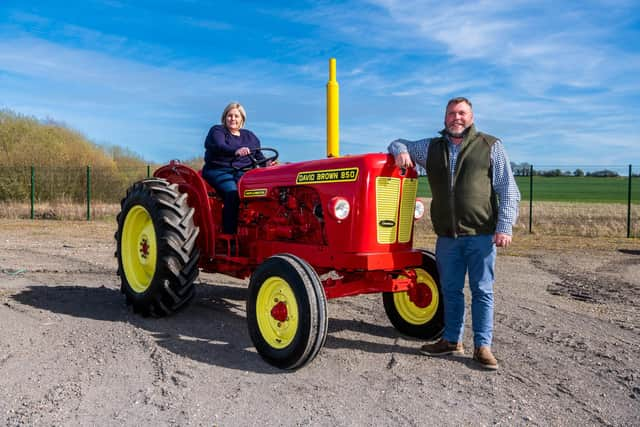
“We’re bringing a vintage David Brown for the tractor run,” says Richard. “But we’re also bringing our New Holland CR9.90 combine harvester with its 41ft MacDon header for Big Farming Sunday.
“At Farmer Copley’s all the children just want to get on the tractors,” says organiser Joanne Bulmer. “We decided to have bigger farm machinery this year and let the kids get up close to a combine or a forager, to experience things they see in fields but never get chance to go near.
Richard’s family has farmed at Nostell since his grandfather Fred Metcalfe took on what was then 176 acres. Today’s farming operation sees Richard responsible for over 2700 acres with a mix of owned land and a contract farming arrangement with Nostell Estate.

“We grow mainly arable crops on what is predominantly Grade 3 land, which isn’t great. We’ve a lot of what was open cast land, land that has been disturbed. It’s what we call September land, because if you don’t do the jobs in September and October comes, you’re struggling.
“Winter wheat is our biggest crop with over 1200 acres. We grow Group 1 top quality milling wheat, supplying local flour mills for bread. This year we’ve the varieties Skyfall, Cheers and a new one, Goldfinch. We’ve high hopes as it is meant to be more resistant than others, which it seems to be so far, helping us not use pesticides. Goldfinch is quite an important development especially with our SFI agreement because not spraying insecticides and getting resistance in the crop is a win-win.
“The seed was at a premium and I couldn’t get as much as I wanted this time, but for this autumn’s drilling I’ll aim to go half Goldfinch and half Cheers.
Richard sees 4 tonnes per acre being par for the course across his first wheats.
“I’m disappointed if we don’t get that, but on second wheats land I’m happy with 3.6 to 3.7 tonnes per acre. We suffered on yields last year which were horrendous compared to our five-year average mainly because of the weather at establishment in 2023. We only got a few hundred acres in at September. We tried again in spring 2024 but that failed as well. We lost out on yield and quality last year because in August everything went flat and started to grow and the Hagberg went out of the window.
Richard stores wheat on farm.
“Back in November I sold a fair bit at £250 per tonne and moved a lot of it. It was all sold by Christmas. I’ve sold some forward for next year.
Richard’s next largest crop is oilseed rape, but in line with many other farmers he’s reducing his reliance upon it, although he has also taken a more sustainable course.
“We’ve nearly 550 acres of rape this year, which is down on what we used to do by nearly half. We’ve gone for a higher seed rate because we want to compensate for anything like flea beetle, slugs and pigeons. We grow our own seedbed of Acacia oilseed rape seed and declare it paying the royalties, and instead of putting 3 kgs of it on per hectare we can put 6-7 kgs because it’s much cheaper. The cheapest way to secure a seedbed is to grow your own seed.
“We have around 200 acres of both winter barley and spring barley, which are all feed barley using varieties such as Kingsbarn and Caravelle, and we also have winter beans.
“We’ve rented 100 acres to a neighbouring farmer for potatoes but we’re picking and choosing where they go to fit in with rotation. Rape or beans fit in better as a break as they suit the land.
“We drill when there’s moisture, so if it doesn’t rain until the first week in September I won’t drill the rape until then, but if it rains in the second week in August we’ll drill it then.
Richard is thankful that establishment last autumn was a good deal better than 2023.
“We got everything drilled up and so far all looks well. We haven’t been forced to drill any spring crops, other than our normal spring cropping. Everything has gone to the plan so far.
“We’re min-till. We have a plough but very rarely use it. Ten years ago we moved from plough. Less disturbance equals better soil and lower cost. When we plough it doesn’t fall as a seed bed, and that means the energy then used in diesel and manpower to do so is expensive. If you’re just working with the top you can create a seedbed a lot cheaper.
Richard was in early with the new SFI schemes and he’s also working on his carbon figures.
“I wanted to keep my BPS payment where it was. I got into an SFI in 2023 when it was first being launched and another in November 2024, so I’ve two SFIs running and that takes up some of the land as well, with margins, bird feeds. I’ve 55 acres in two fields and with all margins included I’ve 90-100 acres in SFI agreements.
“We’re also making sure of our carbon footprint being reduced. We take food waste digestate from an AD plant in Bentley to spread on the land. That avoids landfill, creates electricity, which powers homes in Doncaster and Bentley, and means we don’t have to buy as much man-made nitrogen in. It’s a good way of ticking two or three boxes.
Richard always wanted cattle back on the farm. He remembered them on farm when his father David farmed.
“We have a small pedigree Belted Galloway herd of a dozen cows and heifers and a bull. The dream was to show them as a family. Maybe we will, but we’ve just been that busy. We’ve had them about 4-5 years. I love having cattle back on the farm and grazing the pasture around the houses is nice.
Richard and his wife Melanie came up with a new enterprise just before the first Covid lockdown, called The Wild Wood. They run a pet cremation service from a farm building and The Wild Wood offers the opportunity for pet owners to sit, walk and reflect in an area of beauty.
Richard is looking forward to Big Farming Sunday.
“What Joanne has created with Priory Rose Tractor Run and now Big Farming Sunday are events that give people chance to see and experience farming in a small way. The tractor run goes from Farmer Copley’s to Ackworth cricket ground and then back taking in villages along the way.
“Joanne’s efforts have led to £115,000 being raised for Yorkshire Air Ambulance and a helicopter will be visiting Farmer Copley’s too; there will also be the raffle for a quad trailer donated by Graham Edwards Trailers each year.
Big Farming Sunday & Priory Rose Tractor run take place at Farmer Copley’s on Sunday 11 May.