
How Cromwell's hunt for Cavalier spies put Skellow on the English Civil War map
Some people, who made a mark on the country’s history, have stayed in perhaps the most unlikely of Yorkshire villages. This is true of Skellow situated between Doncaster and Pontefract.
During the English civil War, Oliver Cromwell stayed there a few nights. But why? One account said he was searching for an answer to an irritating, baffling problem. King Charles’ Cavaliers had been passing through, both north and south, along the Great North Road, and had to be stopped if Cromwell was to have absolute domination of Britain. Consequently, General Fairfax, with 300 soldiers, was despatched to Doncaster. Yet after about four months, Fairfax received reliable reports that the Cavaliers were successfully bypassing the town. Cromwell decided that he needed to investigate the problem in more detail. So, he stayed for five nights in Doncaster. He also received reliable information from his close friend and active supporter, George Byard, an officer in the Parliamentary army, who resided at Skellow Hall. Eventually, Cromwell discovered that the Cavaliers, when travelling south, departed from the Great North Road at Skellow Five Lane Ends, then passed through Skellow and Carcroft along to the Askern turnpike road. Then, they found a path to the Great North Road having completely avoided Doncaster. Cromwell and Fairfax visited Skellow to develop and mature their plans of resistance. The result was that a number of Ironsides, or as they were so often termed the Roundheads, were stationed at Skellow. They threw up earthworks, each side of the road on which to mount small cannons. However, these formidable forces failed to achieve their objective immediately, so useful and important had the Skellow bypass become. The folklore of Skellow, and the personal records of Capt. Byard, state that Cromwell slept at Skellow Hall during that period.
Local historian, Frank Shaw, suggested that the Skellow name was of Viking origin. The word ‘Skel’ meaning chieftain. The name changed over the years and was known as ‘Scanhalla’ in 1086, ‘Skelehall’ in 1203, ‘Skellaw’ in 1379 and Skellow in 1493. Magilton (1977) in his Skellow section notes: ‘The only known archaeological site is that of Cromwell’s Batteries, almost certain the motte and bailey castle of the Domesday village of Skellow…Chance finds point to Roman settlement somewhere in the area, location unknown.’
Baines (1822) notes that Skellow is in the parish of Owston, wap. of Osgoldcross, and honour of Pontefract with a population of 146. Amongst the four traders mentioned were: a wheelwright; victualler; corn miller & malt dealer; and shoemaker. There were two large houses Skellow Hall and Skellow Grange. Magilton questions whether the Hall dates from the 17th century. Baines records Godfrey Higgins as a magistrate and living at Skellow Grange. His father also called Godfrey had acquired the estate in 1770 and a map drawn by Joseph Colbeck in 1763 shows Skellow Grange. Born in 1772, Higgins II was noted as a landowner, a prominent advocate for social reform, historian and antiquarian. He died in 1833 and his book Anacalypsis was published posthumously. He was succeeded by his son – the third Godfrey Higgins. He never married and after his death in 1861, the estates went to the Hatfield family of Thorp Arch.


An Ordnance Survey map surveyed in 1849 and published in 1854 shows Skellow covering a sparse area peppered with the two country houses, a few cottages, a corn mill, Cromwell’s Batteries, Towns Pump, several limestone quarries and a Pinfold. To the west, the Roman Road extended north and south. Just south of Skellow was the Great Northern and Manchester, Sheffield & Lincolnshire Railways.
Details of Skellow Flour Mill were revealed in a ‘To Be Let’ notice from March 1851. It was turned by water and drove four pairs of stones and included acres of superior tillage and grass. Another ‘To Be Let’ notice from October 1871 said that Skellow Hall contained three sitting rooms, seven bedrooms, two dressing rooms. This was besides a stable and coach house.
A meeting of Conservatives was held at Skellow Grange in March 1888. About 200 enjoyed an excellent tea after which a meeting was held in the Concert Hall. One account from August 9, 1890 said: ‘Now that cricket for ladies is becoming quite the fashion, it will interest our readers to learn that a match in which a number of lady members of Yorkshire County families took part, was played at Skellow Grange…The strict rules of the games were of course adhered to (except that the teams were only ten aside)’. The teams were representative of Skellow and Carleton, near Pontefract. Skellow were eventually defeated by 35 runs and four wickets.
During October 1891, the Primrose League held a meeting at Skellow Grange, which was described as the charming residence of Mr C.E. Charlesworth.

Much change occurred in Skellow after the sinking of the Bullcroft colliery in Carcroft situated a short distance away to the east. According to one local newspaper from June 15, 1961: ‘During the development of the new Skellow, due to the advent of Bullcroft colliery, skeletons were found in the gutter along the roadway each one having by its side the remains of some implement of warfare. One was a lance, another a spear, resting beside the bones. It is not difficult to imagine that these were the remains of Cavaliers, fallen in conflict. Each [grave] was about two feet six inches deep.’
The colliery brought a predicted population boom in Skellow. In 1901, the population was 143, though by 1913 it was estimated at 800. Builders, it was stated ‘cannot cope with the [housing] demand.’
Many Roman coins of the third and fourth centuries were found at depth of only two feet by workmen engaged in laying a drain at Skellow during May 1920. In October of the same year Henry Steel, Chairman of the United Steel Company, and of Steel, Peech and Tozer, who resided at Skellow Grange, died suddenly at the Savoy Hotel, London.
Dave Fordham in Bullcroft Colliery Carcroft & Skellow Early Development (2009) mentions that in 1923 plans were drawn up for an estate of 500 houses which would be initially known as New Skellow. Streets were named after trees and shrubs and English Kings. Also included in the scheme was a new pub the Bullcroft Hotel and it was opened in August 1928 by Carter’s Knottingley Brewery.
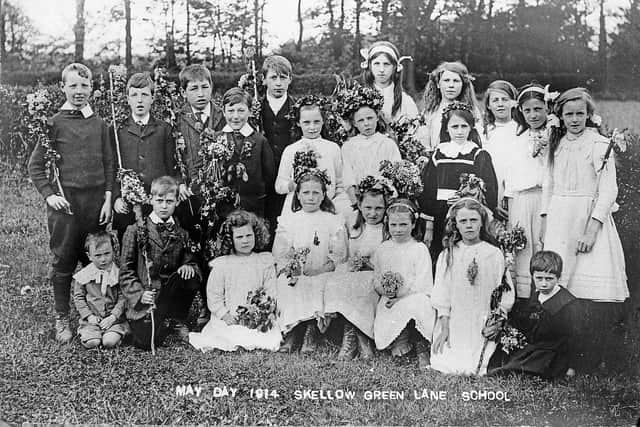
A report from February 1, 1924 said that during excavations at Skellow, workmen discovered an old Roman fireplace cut in limestone. In the centre of it was a small vessel, apparently sunbaked, but unfortunately this was broken in the process of excavation.
J.P. Bone, and J.H. Alcock, the Bullcroft colliery manager, laid the foundation stones in the new Baptist chapel at Skellow at the beginning of October 1925. The cost of the site, building and furnishing was estimated at more than £3,000.
In the post war years, Skellow’s two country houses were no longer occupied by a prominent person or family. An announcement from July, 1946 said that subject to approval by the Ministry of Health, it was proposed to purchase Skellow Hall Estate, formerly occupied by Capt. R.C. Davies Cooke, for £5,500 for conversion as a residential nursery for children under five; spend another £4,000 on adaption and equipment; and maintain the nursery at an estimated cost of £2,800 per annum. In time the house became a residential home.
A sale was held at Skellow Grange during May 1964 for the executors of W.H. Humble. Amongst the items were: a Spanish Treasure Chest; paintings by Sartorius, James Pollard and J.F. Herring, and ‘a 1952 Rolls-Bentley car’. Skellow Grange was eventually demolished and so too was the Bullcroft Hotel c. 2006.
The Roman Road on Skellow’s west side was substantially developed in the 1960s to form part of the Adwick le Street to Darrington stretch of the A1. This gave Skellow a vital link to the motorway network.
Thanks to Professor Dr Paul Buckland for help with this piece.