
Hygge: How the Sheffield cafe chain is staying true to its values as it expands out of its home city
When Alex Moore and his wife launched the first Hygge cafe in December 2019, they were convinced they had found a gap in the market. Almost six years later, as the business looks to launch its fourth venue, and the first outside its home city of Sheffield, they appear to have been proved right.

Pronounced hooga, Hygge takes its name from a hard-to-define Danish concept which encourages people to step away from the daily rush of life and slow down. Inspired by Meik Wiking’s bestseller, The Little Book Of Hygge, Moore wanted to bring this concept to his business.
Rather than trying to turn over tables as quickly as possible, or encouraging customers to leave once they had finished their drinks, Moore decided that the Hygge cafe would instead encourage customers to stay as long as they liked, with no obligation to keep buying drinks.
“People said we should try and turn over the tables quicker and get people to drink and leave, but that is not the business model,” says Moore.
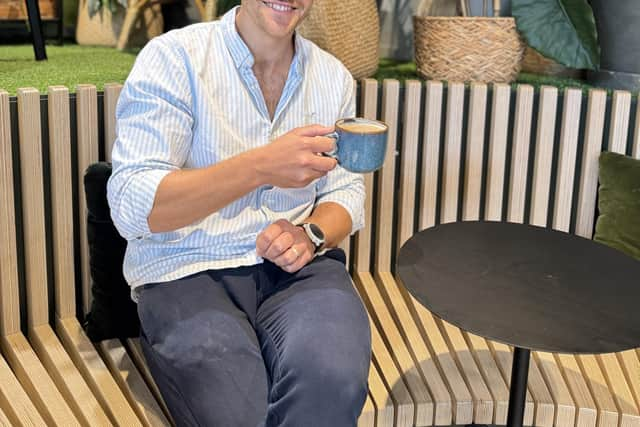

“We stuck to our guns against that, and hopefully we’ve got a bit of a niche in the market. Where the usual situation is that you go into coffee shops and they say laptops are not welcome, or you can use a laptop for 90 mins max and the wifi code cuts out, we’ve got the complete opposite.
“It's very much put your feet up, buy one coffee and stay here all day.”
Hygge’s first location, in Sheffield’s Fitzalan Square, was followed by Hygge Thirty Two, on the city centre’s Eyre Street. Earlier this year, the company launched its third city centre location at the newly created Pounds Park, in the Heart of the City development.
Hygge then made the major announcement that it was now set to expand out of its home city, launching a new venue at the Merrion Centre, in Leeds. But when asked what the future now holds for the company, Moore is cautious in his response.
“We’ve been asking ourselves that a lot recently,” he says.
“In an ideal world, we would be a regional company at most. We would never consider going national. I think it's something we wouldn't do because we would feel too far away from the business.
“I love the Northern cities, and I’d say that those within an hour of Sheffield, and those which are university cities, are our goal. I’m not from Sheffield, but my wife is, and I’m now a very proud resident of over 10 years.
“Manchester is a big city that has a big influence, and all the successful businesses from Manchester come to Sheffield and Leeds. But I love the idea of us being able to say that we’ve taken Sheffield out of Sheffield.
“I love the idea of us having a little imprint on the environment elsewhere, and people walking into a coffee shop in Manchester and saying ‘this is a Sheffield brand’. That makes me really proud.”
Moore also takes much pride in the ethos of the brand and its staff, something he feels could be at risk should the brand expand too much.
“I'm conscious of the fact that I'm going to keep the ethos and quality of the business as good as it can be while expanding,” he says.
“Whilst we’re blessed to be able to look at expanding and opening new sites, I do worry that if we grow more, we become more detached from the business.
“We’ve got our eyes set on another couple of slight adaptations and variations of the brand, but for the time being we don’t have any major ambitions. Certainly not to the point where we’re no longer independent, with investors taking control or other people that might chase the money more than us.”
Now employing around 40 staff, Hygge has from its early days employed a welfare manager, tasked with making sure staff are happy at work, and keeping track of any ongoing challenges they may face outside it. The company also pays for staff to have gym and cinema memberships.
In 2021, the company became the subject of multiple news articles after Moore came to the defence of a staff member who had been targeted for wearing a hijab in a negative online review.
The one star review, which contained just one sentence, referred to being served by a member of staff wearing “moslem dress” [sic].
Moore responded to the review, telling the writer that their opinion had “no place in this world”.
He added: “If you do find yourself visiting HYGGE again, please ask for me by name – as I'd be happy to tell you in person that you will never be welcome at our business, until you change your outrageous and despicable attitude.”
Moore’s response was praised by Tell MAMA, an organisation which works to counter Islamophobia, and led to the cafe being flooded with positive online reviews.
As Moore looks back on six years since founding Hygge, he still sees its founding principles as the key ingredients of the company’s success.
“I used to do contract work, so I would spend my life sitting in coffee shops on a laptop,” he says.
“I realised the gap in the market was for a place that competes more with co-working buildings and communal office space than coffee shops. We worked out that people spending very little per customer would be enough to just about break even if we had the right site with the right rent. So we launched on that basis, and as you can imagine, very quickly became very busy.
“Some connoisseurs may say that our coffee is not the best they’ve ever tasted, and people aren't going to get ground breaking food or drink at our places – we’re quite open about that. But our unique selling point is the environment we create, and people really like that. And I don't know many other coffee shops that get Christmas cards from their customers.”