
"I was born with one hand but it has never stopped me following my dreams," TV furniture maker Bruce Kenneth

When Bruce Kenneth moved from his native New Jersey to West Yorkshire ten years ago, not only did this signal a change in location, but it also signalled a change of career as he decided to pursue his dream of being a furniture designer and maker – despite only being born with one hand.
Bruce is now a regular on television programmes such as BBC’s Money for Nothing, where items people are throwing in the tip are rescued and then upcycled by a team of experts and then sold.
“I sold my house in America and used the money to move over here and set up the business, and it was about a year after I moved here that I did my first episode of Money for Nothing,” explains Bruce. “They initially gave me two episodes to see how I got on, and now I’ve been doing it for more than nine years.”
He even presented his own gardening programme on Channel 4 – the Great Garden Revolution – which allowed him to explore his passion for design. “I had a lot of fun with that show as I got to design and make things I wouldn’t normally do. It was a shame it only lasted two series. I really enjoyed it.”
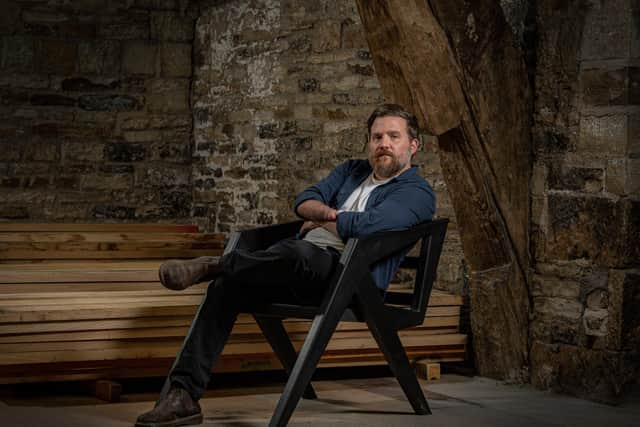

It is clear that his first love is designing and making his own furniture rather than the time-consuming job of repurposing other people’s goods, although he does still get called on by Money for Nothing from time to time and he remembers some particular projects that have been really special and stayed with him.
“There was one episode a few years ago presented by EJ (Osbourne), who passed away in 2020 from cancer. He had found a pair of French doors with plain glass in them, and I took them all apart and took them to this stained glass place in Bradford that was closing down – it was only open two hours a week. I built this really beautiful stained glass room divider, and EJ really loved it. There have been a few over the years that have been particularly meaningful, or there has been good profit on them.”
While he enjoys doing the Money for Nothing show, he says he often has to disappoint people who find him after seeing him on television.
“I’d say 95 per cent of people that find me through Money for Nothing I can’t help them,” says Bruce. “They want me to upcycle something, and really the time it takes to do something like that just doesn’t make commercial sense. In the time it took me to upcycle one piece for the programme, I could have made 26 sets of table legs. The show has a special place in my heart – I've been doing it a long time.”
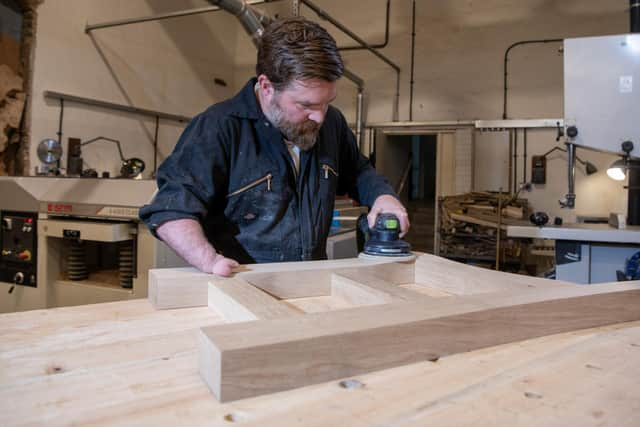
It is all a far cry from his life in America, where making furniture was nothing more than a hobby.
“I studied biochemistry at university, but I didn’t end up finishing my degree. I went back to work and joined a makers space where I could go in the evenings and weekends and just fell in love with making furniture.
“Like most people, I started making chopping boards and then made some furniture for my house.”
Inspired by mid-century design, Bruce is completely self-taught, and what makes his success even more remarkable is that he was born with no right hand and has had to undergo multiple surgeries on his left.
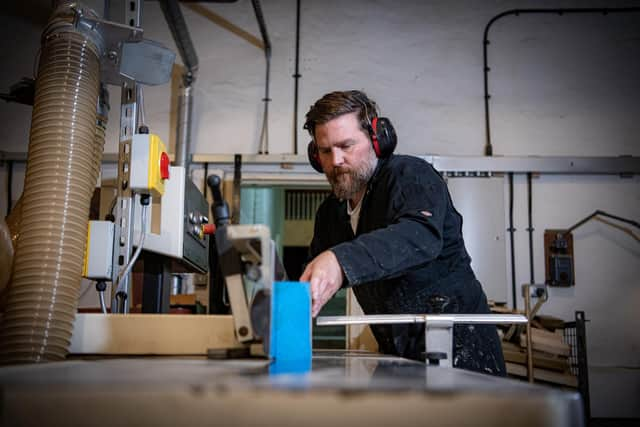
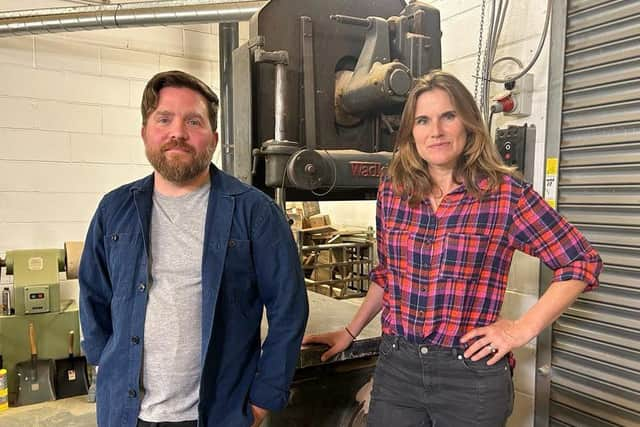
When we meet at his workshop in a village on the outskirts of Huddersfield, he is making tables for the exclusive Hyll Hotel in the Cotswolds that he has done a lot of work for over the years.
“I just made 110 oak table legs in the last two days,” he says. “I have to make 26 tables for the hotel. I am big enough to handle this type of volume but not so big that I can’t do small runs of particular things. I can do the commercial work that is too small for big companies and yet too big for the smaller one-man band.”
Even though he is a one-man band, he has reinvested the money he makes from his furniture into state-of-the-art equipment to help him take on the bigger jobs; the machinery also helps him work around his disability.
“I was born with one hand,” he says. “I have chosen to do a very manual job which has its challenges every day, and I have to contend with that. Sometimes it is frustrating, and sometimes it does slow me down a bit. But I am pretty efficient with how I have set things up, and I try to make sure the machines and tooling are always correct.
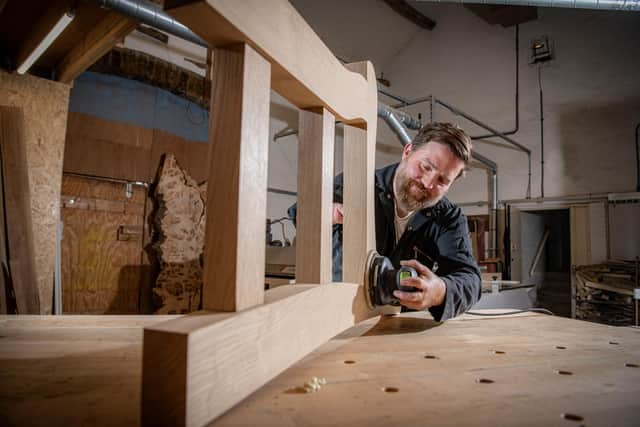
“I have invested in industrial machinery to make my life easier. Especially the CNC (Computer Numerical Control). I don’t think I’d be in business if I didn’t have that. I do a design on my computer, and then the machine cuts the wood for me, which means I can do it by myself rather than having to bring in people to help me.” He did make a prosthetic arm for himself with interchangeable components that he thought might aid him.
“I found it a bit cumbersome to use, as I was so used to functioning without a hand, I just decided I would work without it. Since I was born this way, I have never known anything else. I never let it stand in my way. I was determined to play sports as a kid. I played soccer and did a lot of the stuff the other kids did. I never got picked on because of it.” He said it was a bit harder when he was a teenager. “I was never bullied, but people did make jokes about it sometimes, and you just don’t have to let it get to you.”
Although the similarities between furniture making and biochemistry might not be immediately apparent, Bruce maintains there are similarities.
“When you are doing chemistry, it is very much like woodworking,” he says. “When you are formulating a reaction in chemistry, you look at your basic products; you have to treat them a certain way – you are slowly building a molecule that you can’t actually see, so you have to test for it. But in the end, you are building something. The same goes for creating a piece of furniture.
“I like clean design, although sometimes clean design can go too far and be too clinical and sterile; I like a good line.”
He also wants to create a tactile element to his furniture that makes people want to touch it.
A lot of his commissions are for hotels and restaurants across the country, and he enjoys working with interior designers and architects. As well as tables and chairs, he likes to do bespoke one-off items for clients.
“I often come up with a selection of different pieces and work with them to give them what they want. Or sometimes they need a bespoke piece made for an awkward area, and I am more than happy to do that.”
His work for Hyll Hotel is credited to him, so you know if you are sitting in a Bruce Kenneth chair or eating off a Bruce Kenneth table. “I love working with them; everything is very considered, and they are putting a person behind virtually everything at the hotel, from the mattresses to the bread made by a baker in the kitchen. I am thankful to be a part of it.”
He wants to do more work in the commercial sector and even explore creating works of art. “I want to do more one-off high-end pieces and limited runs of things. I really want to spend more time on things and be more creative with materials and get more enjoyment out of it.”