
' I’m quite optimistic that turkey will maintain its place as number one, but traditions do get diluted'
Boar’s head, peacock or goose? Who knows what would have been the traditional Christmas dinner centrepiece today if Charles Dickens hadn’t given turkey its best-ever advertising campaign in his 1843 masterpiece A Christmas Carol when Ebeneezer Scrooge sees the light and Bob Cratchit’s family benefits with a big bird on the table.
Charlie Woodall has been rearing turkeys for Christmas at Milford Farm on the old Great North Road, now a feeder road alongside the A1 near the old Selby Fork Motel, every year since he was born and tells, slightly tongue-in-cheek, of his own similarity to the man who became a reformed character through a series of ghostly encounters.
“Turkeys are now all we do,” says Charlie. “That means we don’t have a farm shop like we used to when we were rearing pigs and poultry, as that would mean I’d have to smile for more than two days a year, but ironically we are financially in about the same position we were by doing substantially less, going with what gave us the best return.
Turkey took over from those other three previous centrepieces and became the UK’s top choice only in the 20th century as goose went on the wane. It is reported that over ten million turkeys are purchased for Christmas Day each year and that while its popularity among those who celebrate Christmas has reduced in recent times it remains the No 1 choice with around 58 per cent gathering around the table for turkey each Yuletide.
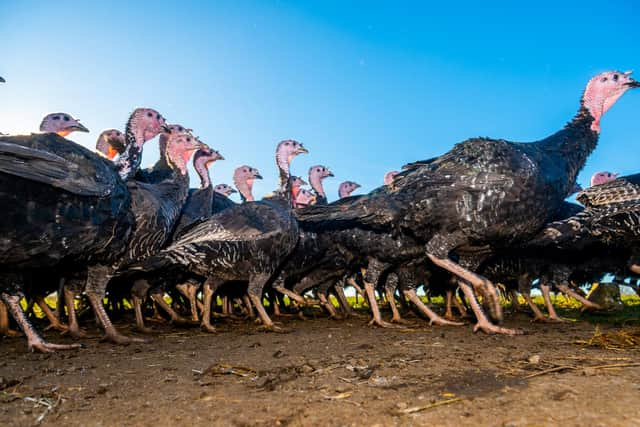

Charlie tells of how the market for cuts of turkey rather than the whole bird is now a trend he is following.
“The traditional whole bird market is declining and is going towards the turkey breast rather than the whole turkey. I’m quite optimistic that turkey will maintain its place as No 1 but over time traditions do get diluted and people don’t feel as obliged to have a whole bird.
“We’ve seen that ourselves and we are responding to the market. Last year we saw an increase in our orders for turkey breasts so this year we have brought in more Bronze stags that produce fabulous turkey breast meat. We have been rearing 1000 stags, an extra 700 on last year, to produce this. That’s where most of the meat is.
Whole birds still make up the lion’s share of Charlie’s turkey business that he operates with his wife Louise, son Sam, daughter Lottie and her husband and Charlie and Louise’s son-in-law Ed.
“As well as the Milford Bronze stags reared for breast meat we are also rearing 800 Milford Bronze whole birds and 3200 Milford Whites this year.
This is a return to bigger numbers at Milford Farm after a period when Charlie and Louise were once rearing 25,000 turkeys and then dropped to 2,000.
“We were previously concentrating on domestic size hen turkeys, which has been the more traditional market. Our industry information shows that sales have now gone towards more boneless products. I do get it, it’s progress and it’s easier.
What hasn’t changed at Milford Farm is the animal husbandry and looking after the welfare of the birds that come in as day-olds, starting with the Milford Bronze stags in early July and the rest by the end of July and into August.
“Even when we had pigs, I was always more a poultry farmer,” says Charlie. “My father George and mum Jennifer moved here in 1964, had pigs and poultry and started a farm shop. The farm was 100 acres. We now own 10 acres and rent 35 acres. We have arable land and grow our own wheat to feed the turkeys.
“We had up to 250 breeding sows at one point taking everything through to bacon which we tried to market through the farm shop and wholesale. It never really worked. I don’t understand how anybody makes money out of pigs, we tried for 40 years and never made anything. We still had them until eight years ago.
That’s when Charlie and Louise concentrated wholly on turkeys.
“We are really proud of the turkeys we rear and I always make sure that they are contented birds. They come in from Hockenhull Turkeys based in Lincolnshire and Cheshire and are what we call Barn Reared Milfords that are given plenty of room, plenty of straw, and plenty of daylight with open sided buildings. They are bedded up twice a week and we make a point of keeping them clean and ensuring they enjoy their lives in the right kind of environment.
“In addition to the wheat, their feed is also made up of other key ingredients including minerals, soya and soya oil. We also include fish when they are younger. We want our birds to be as healthy as possible.
Charlie says he took the decision to keep his birds inside with the heaviest of hearts.
“Sadly, because of the risk of bird flu we simply cannot afford to let them roam outside, except for a few minutes for the Yorkshire Post photographer. It’s just too big a chance to take, but as we are rearing substantially less, the birds have far greater space than they had previously.
“They’ve got it (bird flu) worse on mainland Europe. That’s where it comes from to get over here, from migratory birds. The threat is quite geographical, if you have migratory birds on your farm the chances of your birds getting bird flu are higher, although that’s not definitive. I have heard horror stories among other bird farmers in the UK that I wouldn’t wish on anybody.
Charlie says that the contributions being made by Sam and Ed, who both have full-time occupations in other businesses is what is shaping today’s Milford Farm Turkeys.
“I’m old school and have been more interested in wholesale orders, but the future clearly is more into retail and that’s where Sam and Ed are moving us. We need the volume of turkeys to justify keeping the whole operation and we’ve already gone from 200 turkeys retail four years ago to 500 that we anticipate we’ll sell retail this year through Sam’s experience of marketing as a paid media buyer using Google Ads and Ed’s digitalising of our order tracking process and use of bar codes. We’re no longer a pen and paper business, everyone can order online and pick up from our pop-up shop.
“We’re in a far better place and more sustainability focused with the light and heat for the turkeys coming from solar panels on the barn roof.
“I’m very proud of the way we are marketing and what we are producing and how we have achieved it through the face of adversity from Brexit, Covid or Bird Flu. I’m also proud of continuing to supply local butchers and farm shops.
“Farmers only want to get a fair return for their labours and probably would be quite happy to pay Inheritance Tax if they were able to get that, but the price of food would need to go up.
“Our Milford Bronze turkey breasts are certainly great value, as are our whole birds – and I might even smile like Scrooge when you come to pick up yours!
Www.milfordfarm.co.uk