
Leeds Palestinian Film Festival: Yalla Parkour and Palestine 36 among highlights at event
Leeds Palestinian Film Festival aims to go beyond the headlines to explore the lives of people in Gaza and the West Bank. John Blow talks to the organisers.

The first Leeds Palestinian Film Festival, Frances Bernstein remembers, was a modest affair. “We started in a very small way, in a very amateurish way, showing films in rooms where we had to stick bin bags over the windows with masking tape to darken the room,” she says.
When the 11th edition of the event takes place from November 12 to December 6, it will be decidedly more professionaly, with the help of venues across Leeds including Hyde Park Picture House to community spaces like Mill Hill Chapel, St Luke’s Cares, Heart in Headingley, All Hallows, St Chad's, Otley Courthouse, Quaker Meeting House and the University of Leeds.
Frances and Helena Johnson are two of the festival’s co-directors and have quite different reasons for taking an interest in the Palestinian cause.

“My family were political activists in South Africa against apartheid, and were forced to flee when I was 13, and came to England,” says Frances.
Her father was Lionel ‘Rusty’ Bernstein, an African National Congress campaigner who was tried alongside Nelson Mandela.
Frances says: “England offered me a home and so I had a strong affinity with people who feel that they're under oppression and wanting some freedom. That attracted me to be interested in Palestine.
“Film felt like a wonderful way to invite people who know nothing or little or a lot to come into a safe space and explore other human beings, connect with other human beings, which is what film, like any art form, does - is enable people to connect. And I felt with Palestine that was really important, to help people understand and connect and identify with people, their fellow human beings.”
Helena comes from a community arts background and her involvement with the festival stems from being an attendee, admitting that she previously knew “very” little about Palestine.
“It really did help me to start to understand some of the issues,” she says. “I'd always been aware of the situation in Palestine, but I hadn't fully understood the depth, I think, of the issues and it just whetted my appetite. I wanted to find out more.”
People attending the festival can expect a mix of feature films, documentaries, shorts and panel discussions, showcasing both new and established Palestinian voices.
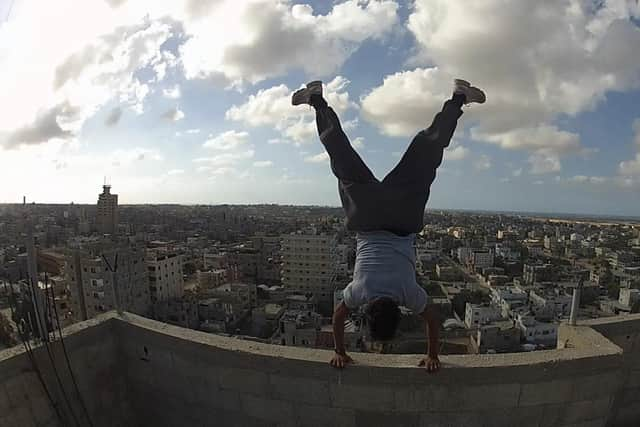
The festival kicks off on Wednesday, November 12, at Hyde Park Picture House with the opening film, Yalla Parkour, in partnership with Leeds International Film Festival.
The documentary is written and directed by Areeb Zuaiter in her directorial debut feature. Frances notes how parkour - in which participants run, jump and vault around urban environments - “gives them a sense of freedom which they don't have in their everyday lives, to be free to cavort on the tops of buildings and take risks and be in danger, but in an enjoyable way”.
Helena says: “Once issues like conflict hit the headlines, the people involved very quickly become dehumanized, and we as consumers of news, very quickly stop seeing the people as humans behind the headlines.
“That is what is so exciting about this festival. Just before this interview, I jotted down the main subjects that the films are covering this year and it's sport, street art, history, comedy, current events, the conflict, fine art - it's right across the human spectrum, and and the themes are so strong, things like love and loss and family and homesickness. It's just such a powerful tool to kind of help us in this situation, to realise that there are people behind the headlines.”
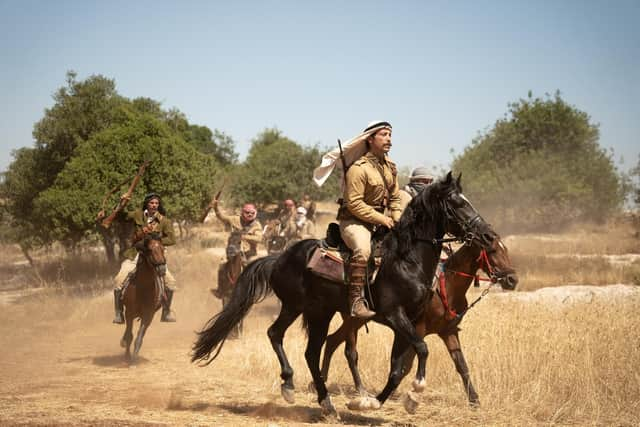
Another highlight takes place on Thursday, November 20, at the same venue, featuring the exclusive Leeds premiere of Palestine 36, Palestine's official submission for Best International Feature Film at the Oscars which portrays villages revolting against British rule 90 years ago.
Sir David Hare, too, is a friend of the festival, as he previously came to give a talk when his film Wall was screened.
“Obviously, in 2025, the festival is more necessary, more urgent and more important than ever,” he said.
It is a volunteer-led programme with a core of eight people - directors of what is a community interest company - who are then joined by around 30 others at festival time.
One of those is Saba Saddiqui, a visual artist from Sheffield now based in Leeds, who is helping to organise the festival’s final event, Art in Ruins: Persistence and Resistance. Three short films will be screened at Heart in Headingley to coincide with a new exhibition of work by five Gazan artists and curated by Gav McIntosh from Artists Supporting Palestine.
Saba, 26, started attending in 2023. “I thought it was a really good way to learn more and hear about stories through quite an accessible way,” she says. “I just found it to be such a lovely community and, going with friends, it was something that we could do practically as well.”
Darcy McBrinn, 23, a writer who now lives in Glasgow, was based in Bramley, Leeds, when he got involved with the festival a couple of years ago.
He says: “I’m from Northern Ireland and I find that so much of the international understanding of us is based solely around tensions and politics, even though there is such a rich culture and community. I feel Palestine can be perceived similarly, and thus I really resonate with its cultural status. Just like all of us, Palestinians are humans with human experiences and human stories that I want to help share and celebrate.”
Juman Quneis, a Palestinian documentarian who lives in Ramallah, in the West Bank, and who in 2023 studied cinematography at MetFilm School in Leeds, will also present her film The Loud Silence on December 4. It profiles Women in Black, an anti-war group which holds silent vigils in the West Yorkshire city’s Dortmund Square.
Meanwhile, the Women, Film & Resistance in Gaza event is on November 27, featuring women’s stories from the last two years and is presented with Gaza International Festival of Women’s Cinema, which has been taking place this month amid the wreckage left there by the war.
Frances says: “We cover all aspects of human life. The opening film is about parkour in Palestine. We have an embroidery workshop. We have a film made by an Israeli comedian who was also a UN diplomat (Noam Shuster-Eliassi). We have an art exhibition. You can come and discover the richness of Palestinian life, far beyond what you experience through the ordinary media, who can only show you current affairs and often very narrow, stereotyped ideas of what other people are like. We really invite people to come and experience some of the richness that they are unaware of and the variety, the broad variety, of what Palestinians are saying and have to offer and are doing.”
For more information and tickets, visit: leedspff.org.uk/