
Metal detectorist strikes gold in Yorkshire field as rings set to fetch £10,000
Andrew Riley has been scouring the fields in Northallerton with his metal detector for week when he literally struck gold.
Now the 15th century enamelled ‘blood of Christ’ ring and a late Medieval iconographic ring of St Margaret of Antioch which he uncovered are up for sale today in a Noonans Mayfair auction on Tuesday, September 22, 2026.
Both rings were discovered by semi-retired architect Mr Riley, who lives in North Yorkshire on the rural outskirts of Middlesbrough. They are expected to fetch £5,000-7,000 and £4,000- 6,000 respectively.
Mr Riley began metal detecting in the 1990s but stopped and only took it up again about four years ago. Now he tries to go out at least twice a week to keep fit.
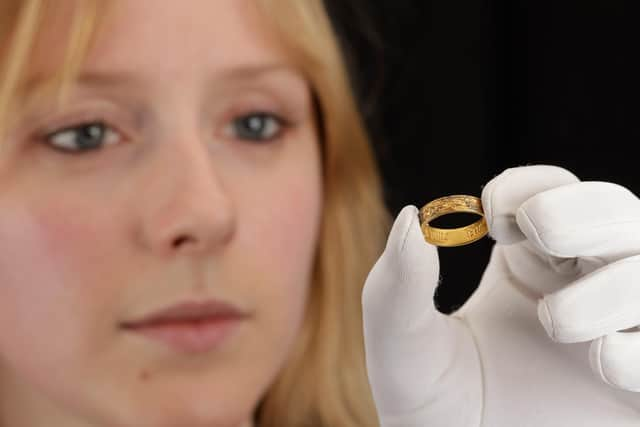

Of his find, he said: “I had methodically searched the rigg and furrow field over the course of a few weeks when I found the “blood of Christ” ring. It was about eight inches deep just laying on top of the soil after I had removed the clod, I thought it was just costume jewellery at first until I saw the inscription. I was on my own at the time so ran up to the farmhouse to show the landowner."
He added: “The iconographic ring was in a field I had only been in a few times before, I was on my own, it was a very hot summer’s evening and I nearly gave up as I hadn’t found much, then I found an Elizabeth I sixpence followed by some mystery silver chain links.
"As soon as I saw the glint of gold in the soil, I knew straight away what I had found and took some photos in situ, did the obligatory gold dance and then had a lie down in shock. I then went to show the landowner who was equally excited.”
He intends to share the proceeds of his find with the landowners.
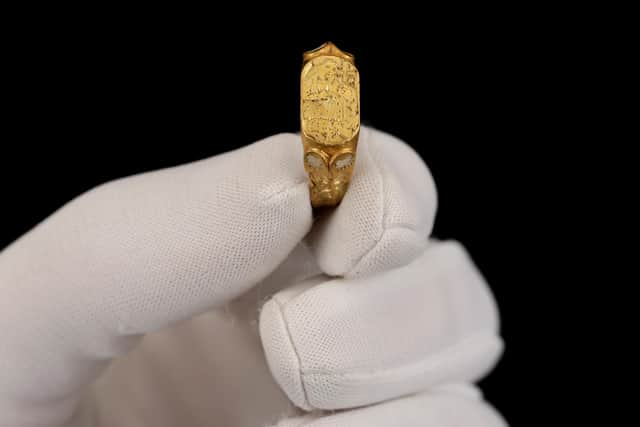
Laura Smith, jewellery specialist at Noonans, said: “During the Medieval period there was a shift in tone in Christian devotion towards an emphasis on Christ’s bodily suffering in order to bring redemption to the world. There was a focus on the five wounds of the crucifixion and the blood shed by Christ, and this is seen in illustrations in manuscripts and in pieces of personal devotional jewellery, such as the first ring here.”
She added: ”Also at this time religious guilds were popular. One such was the Corpus Christi Guild at York which was founded in 1408 and by the dissolution had 17,000 members, including James Strangeways, a landowner close to where both rings were found.”
She said the other ring depicts St Margaret of Antioch, who was highly venerated in the Medieval period and was supposed to have appeared to Joan of Arc in 1428.
"She was particularly called on by women experiencing childbirth. She was the daughter of a pagan priest but was inducted into the Christian faith by her wet nurse, who raised her after her mother died in childbirth. She pledged her virginity to Christ, which led to disownment by her father, and when she refused to marry the Roman governor, she was imprisoned,” Ms Smith added.
"She endured torture but survived by the power of various miracles. Her most famous involved Satan appearing in her prison cell in the form of a serpent or dragon and swallowing her. She was eventually beheaded.”