
'Mountain ash are an adaptable lot, well able to make the most of various soils and situations'
Autumn has arrived - if rowan berries are anything to go by. The birds are in for an early feast because the branches of the mountain ash have been weighed down with avian fast food for several weeks.
The bright red fruits of the likes of Sorbus aucuparia are usually ready for the eating at the end of August, but other varieties seem less attractive to the birds and so can hold on to their fruits for months.
Mountain ash are an adaptable lot, well able to make the most of various soils and situations – and weather. They also self-seed like mad - if you decide to grow one, expect its offspring to sprout up in the most unlikely places.
Sorbus, although not long-lived, are tolerant individuals and come in a variety of shapes and sizes. Some spread their canopies wide; others grow almost like columns, and many are recommended for smaller gardens. But ‘small’ can mean many things, and unless you’re prepared to prune regularly, that ‘small’ rowan could end up a bit on the large side.
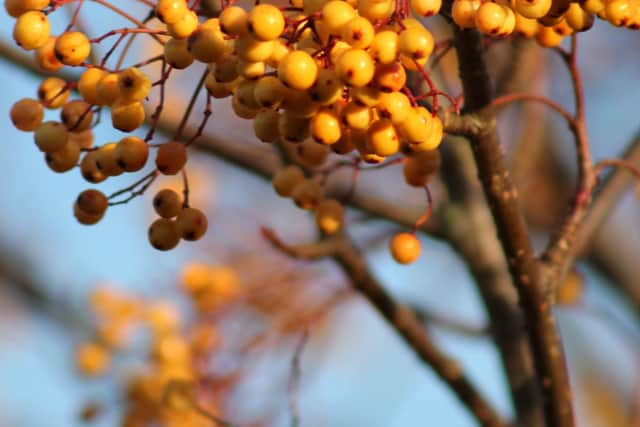

In the end, it’s down to the individual, and the colour of those berries - if you’re really brave and are willing to search for and spend a bit more on something rather special, you can have brown berries in the shape of S meliosmifolia, which hails from China.
For white berries, there’s none better than S cashmiriana. It comes, no surprise, from Kashmir. And it is one of the most attractive of the family, growing slowly to a maximum height of 24ft or so.
If you want red, then S hybrida ‘Gibbsii’ should fit the bill. This is one tough tree, with lovely foliage as well as those long-lasting berries. However, it demands more room than your average rowan.
And then there’s Sorbus americana, which has clusters of small white flowers in May to June, and then red, showy fruits ripening in September. It’s also described as a small tree, but it can actually reach 40ft.
Viburnum
And then there’s the equally-berried Viburnum opulus, seen occasionally in gardens where it more often than not forms part of a mixed hedge.
Occasionally, if may be grown as a specimen shrub but it can be unreliable, even downright sulky, so there are definitely grounds for giving it a wide berth if you want something consistently floriferous.
Once it was a lot more common, grown for beautiful white flowers and waxy, red berries that look a bit like red currants. The plant’s leaves resemble those of a maple, but there the similarity ends. But that’s one of the reasons many people are puzzled by the plant – they can’t identify it.
And yet it’s a very accommodating shrub; it doesn’t mind even moist, moderately alkaline soils. In fact, it will tolerate most soil types that at one time it was a bit of a fall-back for sites where a lot of shrubs fail to flourish.
Yet give it a well-cultivated soil rich in humus, and it will put on a first-rate show before it finally sheds its leaves and becomes nothing more than a pile of brown twigs.
The acidic fruit is edible in small quantities, but it can be used to make jelly. It is, however, mildly toxic – so perhaps that’s why birds leave it alone unless there is absolutely nothing else on the dining table.
It can get a bit twiggy, and if left unpruned will spread to become a healthy 10 foot tall and equally as wide, and it can throw out more growth via lengthy underground roots, so it pays to keep it in shape by cutting it back after it’s flowered. Then, of course, you forfeit the berries for that year – although the birds probably won’t mind.
Any unwanted bits springing up from the soil should be pulled or dug up before they join to make an impenetrable mass of woody growth.
Snowberry
While some plants grow to become stars in the garden, others seem content to play a supporting role.
And so it is with the snowberry, Symphoricarpos albus, a deciduous shrub that often appears suddenly among established garden plants because few, if any, are actually planted by the gardener; they are plants that ‘blow in’ and take root.
While Symphoricarpos albus may not be the most beautiful or best-behaved shrub in the garden, it has some good qualities - it blooms in spring, with small dense clusters of bell-shaped, pink/white flowers at the ends of the branches. In autumn, the flowers are replaced by clusters of white berries that give the plant its common name.
These berries are round, fleshy and last long after the shrub has shed its leaves for the year. Birds and other forms of wildlife appear to be able to eat them but they are poisonous to humans, so that’s another reason to consider carefully should you ever decide to invite one into your garden.
A snowberry grows reasonably quickly and it’s happiest in a sunny spot in reasonably fertile soil. But it’s also adaptable enough to cope with a fairly shaded area. In the wild, the shrub is often found naturally along stream banks but it is tough enough to grow just about anywhere.