
Mystery of the Victorian top hat found in pond in archaeological dig

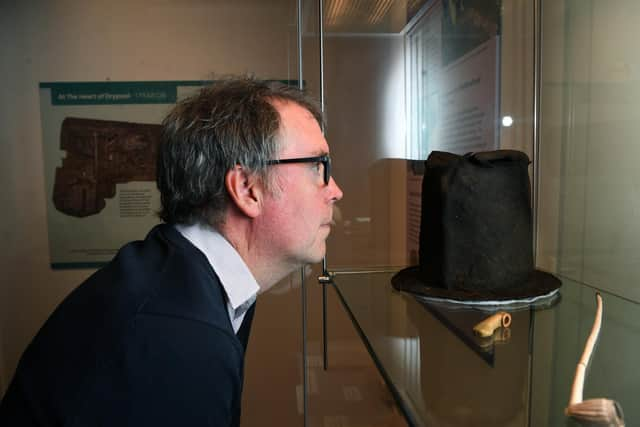
In among the thousands of items found dumped in a centuries-old pond archeologist Peter Connelly’s favourite is a top hat.
Buried along with clay pipes, buttons, belt buckles, hat pins and wood combs, the crushed top hat has since been conserved.
But how it got there remains a mystery.
Was it knocked off the gentleman’s head by a mischievous urchin, or was it blown off by a gust of wind and did he watch as it sank forever under the turbid waters?

No one will ever know.
The artefacts, which have gone on display at Hull’s Streetlife Museum, were discovered during a community dig at the site of the former Clarence Mill.
The huge flour mill built in the 1890s by Joseph Rank next to the River Hull was demolished in 2015, and is now finally being redeveloped for housing.
The excavated area was once a yard, built on top of the pond, which had been gradually filling up with rubbish over the years, and was finally filled in by 1840, when the village of Drypool, became part of Hull.
Peter, who is manager of Humber Field Archaeology, said: “The pond had become a smelly, polluted mess.
"People have used it as a tip which is why we found lots of pottery and clay pipes – including an almost complete long stem clay pipe, badges from the local militia that were housed in the (Henry VIII) Citadel, a toy anchor from a toy boat, animal bones, leather shoes.
"There are objects that take you back to the medieval period, a large fragment of a jug which dates from the 14th century, after Hull got its charter.
"It might be quite a deep pond because we haven’t got to the bottom of it. We don’t know if it’s natural, or was dug out for clay extraction.
"We do know it’s long been a part of Drypool – certainly for 400 to 500 years.”
As for the 19th century top hat, the volunteer must have been surprised by the transformation it’s undergone at the hands of conservators, as when it was first dug up it looked like a dirty bit of leather.
It was made out of rabbit fur – a notch down from the finest top hats, which used the dense, underfur of beaver – the hat of a manager or millowner.
The dig also uncovered the base of the wall and the top of a 10-m wide ditch, which were part of extensive fortifications ordered by Henry VIII, including a central castle and two large blockhouses, built to guard the strategically important port.
The exhibition is accompanied by an events programme, including a walking tour with staff from Humber Field Archaeology on the history of Drypool.
“At the Heart of Drypool: One Year On” is on display until November 9. Entry is free.