
New date for opening major visitor attraction with historic fishing trawler in Hull

A historical deep-sea trawler will finally move to a new berth when the tide is right next Spring.
Arctic Corsair, the sole survivor of Hull’s once-mighty distant water, sidewinder fishing fleet, will float into dry dock on the River Hull, alongside a new visitor centre as part of the long-running £65m Hull Maritime project.
Visitors will be able to look inside the trawler, built in 1960 at a Beverley shipyard, and get a sense of the fishermen’s lives, see the food they ate and listen to the country and western music they played on their trips to the Arctic.
People will also be able to go down into the dock to appreciate the true scale of a ship, which famously rammed an Icelandic patrol vessel during the Cod Wars - disputes which eventually saw the decline of the British distant water fishing industry and the loss of thousands of jobs.
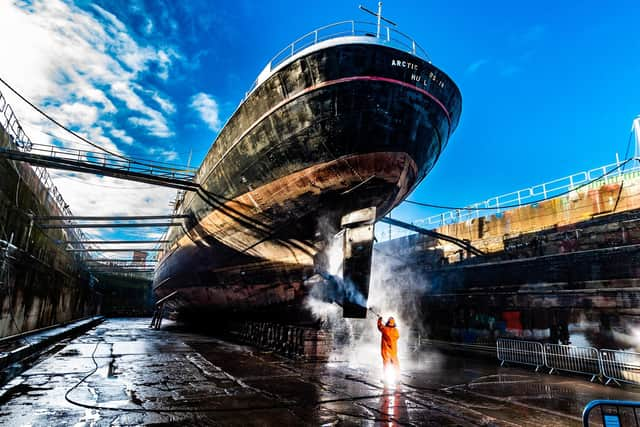

The attraction at North End Shipyard – where the HMS Bounty of Mutiny on the Bounty fame was launched in 1784 - was originally due to open in 2024.
Hull Council has had to wait a year-and-a-half for a licence from a Department for Environment, Food & Rural Affairs quango, the Marine Management Organisation, to dredge silt from the River Hull.
Some 3,500 cubic metres needs to be removed so a new 50-tonne dockgate can be installed and also to give the trawler, currently berthed at William Wright Dock, headroom to turn into her new home, on the first suitable tide, which won’t now be until next April.
The licensing process has become more onerous since the mass die-off of shellfish off Teesside and North Yorkshire in 2021, which led to fishermen’s protests and was initially blamed on the dredging of the River Tees. A report said a disease or parasite new to UK waters may have been responsible.

Hull Council now has to dispose of the dredged silt on land, rather than in the Humber, adding to the cost.
Project director Gill Ogersby said: “Even if we wanted to (move Arctic Corsair) we wouldn’t be able to this year. The tides aren’t right – the first is in April next year.”
When the vessel is in dry dock, she’ll be fitted out with equipment which forms part of the new displays and will finally open to the public next Autumn.
Ms Ogersby said the new highly insulated visitor centre was “the first of its kind”. It has achieved Passivhaus certification and doesn’t require gas, producing much of its own energy from solar panels on its roof. "It is ground-breaking and sometimes (these projects) are not always as straight-forward as anticipated. But the end result will be worth waiting for,” she added.
“This will be an incredible visitor attraction for Hull and East Yorkshire, which will show you can make a very energy efficient building.”