
90 years on, the Battle of Holbeck Moor in Leeds remains a powerful reminder of what can happen when a community refuses to surrender to hatred - Jon Trickett
To build a better future we need to know our past. When - 90 years ago in September 1936 - Mosley’s Blackshirts threatened to march through Leeds, thousands stood up to be counted.
We occasionally hear the phrase about ‘man’s inhumanity to man’. One of the most grotesque incidents in the last century was the Nazi attempt to wipe out the Jewish race. One of their first actions was to mark the outside walls of properties of Jewish families and business.
The chilling sight of men in black shirts, black hoodies and balaclavas in Dover reminds us of the times when in England there were thugs in Blackshirts. 90 years ago this month they marched into the East End and slunk out defeated. Cable Street is rightly remembered. It was a great popular stand against fascism, and its place in our history is secure. But we shouldn't imagine that the resistance to the fascists only occurred in London.
Something similar happened right here in Yorkshire, in the city of my birth, Leeds. One week before Cable Street Oswald Mosley brought his Blackshirts to Holbeck Moor. In the dark of night fascist thugs were reported to be painting identifying marks on Jewish properties. They came to make a display of strength. They left having learned that Leeds would not be cowed. Many of these thugs weren’t local.
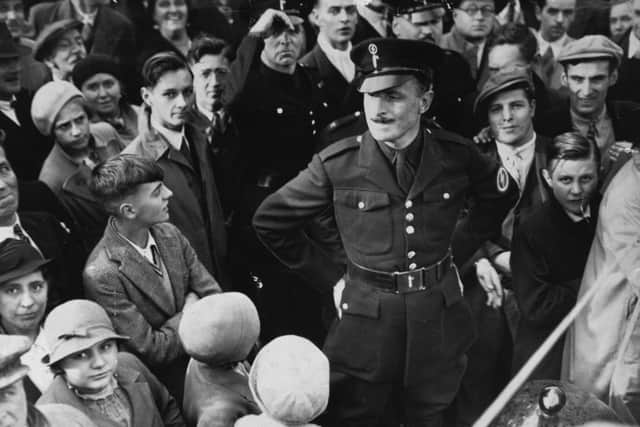

Leeds became the scene of one of Britain’s most remarkable confrontations between home grown fascism and ordinary working people. What happened should make all local Yorkshire and Leeds people proud.
On September 27, 1936, Sir Oswald Mosley and his British Union of Fascists – the notorious Blackshirts – brought their antisemitic politics to Leeds. Their proposed march through the Leylands, home to a large Jewish community, was met with fear, anger and determined opposition.
For many local people, including my own family, this is not simply a chapter in a history book.
On my mother’s side, our family had arrived in Leeds after being driven out of Eastern Europe during the nineteenth century. Thousands of Jewish immigrants made their home here. They had escaped persecution and sought safety and opportunity in Britain. In Leeds, my great grandparents were boot and shoe operatives, working in a workshop near a synagogue in the Leylands area.
My mother told me about what became known as the Battle of Holbeck Moor, passing down memories of an event that had taken place long before I was born. The story remained alive because it represented something more than politics. And we shouldn't forget it now. It was about ordinary people defending their neighbours, their homes and their right to live without fear.
The Jewish community of Leeds had grown throughout the late nineteenth and early twentieth centuries. Families arriving from Russia, Poland and other parts of Eastern Europe settled in areas such as the Leylands, building businesses, synagogues and community organisations.
The Leylands became a centre of Jewish life. But in the 1930s, the rise of fascism across Europe cast a long shadow over the community.
Mosley, a wealthy posh boy, turned fascist leader, openly promoted antisemitic ideas and admired Hitler’s Nazi Germany. When plans were made for a Blackshirt march through the Jewish quarter, there was real fear that they would foment violence and disorder.
The Leeds Watch Committee, the organisation responsible for overseeing policing, refused permission for the march to pass through the Jewish community. However, Mosley was allowed to hold a rally at Holbeck Moor.
On that September day approximately 1,000 Blackshirts gathered. But, waiting for them were an estimated 30,000 local people, determined to demonstrate their opposition to fascism.
The scale of the protest was extraordinary. Leeds had sent a clear message that hatred would not be allowed to march unchallenged through its streets.
The intimidation did not stop with political speeches and swaggering fascist marches, in a spine chilling series of actions Jewish homes, shops and property were targeted with antisemitic graffiti and swastikas, echoing the persecution of Jewish people already taking place in Nazi Germany. Even as I write this my blood runs cold as I think of the evil which was perpetrated that day.
For families who had fled Eastern Europe to escape antisemitism, seeing Nazi symbols appear in our wonderful Yorkshire was deeply disturbing. The symbols were not merely political slogans. They carried the terrifying meaning of what was happening to Jewish communities across Germany.
Yet the story of the Battle of Holbeck Moor is ultimately one of resistance, justice and fairness.
My mother’s memories, passed down through our family, remind us that history is not only about famous politicians or major events.
Ninety years on, the Battle of Holbeck Moor remains a powerful reminder of what can happen when a community refuses to surrender to hatred.
The Jewish community went on to help create Leeds’ later prosperity, its varied cultural life and strong values. Nowadays we remember the 30,000 Leeds people who stood up to be counted for justice and strong neighbourly ties. To do justice to their memory, never again must we tolerate the stain of anti-semitism and any other form of racism on our streets or in our communities.
Jon Trickett is the Labour MP for Normanton and Hemsworth.