
A hardening stance on immigration across Europe could lead to populist-fuelled instability - Joe Harrison
Despite an agenda originally designed to focus on Ukraine and the Middle East, it was migration that dominated the recent European summit. Responding to unilateral decisions such as Poland suspending the right to asylum and Germany imposing new border checks, President of the European Commission Ursula von der Leyen proposed new legislation to facilitate the deportation of irregular migrants and outlined opportunities to explore using ‘return hubs’ in third countries.
Given the UK’s longstanding concerns over irregular migration, this hardening of attitudes may tentatively seem like a positive step for UK-EU rapprochement. But it also highlights the growing influence of Europe’s populist parties – on both the left and the right – and their potential to disrupt future cooperation by creating divisions at the EU’s core.
With a wobbly mandate and a public mostly in favour of stricter immigration controls, Prime Minister Keir Starmer – who has himself explored offshoring arrangements – may hope that a tougher EU consensus on irregular migration will bring fresh opportunities for closer alignment and improve his chances of achieving a reset in UK-EU relations.
However, look behind this shift’s potential appeal and you will quickly find that it foreshadows a much bigger problem down the road: populist-fuelled instability.
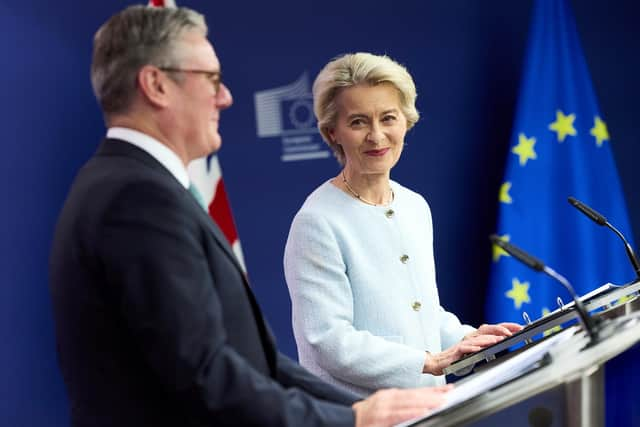

At first glance, the Commission’s exploration of return hubs is a clear nod to the growing influence of far-right Italian Prime Minister Giorgia Meloni. Her new Albanian detention centres – though recently thrown into question by a series of legal hurdles – have regularly been held up as a model to follow. Yet, the summit’s discussions also respond to a much broader increase in the policy momentum that populist parties are able to generate on the European stage.
Clear evidence of this is the joint letter sent to the European Commission earlier this month which relayed 17 European nations’ demands for tougher controls and was a key trigger of the summit’s legislative discussions.
The letter’s two principal authors – Austria and the Netherlands – both saw far-right populist parties win national elections in the past year on strong anti-immigration platforms. More significantly, of its 17 signatures, eight represented nations where populist parties now boast serious political power: whether as primary parties of government, as in Austria, Hungary, Italy and Slovakia; as junior coalition partners, as in Finland and the Netherlands; or in confidence and supply arrangements, as in France and Sweden. The letter was also signed by Germany, where the far-right Alternative for Germany and the far-left Sahra Wagenknecht Alliance parties recently soared up the polls in last month’s regional elections.
European consensus may be able to stomach offshoring. Indeed, an overwhelming 71 per cent of the EU public supports stronger migration controls. But the broader growth of these radical movements, often characterised by thinly-veiled euroscepticism, seriously threatens Europe’s long-term cohesion and stability.
The UK may no longer be part of this imperilled Union, but its division will seriously complicate the task of improving relations across the Channel.
European instability in general is bad news for Starmer’s ‘reset’ ambitions as it risks upsetting the continuity needed to rebuild relations. Yet defence and security are where Starmer’s ambitions are especially endangered. These are the policy areas where the UK holds the most sway and where Starmer has rightly pinned most of his reset hopes.
Frustratingly, they are also areas where anti-establishment populist parties can cause the greatest damage to partnership arrangements. While Meloni has fallen in line with the European consensus on issues like Russia-Ukraine, Hungarian Prime Minister Viktor Orbán has provided an obstructionist playbook for other populists sympathetic to Putin such as Robert Fico in Slovakia or Geert Wilders in the Netherlands.
With the US election just weeks away, a potential second Trump presidency risks aggravating this situation even further. With added economic pressure from protectionist tariffs that could knock 1 per cent of Europe’s GDP overnight, the Republican candidate’s brazen attitudes to NATO and Ukraine risk widening European splits down pro- and anti-Trump lines.
What is more, there is a chance that Brussels responds to increased internal division by going on the defensive. This could mean seizing the opportunity to show a united front against British efforts towards fresh concessions, just as Brexit negotiations provided a useful rallying point during the 2016 ‘polycrisis’ of national debt and migration.
These gloomy predictions are by no means certain. The EU has a long history of resistance against instability. There is likewise a chance that this summit kicks off a concerted effort that tackles irregular migration, undercuts the populist resurgence and creates a policy platform that the UK can work alongside. But in the context of populists’ growing capacity to set the terms of EU debate, it has to be said that this chance looks remarkably slim.
Tougher consensus on irregular migration might seem auspicious for future UK-EU relations, but its broader context is anything but.
Joe Harrison is a researcher at the Bright Blue think tank.