
Andy Burnham's 'good growth in every postcode' pledge looks like an unachievable fantasy: Jayne Dowle
Is it really only six months since Prime Minister Andy Burnham promised “good growth in every postcode and hope in every heart”? As winter sets in, Christmas looms a month away and the threat of gas and electricity bills going up by £500 in 2027 awaits us to beckon in the New Year, we could be forgiven for wondering if he is thinking of postcodes - and hearts - on another planet in a galaxy far, far away.

Because it’s certainly not happening where I live. Christmas lights are appearing in windows, the supermarkets are plastered with festive posters advertising eye-wateringly expensive tech and toys, and you can’t turn on the TV without tables laden with turkey, trimmings and ‘picky bits’ at a fiver a pop reminding you with dread that shopping lists must soon be composed.
It’s probably true to say that unless you’re one of the lucky Yorkshire residents who has recently won big on the Postcode Lottery - that’s certainly going to be putting a bit of hope in their hearts in Birdsedge, Dacre and Keighley - or benefit from a substantial private income, you’re wondering how on earth you’re going to pay for it all.
I’m beginning to notice a grim acceptance that things are not going to get any better, any time soon, no matter what any politician says. That £100 Chancellor John Healey promised in the Budget to hand out to all households paying Band D council tax to help with fuel bills? It’s a miniscule drop in the rising ocean of punishing prices - not just home energy, but food, household goods and the cost of petrol and diesel so unstable going to the garage to fill up has become a lottery in itself.
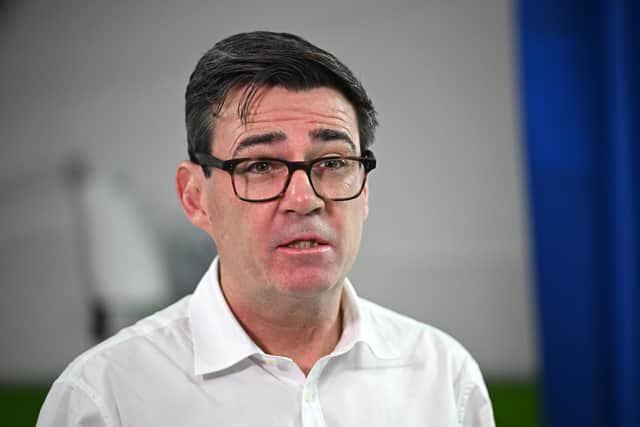

It would be invidious of any PM to paper over this general mood of national gloom, but still Burnham can’t stop himself. In his speech at the Lord Mayor’s Banquet at the Mansion House in London last week, he was at it again.
Announcing Labour’s Plan for Britain, which we can look forward to arriving in December, he described it as “… the circuit-breaker. A 10-year roadmap to a resurgent Britain, rewired to put power into every postcode and the good growth that follows”.
Let us hope then that not only can we afford to flick the switch but that the storms, blizzards and general chaos we’ve been warned to except from a lethal combination of El Nino and polar vortex disruption don’t take out the entire National Grid.
Honestly, what on earth is Burnham talking about? Even one of his own most trusted economic senior advisors, Sir Jim O’Neill, had told him that his pledge is not realistic and risks wasting taxpayers’ money.
Back in September, O’Neill - who turned down a job in his government – warned Burnham that ministers should instead focus on generating growth in key city regions.
O’Neill believes that Burnham’s devolution agenda should encourage ministers to be “pretty honest and brutal” about which areas need to be prioritised, focusing on parts of the country where regional government was already well-established. He did add that along with London, the Northern Powerhouse region of Leeds, Sheffield, Manchester and Liverpool, Leeds and Sheffield should be at the fore. But this leaves many other areas out in the cold.
He also warned Burnham that his devolution plans could backfire if he handed too much power to regions that did not have the “capability” to spend taxpayers’ money effectively.
“I’m not a huge fan personally of the growth in every postcode. As I’ve actually said to them privately, recently,” O’Neill told the Centre for Cities, an economics think tank.
“Most of us take that to mean they are going to try and directly support growth in every postcode. And let’s just say, good luck with that strategy, if that’s it … it would almost definitely result in some wasted taxpayers’ money.”
So, not only are we feeling the pinch privately, this hapless so-called strategy looks as if it holds strong potential to waste public money too.
Never fear, Burnham announced at the Mansion House that he has devised something called ‘the Makerfield Test’ - a new approach to government which is inspired by his own Greater Manchester constituency.
Apparently, this test will judge “all policies through the lens of our least well-off communities and whether they will make life better there or worse”. This sounds hopelessly parochial at best, highly untenable at worst. As Jim O’Neill might say, “good luck with that as well”.
In these tough times, there really is no need to make things complicated. We need strong leadership from the front, not promises that in 10 years’ time the country will be a different place again. Most of us already fear this prospect in any case, because everything is so uncertain with the world.
Would it be too much - as we face challenges on the home front and global threats, not least Trump, Putin and Xi lining up for a cheesy world leaders’ shot - to ask Burnham to consider seriousness over soundbites as his New Year resolution?