
Answers are long overdue on Orgreave but the inquiry could prove to be worth the wait - David Behrens
There’s a lot of stuff we don’t hear about until it’s too late: dirty little secrets that governments sweep under the carpet and leave to fester until long after the dust has settled. Eventually, under the ‘20-year rule’ that spares the embarrassment of those involved, the files are unsealed and there begins a game of guessing whose names have been redacted.

This week the National Archives released their annual batch of previously classified documents and we learned, for instance, that Buckingham Palace tried to orchestrate Cabinet support for a new Royal yacht; that the scandal-prone Peter Mandelson grovelled to Tony Blair for a new job; and that Blair received thousands of pounds in discounts on designer clothes. Look out for a similar note on our current PM, 20 years from now.
Under the 20-year rule, the details of what happened outside the Orgreave coking works in South Yorkshire during the miners’ strike of 1984 should have been made public a generation ago. So it ought now to be documented history that Margaret Thatcher made a concerted effort to weaponize the police against members of the public.
But some secrets remain secret. And while Mrs Thatcher’s motives have never really been in doubt, her exact instructions have remained locked away; a ticking time bomb under the careers and police pensions of those who carried them out. As recently as last year, the Northumbria force was revealed to have destroyed two boxes of relevant evidence, on the pretence of data protection.
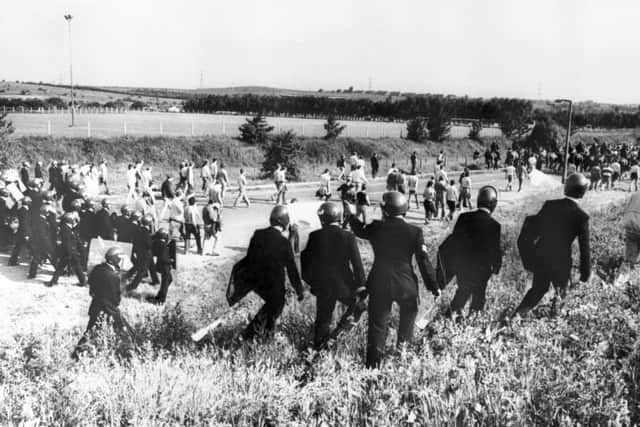

In the meantime, resentment and suspicion of law enforcement has fermented in the towns most affected. So Monday’s announcement by the Home Secretary that the violent clashes between police, strikers and their supporters at Orgreave will at last be scrutinised in a statutory public arena is the least those communities deserve.
Unhelpfully, the fact that the inquiry will be conducted by a Bishop of the Church of England, an institution whose recent cover-ups could fill a National Archive all their own, somewhat compromises its credibility.
As head of the local Diocese, the Right Reverend Dr Pete Wilcox must have seemed a good choice on paper: he is one of the few Bishops untainted by abuse scandals and he did, after all, oversee an inquiry on his own doorstep concerning bullying at Sheffield Cathedral – but the 80-page report he commissioned has not been publicly released.
Instead, Dr Wilcox issued just a six-page ‘determination’ in which he summarised the findings and admitted they made “undeniably uncomfortable reading” but did not say how or why. The walking wounded of Orgreave will demand more transparency than that.
A great expectation is now placed on Dr Wilcox, for the timing of the Orgreave inquiry is propitious. It will be expected to make a moral judgement on the consequences of commandeering the police for purposes of the State at a time when there are moves afoot to do so again.
On the very day the inquiry was announced, Nigel Farage set out his vision for a police force of “physically tougher” officers, and in almost the same sentence defended those who had taken part in violent protests outside an asylum hotel in Essex. He evoked a world of policemen laying into anyone on the ‘wrong’ side of a confrontation.
It is a page torn straight from the Orgreave playbook: of officers being mobilized against any group a Government wants to suppress.
Farage justified his prognosis by warning of (and thereby inciting, some would say) “societal collapse” brought on by public distrust over crime and immigration. “I don’t think anybody in London even understands just how close we are to civil disobedience,” he said.
In South Yorkshire they passed that point a year ago when an attempt was made to burn down an asylum hotel outside Rotherham. Orgreave is barely 10 miles from there: don’t tell me the people who did it hadn’t been conditioned by 41 years of simmering resentment in their communities.
Farage is not wrong to identify out-of-control criminality in the immigration system. Young adults are posing as children to gain privileges that would otherwise be denied them; an organised criminal network is supplying them false passports. This has to be stopped and it remains to be seen if new Home Office ‘sanctions’ on suspected people smugglers will be enough.
But making the police take sides, as Farage seems to want, will breed yet more enmity, mistrust and, eventually, another Orgreave. If Dr Wilcox’s inquiry can prevent that, it will have been worth the wait.