
Are Western leaders nudging us in the direction of war? - Patrick Mercer
Did you get a government alarm on your mobile phone a couple of Sundays ago? Have you seen Westminster’s latest discussions on the introduction of conscription?
Are you stockpiling canned food and other essentials in case there’s a crippling crisis - as our lords and masters are advising? Did you see that President Macron of France has ordered an overhaul and expansion of national hospitals in the expectation of overwhelming military casualties?
If not, you’ve missed all the subtle and less than subtle nudges that we’re getting to alert us that we’ll soon be at war. Now, it’s the oldest trick in the book: unravelling, embattled governments have often used war or the threat of war to pull their nations together or distract the people from their own leaders’ incompetence.
Think no further than Argentina’s political chaos in 1982, the remedy for which was an attempt to snatch back the Malvinas - or the Falkland’s as we know them. That went well, didn’t it?

Now, I trust that Sir Keir Starmer and his cronies are above such things. On the other hand, all the comings and goings with Angela Reyner and the noble Lord Mandelson have quite distracted us from a very serious escalation in the Ukrainian war.
The latest crisis revolves around Poland. As Western politicians have warned us about open war with Moscow within the next five years, Warsaw has been the only NATO member fully to mobilise for such a confrontation. Her economy’s been moved to a war footing and national service extended whilst her factories are churning out warlike materiel on an impressive basis.
So vulnerable does she feel that the government has refused to sign up to the Coalition of the Willing on the basis that once the shooting has stopped in Ukraine she might need every bayonet and tank she’s got to counter Moscow’s next thrust.
So it was that a few days ago a dozen drones intruded - one very deeply - into Polish airspace causing Warsaw’s and NATO aircraft to shoot many of them down. Now, several nations - not least Ukraine - saw this as a direct assault by Russia on a NATO country, no accident, just an act of dangerous provocation. There was even talk of triggering Article 5 (the protocol where all NATO countries must consider armed support for another member which is under attack).
But you can take your pick which explanation you choose to believe. Poland and the West think that Moscow was testing the Alliance’s resolve at a moment when Russia is advancing on all fronts and her pacts with China and India have given her greater confidence.
Conversely, Kremlin agitprop claims that drones similar to those used by Russia had been acquired by Kiev and flown deliberately by them over Poland. By doing this, NATO would be shocked to the core and injured Poland so outraged that she would immediately throw herself into Allied plans to deploy troops to Ukraine.
Interestingly, none of the drones that was used was capable of carrying weapons. All of them were reconnaissance models which could only cause damage and casualties should they fall from the sky. Whoever did this balanced the immediate consequences most carefully.
There’s another piece of evidence, though, that might help to join the dots. Over the Polish border in Belarus joint exercises were taking place between the host nation and Russia which were officially said to involve no more than 25-30,000 troops.
Their manoeuvres took place deep inside Belarus far from neighbouring, NATO territory, but the real numbers are said to be much higher. Also, it’s assessed by Allied intelligence that many of the skills honed by the Kremlin’s troops in Ukraine were being practised as well as the sort of blitzkrieg that might be used to storm the Baltic States. Simultaneously, forces in the Russian exclave of Kaliningrad were carrying out parallel evolutions.
This might all seem fairly normal until it’s remembered that ‘Zapad 25’ (the code name given to annual, autumn exercises in this area) last took place in late 2021. After they were finished the troops stayed in place before, in February 2022, rolling over the border towards Kiev.
In truth, Russia gets just as jumpy when the West indulges in large scale exercises. The trouble is that many of these Union State (the supranational pact between Russia and Belarus) forces are battle hardened and at a far higher state of readiness than any NATO troops. Perhaps that’s why the Alliance has reacted so swiftly.
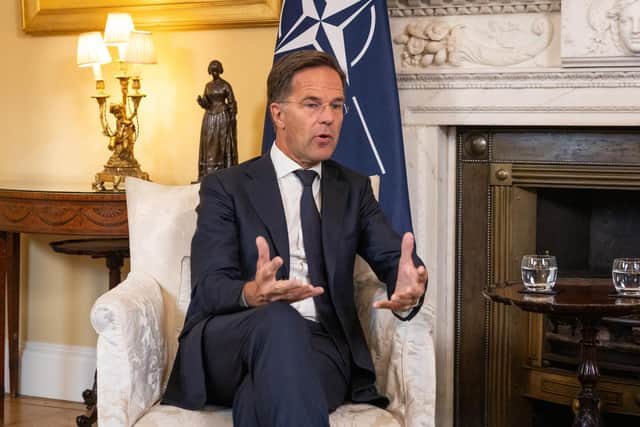
Goaded by the drone incident - and others in the Baltic States and Romania - NATO Secretary General Mark Rutte said: “Russia's recklessness in the air along our eastern flank is increasing in frequency. (The) Allies expressed full solidarity with Poland…and we are prepared and ready to defend every inch of Allied territory.”
Now, whilst Mark Rutte is widely viewed as being highly bellicose, these are weighty comments and they follow Poland’s invoking ‘Article 4’ when an issue can be brought before the North Atlantic Council for urgent discussion.
Patrick Mercer is a former MP for Newark and Army colonel.