
As long as communities are treated as sites of delivery, the net zero transition will become more politically brittle - Asif Husain-Naviatti
Britain is getting closer to a clean power system. Over 60 per cent of Britain’s electricity generation is now derived from home-grown renewable or low-carbon sources. Wind provides around 30 per cent of Britain’s power, and Yorkshire is one of the country’s most important regions for generation.
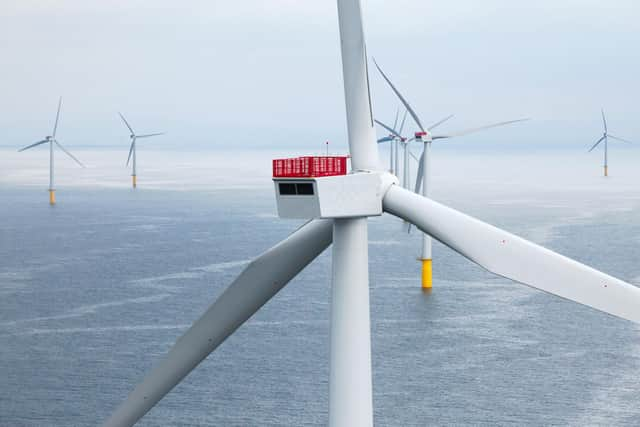
Hornsea is home to one of the world’s largest offshore wind farms, while the UK as a whole accounts for around 20 per cent of global offshore wind capacity.
But in Yorkshire, where decisions about land, infrastructure and local growth are becoming more contested, the real fault line in the energy transition is no longer technological. It comes down to knowledge, trust and informed decision-taking at local and regional levels.
Energy security is once again at the centre of political debate, and with local elections just behind us, the case for accelerating domestic, low-carbon energy has rarely been more urgent. The latest escalation in conflict affecting global oil and gas supplies is a stark reminder of how exposed the UK remains to geopolitical shocks. That matters in Yorkshire, a region with deep industrial roots, high energy demand and major renewable potential. The underlying questions will be familiar to communities across the country as they are asked to accommodate the infrastructure the transition requires.

The Yorkshire and Humber Climate Commission developed a series of structured questions designed to test understanding of energy systems and decision-making through energy workshops with the Yorkshire Local Councils Association, exploring knowledge gaps at the heart of the energy transition. Its findings were quite revealing.
The central conclusion is not straightforward public hostility to decarbonisation, as is often assumed, but something more politically consequential: weak local understanding, low trust in planning, and a growing sense that communities are being asked to absorb the costs of transition without meaningful agency in shaping it.
This unearths a striking disconnect. Those at the front line of decisions on land use, planning and local infrastructure often lacked confidence in their understanding of the energy system, the planning regime, and the trade-offs involved in transition. Support for clean energy is broad, but highly conditional. It is shaped less by climate scepticism than by questions of fairness, visibility, land use and whether local people see any tangible benefit.
That distinction matters in Yorkshire, where debates over solar, grid infrastructure, housing growth, transport and land use are increasingly colliding. What is often framed as local resistance to net zero is more accurately understood as a failure of communication, participation and institutional trust.
Our experience in Yorkshire also illustrates a wider national problem in the disconnect between national political and local civic institutions. Ministers are increasingly framing clean power as a matter of national resilience and energy security. Indeed, geopolitical disruption is becoming the new normal, and is driving volatility in global energy markets, with clear knock-on effects for the cost of living. As always, these pressures fall most heavily on those least able to absorb them, through higher costs for heating, transport, food and manufactured goods.
So the shift towards renewables should, on the face of it, be welcome. But instead, for many communities, the transition is experienced as imposed, opaque and unevenly distributed, which is met with scepticism and concern. Across Yorkshire, as elsewhere, similar patterns emerge: confusion about the role of different energy sources, concern about visual and land use impacts, and doubts about whether communities will see meaningful benefits – particularly as returns are perceived to be small relative to commercial profits and uncertainties prevail in their delivery.
This inevitably raises questions about what the transition requires from the system itself and whether it is affordable. Some will argue that a fundamental and costly redesign of the UK’s electricity infrastructure is needed to accommodate the transition. According to the National Energy System Operator (NESO), the Climate Change Committee (CCC), Ofgem and others, electricity demand could more than double by 2050, due to rapidly rising demand driven by electric vehicles, electrified heating, and industrial electrification. The current grid was built around large, centralised power stations feeding homes, businesses and industry in one direction. It now has to integrate thousands of distributed renewable generators.
However, the reality is more complex. Numerous expert assessments from energy experts, regulatory bodies and industry leaders also conclude that Britain’s electricity infrastructure is ageing and requires major urgent upgrades to meet increased demand even if clean energy stalls. These are not marginal technical adjustments. System-wide changes are needed for a network designed for a fundamentally different era.
At the heart of all this is a simple question: is the transition being correctly understood by the public and by their local representatives, and is it being experienced as something done with communities, or to them?
The two are inseparable. As long as communities are treated as sites of delivery rather than participants, the transition will become more politically brittle, more contested, and more vulnerable to backlash.
Asif Husain-Naviatti is chair of the Yorkshire and Humber Climate Commission, a Visiting Research Fellow at the University of Leeds School of Earth and Environment, and a former United Nations sustainable development expert.